Play store

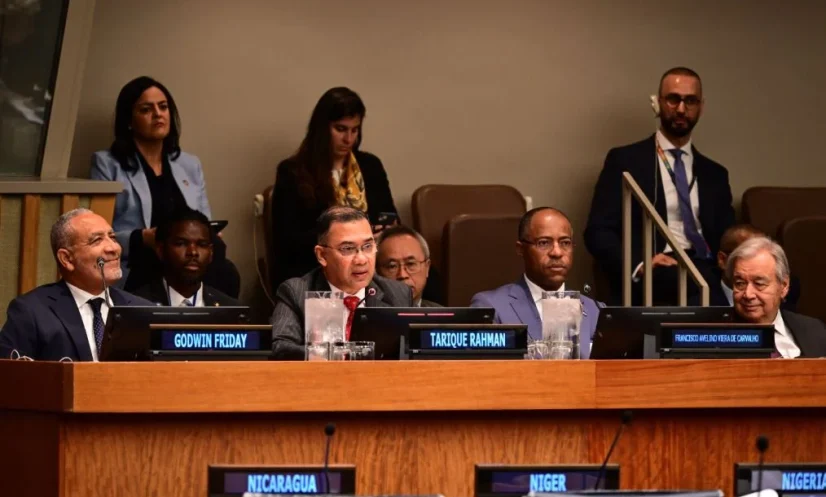
Prime Minister Tarique Rahman has called for four urgent global actions to tackle the growing threat of sea-level rise, including deeper emissions cuts, greater climate finance, wider access to climate-smart technology and stronger international cooperation on climate-induced displacement and loss and damage.
He made the call at a high-level meeting on the existential threat posed by sea-level rise at the UN headquarters on Thursday, on the sidelines of the 81st session of the UN General Assembly. Bangladesh had been scheduled to highlight climate finance, adaptation, technology transfer, loss and damage and climate justice at the UN climate-related meetings.
Tarique said a 25-centimetre rise in sea level could submerge around 4 percent of Bangladesh’s land by 2050, threatening the homes, livelihoods and dignity of about 10 million people, citing a World Bank estimate.
“The sea is rising fast. Our ambition must rise faster,” he said, urging the international community to translate the Declaration on Sea-Level Rise into concrete action.
The prime minister first called for faster, deeper and fairer cuts in global greenhouse gas emissions to keep the 1.5-degree Celsius target within reach.
Second, he urged the international community to ensure predictable and accessible adaptation finance for climate-vulnerable countries.
“Vulnerable countries like Bangladesh cannot face the grave consequences of sea-level rise alone,” he said.
Third, he called for wider access to climate-smart technologies, data and early-warning systems for vulnerable coastal countries.
He said Bangladesh had already developed early-warning systems, strengthened cyclone preparedness and invested in coastal protection despite limited resources.
Finally, he called for stronger international cooperation to address climate-induced displacement and loss and damage while ensuring dignified pathways for communities displaced by rising sea levels.
“Our prosperity and future are tied to the coast,” Tarique said, describing Bangladesh as an active delta where hundreds of rivers meet the sea.
He said adaptation alone would not be sufficient because “the ocean reacts to every tonne of carbon the world releases.”
Bangladesh, he said, plans to dig around 20,000 kilometres of rivers and canals over the next five years, advance the Padma Barrage initiative, modernise the Teesta Barrage under a master plan and plant 250 million trees.
The country is also targeting at least 20 percent renewable electricity by 2030, with an emphasis on solar power, while promoting green industries and eco-friendly transport.
Bangladesh is developing a national carbon market and strengthening the protection of forests, wetlands and vulnerable coastal ecosystems, he added.
Tarique urged world leaders to turn the Declaration on Sea-Level Rise into action and ensure that no country is left behind.
“Let our resolve rise with the sea, and let our action rise even faster,” he said.