


 Play store

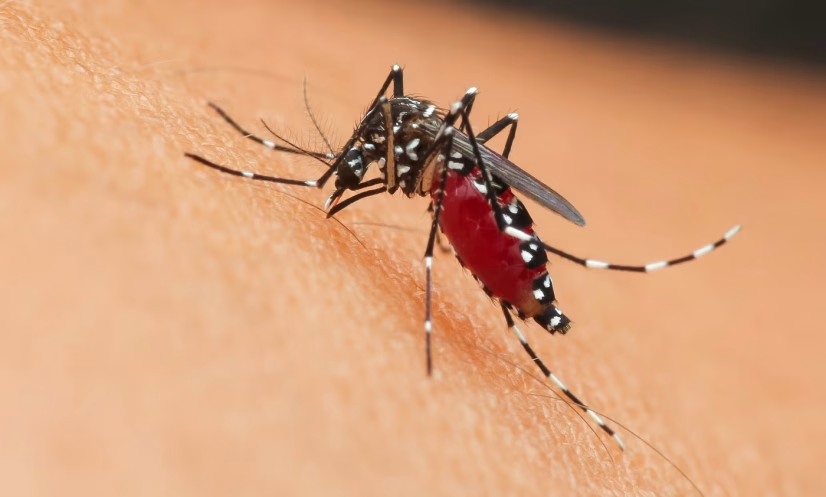
Researchers at the University of Dhaka (DU) have developed an artificial intelligence-powered device that attracts male Aedes mosquitoes using sound, captures their images and identifies and counts them automatically.
The technology, named Mast-CloudNet, could help authorities monitor the presence and population of Aedes mosquitoes, which transmit dengue, and identify areas requiring targeted mosquito-control measures.
The device was jointly developed by researchers from DU’s departments of Electrical and Electronic Engineering and Zoology. A camera inside the device captures images of mosquitoes trapped in it and sends them over the internet to a cloud-based AI system for identification and counting.
Under conventional methods, mosquitoes collected from traps must be examined individually in laboratories to identify their species. The process is time-consuming and labour-intensive, while Mast-CloudNet automates much of the work.
The device attracts male Aedes mosquitoes by producing sounds that mimic the wingbeats of female mosquitoes. Laboratory tests found that traps equipped with the sound mechanism captured five times as many Aedes mosquitoes as silent traps.
During a preliminary three-day field trial on the DU campus, the sound-equipped device captured 59 mosquitoes, including 49 Aedes mosquitoes and 10 from other species. Aedes mosquitoes accounted for 83.1 per cent of the total catch.
By comparison, a silent trap captured only four mosquitoes, including one Aedes mosquito.
The device continued operating amid rain, wind and the usual background noise on the campus. However, under outdoor conditions, the AI system correctly identified 35 of the 49 Aedes mosquitoes, achieving an accuracy rate of about 71 per cent.
The researchers said larger-scale trials would be needed to assess its performance further. They estimate that the device could cost around $99.
The research was led by Mohammad Ahsan Habib, an associate professor, and Professor Saeed Mahmud Ullah of DU’s Department of Electrical and Electronic Engineering, alongside Associate Professor Khandaker Ashfaqul Muid of the Department of Zoology. The study was published this year in the journal IEEE Transactions on Instrumentation and Measurement.
Speaking to New Age, Habib said the system could provide authorities with timely information about the presence of Aedes mosquitoes and changes in their numbers over time.
Such data could help officials prioritise the removal of potential breeding sites and evaluate the effectiveness of mosquito-control measures, he said.
By automating mosquito collection and identification, the device could complement existing mosquito-control programmes, Habib added.
However, he cautioned that trapping male mosquitoes alone would not control dengue, which is transmitted by infected female Aedes mosquitoes. Although the presence of males can indicate that Aedes mosquitoes are present in an area, it cannot reliably establish the number of infected females or predict the scale of a dengue outbreak.
The device is primarily designed to monitor mosquito populations and help identify areas where control measures may be needed, he said.
The research team plans to test 10 to 15 devices in residential areas under Dhaka South City Corporation in June and July 2027. The trials will focus on improving outdoor identification accuracy, protecting the devices from weather and assessing their long-term performance.
The researchers are also considering solar power and more reliable internet connectivity.
Atike B Zaker, a postgraduate student in DU’s Department of Electrical and Electronic Engineering who led the project and co-authored the paper, said integrating the hardware with AI software had been a major challenge.
The initial prototype became more expensive to develop because of specialised laboratory equipment, component fabrication and imported materials, Zaker said, adding that greater access to research funding could help researchers overcome such barriers and develop practical technologies.
The team is now working on the next version of Mast-CloudNet. Researchers are also testing a potentially cheaper approach that would identify Aedes mosquitoes by detecting the sound of their wingbeats instead of analysing images.