


 Play store

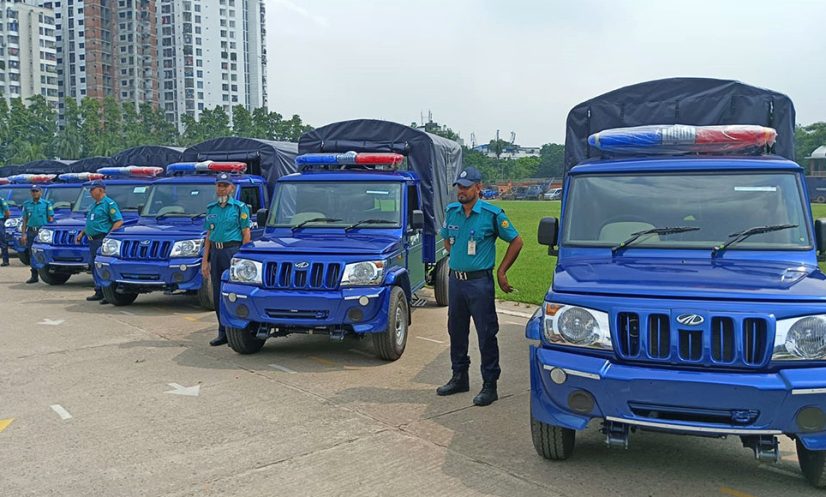
The Home Ministry has proposed an allocation of Tk 6,608.14 crore to purchase 5,830 vehicles for the police to address a longstanding transport shortage, improve emergency response and strengthen law enforcement operations across Bangladesh.
The ministry has submitted two projects for consideration by the Executive Committee of the National Economic Council (ECNEC), scheduled to meet on October 25 at the Secretariat, with Prime Minister Tarique Rahman in the chair.
Of the proposed investment, Tk 4,328 crore would be spent on purchasing 4,829 operational vehicles, while Tk 2,280.14 crore would be allocated for 1,001 specialised vehicles.
Both projects are scheduled to run from October 2026 to June 2029, with the entire cost to be financed by the government. Neither project has received final approval, and implementation will depend on the ECNEC’s decision.
According to the project proposals, the police currently have 1,237 vehicles to serve 639 police stations across an area of about 147,000 square kilometres. This leaves each station with fewer than two vehicles on average.
Around 64 per cent of the existing fleet is more than 10 years old, creating challenges for routine patrols, emergency response and the deployment of personnel where they are most needed.
The proposed purchases are expected to improve police mobility and operational readiness, enabling law enforcement agencies to respond more effectively to crime, public disorder and security threats.
The specialised vehicle project includes riot-control vehicles, vehicles suitable for difficult terrain, mobile command centres and forensic vans for crime-scene investigations.
These vehicles are expected to support crowd management, operations in remote areas, coordination among field units and the collection of evidence in criminal investigations.
The modernisation plan also includes speedboats and locally made boats to strengthen police operations across the country’s extensive river network. The vessels would support river patrols, the protection of key installations, counterterrorism operations and emergency rescue missions.
Both projects include training programmes to improve the skills required to operate and maintain the new fleet.
Under the operational vehicle project, 650 personnel would receive training in light-vehicle driving and mechanics, 300 in heavy-vehicle driving and mechanics, and another 50 in vehicle repair. The project also includes Tk 1.5 crore for vehicle maintenance and repair equipment.
The specialised vehicle project provides driving and mechanics training for 910 personnel, along with mechanics training for another 50.
The combined proposed expenditure is Tk 2,080.94 crore in the 2026-27 fiscal year, Tk 2,867.55 crore in FY28 and Tk 1,660.58 crore in FY29.
Feasibility studies for both projects were conducted by Hawks Bay. Each project has an estimated benefit-cost ratio of 1.05, indicating that projected economic benefits marginally exceed costs under the assumptions used in the assessments.
The operational vehicle project’s revised development proposal was reviewed at a Project Evaluation Committee meeting on October 15, 2026. Following the committee’s recommendations, overseas training was dropped and the proposal was revised to comply with the relevant regulations of the Bangladesh Public Administration Training Centre and the Finance Division. It was also aligned with the government’s election manifesto.
The specialised vehicle project was separately recommended for ECNEC consideration following a review by the Physical Infrastructure Division of the Planning Commission.
If approved, the projects are expected to significantly expand the police force’s transport capacity and operational capabilities nationwide.
However, the extent to which the investment improves public safety will depend on efficient procurement, needs-based distribution of vehicles, proper maintenance and the police’s ability to translate greater mobility into faster emergency responses and more effective law enforcement.