


 Play store

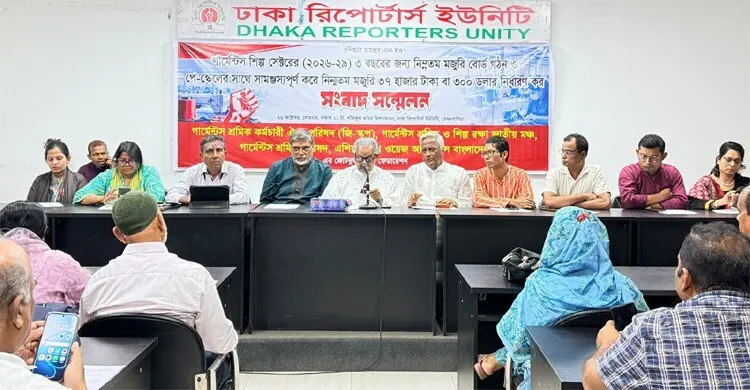
Thirty-five labour federations under four alliances have demanded a minimum monthly wage of Tk 37,125 ($300) for garment workers, calling for a new minimum wage board for 2026–2029 with genuine worker representatives.
The demands were raised at a joint press conference at the Shafiqul Kabir Auditorium of the Dhaka Reporters Unity in the capital on Monday (October 26).
The event was chaired by Shah Md Abu Zafar, a former lawmaker, freedom fighter and senior leader of the alliances and the Workers-Employees Unity Council (SKOP). Khalekuzzaman Lipon read out the written statement, while Nahidul Islam Nayan moderated the event. Abul Hossain delivered the opening remarks.
In response to questions from journalists, labour leaders said national and international laws provide guidelines for setting minimum wages. Article 15 of the Bangladesh Constitution and Section 141 of the Bangladesh Labour Act outline relevant principles and factors for determining wages, they said.
These include the cost and standard of living, production costs, productivity, product prices, inflation, the nature and risks of work, quality of work, employers’ financial capacity, the country’s socioeconomic conditions and other relevant considerations. The leaders said their Tk 37,125 demand was based on an analysis of these factors.
They described the readymade garment (RMG) industry as the country’s largest export-earning sector, accounting for about 81% of Bangladesh’s total export earnings in the 2025–26 fiscal year.
According to figures presented by the labour leaders, Bangladesh earned $48 billion from exports in FY2025–26, of which the garment sector contributed $38.70 billion. In FY2014–15, total export earnings stood at $31.20 billion, including $25.49 billion from garment exports.
The sector’s export earnings have increased by $13.21 billion over the past decade, they said, arguing that workers directly involved in production should receive wages commensurate with the rising cost of living, despite a decline in the number of garment factories and workers during the period.
The labour leaders also cited research by various institutions, per capita income and the cost of living above the poverty line to argue that a worker’s family may need between Tk 57,000 and Tk 70,000 or more per month to cover its expenses.
Even if the main breadwinner contributes 60% of a family’s total expenditure, a monthly income of Tk 37,000–38,000 would be necessary, they said. This estimate does not include expenses related to parental care, recreation, unexpected illnesses, Eid and Puja celebrations, or travel to family homes.
They added that some economists calculate minimum wages by treating food and non-food expenses as equal. If food costs for a four-member family amount to Tk 35,080 per month, total monthly expenses would reach around Tk 70,000.
The leaders urged the government to consider public-sector pay scales, the Bangladesh Bureau of Statistics’ 2025 special survey, market prices, living costs, per capita income, productivity, value addition, minimum wages in competing countries and relevant research reports when setting wages.
Taking employers’ financial capacity and the industry’s circumstances into account, they called for a minimum starting salary of Tk 37,125 for garment workers, including assistant operators.
They urged the government to form a new minimum wage board without delay and ensure that genuine worker representatives are appointed to it.
Among those present at the press conference were Naimul Ahsan Jewel, Lovely Yasmin, Bachchu Mia, Rafiqul Islam Sujon, Asad Chowdhury, Saleha Islam Shantona, Sumaiya Islam, Shamima Akter and Bappi Deb Barman.