Play store

Workers’ representatives have proposed a minimum monthly wage of Tk 32,000 for readymade garment (RMG) workers at the second meeting of the wage board on Monday, while employers’ representatives made no proposal and sought one week’s time.
Briefing reporters after the meeting, Minimum Wage Board Chairman Syed Azad Subhani said employers had been advised to submit their proposal within the next four working days.
“If they fail to submit a proposal within this period, the wage board itself will take a decision on the matter,” he said.
Employer representative ABM Shamsuddin said they had not received proposals from all factory owners due to labour unrest in industrial areas, prompting them to seek an additional week.
On the other hand, workers’ representative Babul Akhter presented arguments and supporting information in favour of the Tk 32,000 proposal.
The second meeting of the wage board, formed to determine a new minimum wage for garment workers, was held at the Minimum Wage Board office in Segunbagicha, Dhaka, with all members present.
Ahead of the meeting, five alliances of garment workers’ organisations submitted a memorandum demanding a monthly minimum wage of Tk 32,131.
They also proposed setting the basic salary at 60 per cent of the total wage, house rent allowance at 50 per cent and annual increments at 15 per cent.
The memorandum was submitted by five alliances representing 55 registered garment workers’ federations.
The workers’ groups urged the board to consider 12 criteria, including the cost of living, in determining the new wage structure. They also proposed reviewing the government pay scale and minimum wage structures in other Asian countries, including Cambodia, Pakistan, India and Vietnam.
The workers’ representatives said a realistic and impartial wage structure was necessary, considering the livelihoods and economic security of around four million garment workers out of the country’s total workforce of approximately 75 million.
They proposed fixing the basic salary at 60 per cent of the total wage, following the structure introduced in 2006.
According to the workers’ representatives, a lower proportion of basic pay reduces workers’ overtime earnings and service benefits upon retirement or termination. Workers with long years of service are particularly disadvantaged by a lower basic salary, they argued.
They also demanded house rent allowance equivalent to 50 per cent of the total wage and a 15 per cent annual increment in line with rising food and nutritional costs, market prices and annual inflation.
The representatives said eight additional proposals would be incorporated after Monday’s meeting, taking into account the specific demands of workers in the dyeing and knitwear sectors.
They stressed that the new wage structure should reflect workers’ living costs, the industry’s capacity and the competitive conditions of the international labour market.
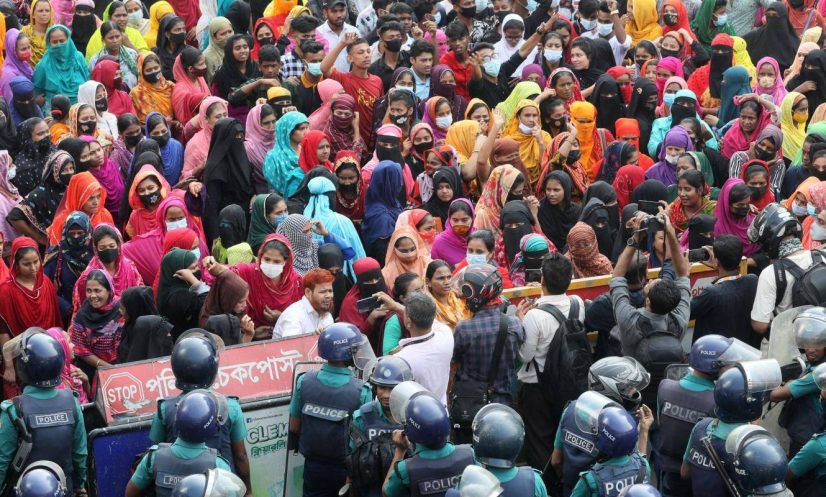
Meanwhile, members of the Garment Workers Front staged a demonstration on the road in front of the Minimum Wage Board office, demanding a minimum monthly wage of Tk 37,000.