Play store


The government aims to transform Bangladesh’s livestock sector into a modern, science-based, production-driven and export-oriented industry to strengthen the country’s position in international markets and boost foreign currency earnings.
Prime Minister Tarique Rahman said the government had prioritised modern technology, improved animal breeds, artificial insemination, vaccination, disease prevention, better feed management and farm waste management to develop the sector.
He also assured continued policy and financial support to promote the growth of the livestock industry.
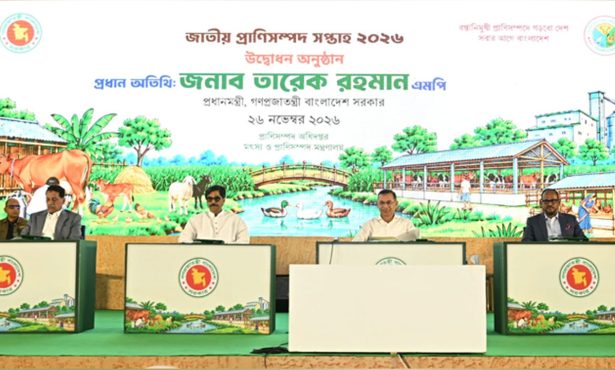
The prime minister made the remarks while inaugurating the National Livestock Week-2026 at the old trade fair ground in Sher-e-Bangla Nagar in the capital on Thursday morning.
“Livestock is no longer confined to rearing cattle and poultry. It is rapidly evolving into a commercial, nutrition-secure and export-oriented industry. Alongside meeting domestic protein demand, the sector offers significant opportunities to increase export earnings,” he said.
Tarique said the livestock sector earned $10.464 million in export revenue during the six months from March to August 2026.
At constant prices, the sector accounts for 1.81 per cent of the country’s GDP and 16.56 per cent of agricultural GDP, with a growth rate of 3.30 per cent in the current fiscal year.
Highlighting export opportunities, he said Bangladesh could expand exports of leather goods, animal by-products and approved processed products in the short term.
He also noted that the country had exported hatching eggs commercially for the first time, adding that new export markets needed to be explored.
“Bangladesh has enormous potential to export internationally certified halal meat, dairy products and poultry items in the long run. Strict compliance with food safety and international quarantine standards is essential to enter global markets,” he said.
To this end, the government is developing modern, internationally compliant animal-product processing centres and disease-free zones, he added.
The prime minister said greater self-sufficiency in livestock production and new sources of foreign currency earnings could be achieved through proper implementation of modern farm management, vaccine production, farmer training, research and productivity-enhancement initiatives.
Highlighting the progress of the poultry industry, he said more than 200,000 commercial and small-scale poultry farms were currently operating across the country.
These farms produce around 68.8 million eggs daily, while approximately six million people are directly or indirectly involved in the industry, 40 per cent of whom are women.
Private investment in the poultry sector stands at around Tk 500 billion, he added.
Describing farmers as the driving force of the livestock sector, Tarique said the government was committed to ensuring their access to training, easy-term loans, improved technology, fair prices for their products and necessary state support.
He identified animal diseases as one of the major obstacles to the sector’s development.
Currently, research institutions produce vaccines against 17 animal diseases, but the supply is inadequate, he said, adding that the government had taken an initiative to establish a modern vaccine production plant.
The prime minister expressed hope that Bangladesh would soon establish itself as a reliable global livestock brand by utilising the skills and efforts of its farmers, entrepreneurs and livestock researchers.