


 Play store

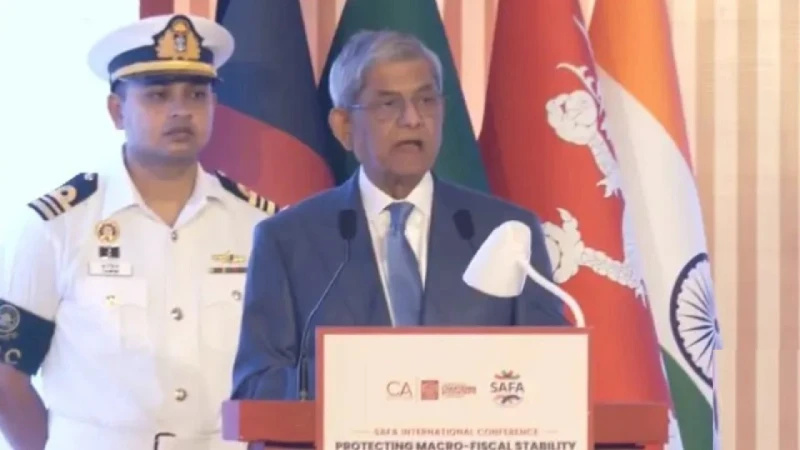
Dhaka: The country’s economy was plunged into a cycle of corruption and extreme anarchy during the previous autocratic regime, as a nexus with business oligarchs facilitated the siphoning off of huge amounts of public money abroad and established a mafia-style system across almost every sector of the economy, President Mirza Fakhrul Islam Alamgir has said.
He made the remarks while inaugurating the ‘SAFA International Conference 2026’, organised by the South Asian Federation of Accountants (SAFA), on Saturday.
In his keynote address, the president said Bangladesh had paid a heavy price for the collapse of good governance.
“For more than 15 years, the country’s key national institutions were systematically weakened and destroyed. This affected not only political institutions but also economic institutions, including banking, insurance, the capital market and corporate governance,” he said.
“An enormous amount of public money was siphoned off abroad through an unholy nexus with business oligarchs. As a result, the economy fell into a cycle of corruption and extreme anarchy, while a mafia-style system emerged across almost every sector,” he added.
Citing figures on money laundering, the president said the 2024 White Paper on the State of the Bangladesh Economy estimated that around $234 billion, or approximately Tk 28 lakh crore, was siphoned out of the country between 2009 and 2023.
On average, around $16 billion, or Tk 1.8 lakh crore, was laundered annually, equivalent to approximately 3.5 per cent of GDP, he added.
Highlighting the troubled state of the banking sector, Mirza Fakhrul Islam Alamgir said, “According to Bangladesh Bank data, the volume of non-performing loans stood at around Tk 607,000 crore at the end of June 2026, accounting for nearly one-third of total loans. Much of this increase reflects the disclosure of previously concealed distressed assets following more transparent loan classification. Transparency can be painful, but it is essential. We cannot resolve the crisis without acknowledging its true scale.”
Outlining the government’s measures to revive the economy, the president said, “The government is taking steps to strengthen anti-money laundering measures, enhance safeguards against banking fraud, recover laundered money through legal processes and reduce the burden of non-performing loans. These initiatives must be pursued through sustainable institutional reforms without compromise.”
Describing the conference theme, ‘Evolving Macroeconomic Landscape and Building Investor Confidence’, as one of the most important economic challenges facing Bangladesh and the region, he said trust was the foundation of a strong financial system.
“Depositors keep their savings in banks, investors rely on audited financial statements, and citizens expect state institutions to protect national assets. When this trust is broken, the consequences extend beyond financial markets to families, businesses and national stability,” he said.
He said Bangladesh needed credible financial reporting in line with international standards to restore financial stability, strengthen the capital market and attract quality foreign direct investment (FDI).
Ensuring access to accurate information and a stable regulatory environment for investors was essential, he said, adding that accountability, transparency and good governance in the public sector also needed to be strengthened.
Taxpayers have the right to clear and verifiable accounts of public expenditure and the operations of state-owned enterprises, he added.
Highlighting the importance of small and medium enterprises (SMEs) in creating employment, the president called for simplified compliance procedures, digital financial literacy and support for proper accounting systems to facilitate access to formal loans on easier terms.
Describing the protection of the economy as a collective responsibility, he said it was not the task of auditors alone.
Accountants, tax and revenue officials, procurement administrators, project engineers and policymakers all had roles to play in safeguarding public resources, he said.
He also called for accountants to be involved in the policymaking process, stressing that integrity, accountability and transparency must serve as the first line of defence against irregularities, misuse of funds and undue influence.
Emphasising the independence of auditors, the president said, “The credibility of an audit depends on the independence of the auditor. Accounting professionals must have the courage to provide objective reports and resist undue pressure.”
He said the government of Prime Minister Tarique Rahman was committed to creating an environment in which accountants, public officials and regulatory bodies could perform their duties free from intimidation and bias.
Noting that artificial intelligence (AI), digitalisation and sustainability standards were transforming the financial profession, the president called on South Asian countries to work together to address common challenges, including illicit financial flows, climate risks and technological changes.
He later formally inaugurated the SAFA International Conference 2026.
The conference was organised by the Institute of Chartered Accountants of Bangladesh (ICAB). Industries and Commerce Minister Khandaker Abdul Muktadir, the Finance Division secretary, presidents of ICAB and SAFA, and representatives from home and abroad were also present.