


 Play store

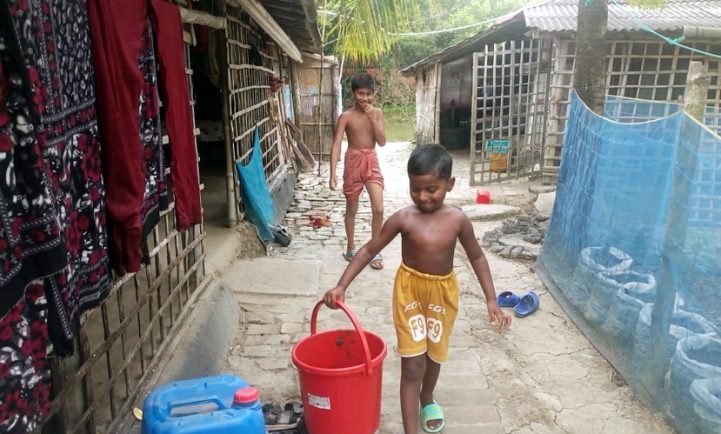
Before dawn breaks, 14-year-old Sohel (not his real name) leaves his makeshift home near an embankment in Gabura Union of Shyamnagar upazila, Satkhira, to head for the crab enclosures.
Just two years ago, his mornings looked very different. He would put on his school uniform, carry books and notebooks, and set off for classes with dreams of a brighter future.
But devastating cyclones and relentless river erosion have changed his life. After losing their homestead, his family took shelter beside an embankment. Struggling to secure daily meals and facing a long journey to school from their new shelter, Sohel had to abandon his studies in Class Seven.
Instead of books, his young hands now hold equipment for catching crabs. He has become a full-time labourer in the coastal waters.
“I feel like going to school when I see other boys carrying bags in the morning. I wanted to study in Dhaka and become a police officer. But the river swallowed our home. If I go to school, there is no food at home. I have to work in the crab enclosures during school hours,” he told Sarabangla.
Sohel is among thousands of children whose childhoods are being disrupted by the devastating effects of climate change in Bangladesh’s coastal belt.
Cyclones, river erosion and rising salinity are forcing families from their homes, while the less visible consequences of displacement are undermining children’s education, security and social identity. Experts describe these impacts as non-economic loss and damage (NELD).
The crisis is also pushing many adolescent girls out of education and towards early marriage.
Mitu (not her real name), a 15-year-old girl from Gabura, said her school is now nearly four kilometres from her family’s new shelter after river erosion destroyed their home.
Her parents have stopped her from attending classes, fearing for her safety on the isolated and damaged roads.
“I wanted to continue my studies. But my parents do not allow me to go to school because they are afraid. Now I hear they are planning to marry me off,” she told Sarabangla.
Conversations with displaced families reveal that poverty, long distances to schools and safety concerns are among the major reasons behind rising school dropout rates.
A displaced parent in Shyamnagar said the family was struggling to meet basic needs after losing their home and land to river erosion.
“The river has taken everything from us. Should we arrange food for the family or pay for our children’s education? The school is far from our new home. It is not safe to send older girls alone along such deserted roads. So we have been forced to stop our daughter’s education and are considering her marriage. We have also sent our son to work,” the parent said.
Beyond the loss of homes and livelihoods, climate displacement is also stripping families of their social roots and identity. Children moving to new communities often face social exclusion and are labelled outsiders or refugees, creating additional psychological pressure.
Madhab Chandra Dutta, executive director of Satkhira-based development organisation Swadesh, said displacement was destroying more than homes and farmland.
“People lose not only their homes and land but also their social identity and roots. Children dropping out of school, rising early marriages and the psychological burden of losing their homes are gradually weakening society. These losses cannot be measured in monetary terms,” he told Sarabangla.
According to data from the Participatory Research and Action Network (PRAN), 33.2 per cent of climate-displaced children aged between six and 18 in coastal areas are currently out of school.
The situation becomes more alarming among older adolescents. Only 35.3 per cent of those aged 16 to 18 have access to education, while around 30 per cent of school dropouts are engaged in various forms of hazardous labour to support their families.
Shah Israt Azmeri, chairman of Children Watch Foundation, stressed the need for targeted policy measures to protect children from the long-term consequences of climate disasters and displacement.
“Special policy interventions are necessary to address disruptions to children’s education and the long-term psychological trauma caused by disasters and displacement,” she said.
She noted that nearly four crore people live in Bangladesh’s coastal region, which accounts for around 32 per cent of the country’s land area. Unless problems such as salinity intrusion, river erosion and shortages of safe drinking water are addressed, more people will lose their homes and livelihoods and be forced to migrate, with children bearing much of the burden.
She called for special allocations in the national budget to address coastal challenges and expand social safety-net programmes for vulnerable families.
Experts say rebuilding embankments and other infrastructure alone will not be enough to restore the childhoods lost to climate displacement. A comprehensive, long-term and people-centred approach is needed.
They recommend establishing specialised educational institutions for displaced children, including residential schools or facilities ensuring safe transportation, under climate adaptation and loss-and-damage financing programmes.
Creating alternative livelihood opportunities for displaced families and strengthening social protection measures to prevent child labour and early marriage, particularly among adolescent girls, are also essential.
Without such interventions, experts warn, climate change could trap another generation of coastal children in a cycle of poverty, insecurity and uncertainty.
For children like Sohel and Mitu, the question remains whether they will ever be able to return to classrooms and reclaim their dreams, or whether those aspirations will continue to disappear beneath the rising tide of climate displacement.