


 Play store

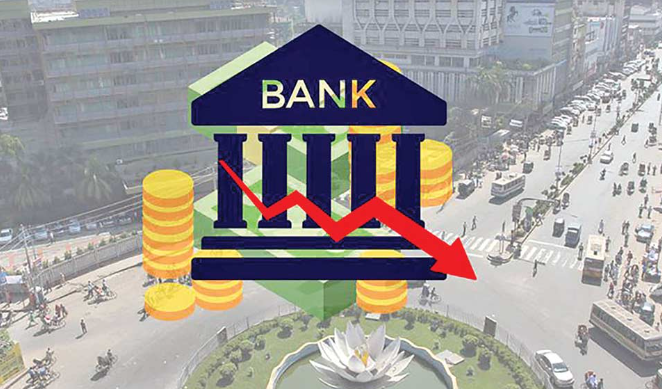
A decade-long legacy of politically influenced lending, balance-sheet manipulation and weak oversight has plunged Bangladesh’s banking sector into a structural crisis of unprecedented proportions, according to industry experts and recent central bank data.
As independent audits and international loan-classification standards expose the true state of non-performing assets, Bangladesh is now grappling with a defaulted loan ratio of 32.78 percent — the highest globally — alongside a severe capital shortfall that threatens overall financial stability.
Central bank statistics show that of Tk18.51 lakh crore in total loans disbursed across the banking sector as of June 2026, a staggering Tk6.07 lakh crore had been classified as non-performing loans (NPLs).
Nearly Tk33 out of every Tk100 extended as credit is either defaulted or impaired, far exceeding the levels reported in regional peers such as India (2.3 percent), Pakistan (7.4 percent) and Sri Lanka (12.6 percent).
The distress is heavily concentrated, with just 10 financial institutions accounting for Tk4.395 lakh crore, or around 72 percent, of the country’s total bad debt.
The largest defaulted loan holders include: Islami Bank Bangladesh PLC: Tk98,914 crore (52.15 percent NPL ratio), Janata Bank PLC: Tk75,728 crore (75.05 percent NPL ratio), First Security Islami Bank: Tk60,645 crore (97.08 percent NPL ratio), EXIM Bank: Tk38,052 crore (70.81 percent NPL ratio), Agrani Bank PLC: Tk32,133 crore (43.98 percent NPL ratio).
Insiders said a substantial portion of these loans went to politically connected individuals and conglomerates, including Beximco, S Alam, Nassa, Sikder, Uttara Group, Bengal Group and Ashiyan City, many of whose key directors are currently detained or have fled abroad.
Surging defaults have forced banks to make provisions of up to 100 percent against bad assets, wiping out profits and eroding core capital. By June 2026, total sector-wide provision shortfalls had risen to Tk2.223 lakh crore.
Highlighting the mechanics of this erosion, Mutual Trust Bank Managing Director and CEO Syed Mahbubur Rahman told UNB: “When non-performing loans rise continuously, capital shortfalls inevitably follow. High provisioning requirements eat directly into net profits, generating sustained operating losses that hollow out the bank’s capital base.”
Consequently, the aggregate Capital-to-Risk-Weighted Assets Ratio (CRAR) for the banking sector dropped to negative 3.17 percent in March 2026, far below the Basel III requirement of 12.50 percent.
During the same period, 21 individual banks faced a combined capital deficit of Tk2.94 lakh crore, with First Security Islami Bank recording the largest shortfall at Tk66,264.80 crore.
Analysing the macroeconomic consequences, Dr Zahid Hussain, former Lead Economist at the World Bank’s Dhaka office, warned that widespread capital deficits create two distinct systemic threats:
Erosion of depositor trust: Capital serves as an internal cushion protecting public deposits. Negative capital creates deep uncertainty, impairing a bank’s ability to maintain liquidity or extend fresh credit.
Loss of international credibility: Foreign financial institutions view the banking system holistically. When more than 20 domestic banks suffer structural capital deficits, global institutions may reduce credit lines, increase Letters of Credit (LC) confirmation costs and penalise even well-capitalised, solvent banks.
Adding to the warnings, NRBC Bank Managing Director and CEO Md Touhidul Alam Khan noted that failure to meet regulatory CRAR targets triggers automatic penalties, including dividend restrictions, credit-rating downgrades and higher foreign borrowing costs.
In response, Finance Minister Amir Khosru Mahmud Chowdhury recently informed Parliament that the government is allocating nearly Tk40,000 crore this fiscal year to restructure and recapitalise vulnerable banks.
Central bank officials and senior bankers are advocating a three-pronged recovery strategy.
Asset Management Company (AMC): Former ABB Chairman Anis A. Khan said policy relaxations have failed and urged the rapid deployment of a specialised AMC to seize and liquidate mortgaged assets from uncooperative defaulters.
Legal enforcement: Faruq Mainuddin, Vice Chairman of BRAC Bank and former Managing Director of Trust Bank, stressed that recovery requires treating wilful default as a criminal offence and legally targeting siphoned or offshore assets.
Governance reform: Strengthening oversight in merged institutions and eliminating political interference in credit approvals remain essential to halting further capital depletion.
Former Bangladesh Bank Governor Dr Ahsan H Mansur has underscored that while bringing transparency to NPLs creates short-term pressure, comprehensive structural reform and strict enforcement remain essential to restoring long-term trust in the country’s financial system.