


 Play store

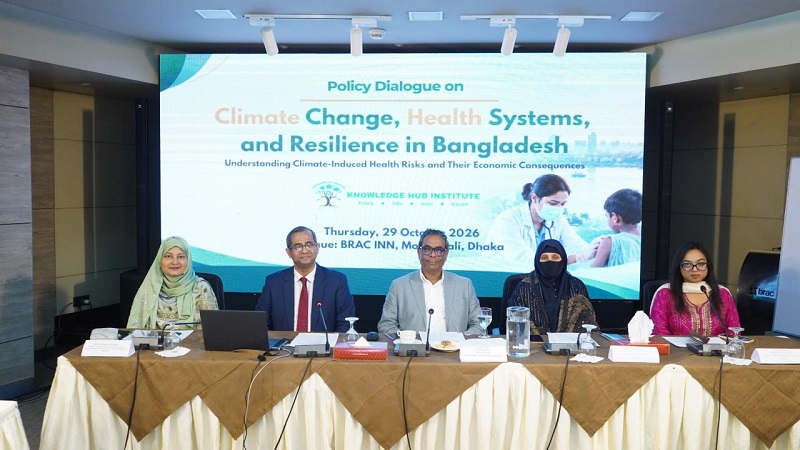
DHAKA: Bangladesh suffers an estimated $20.7 billion in annual economic losses due to heatwaves and climate change-related health risks, including reduced productivity, premature deaths and healthcare costs, according to a study by the Knowledge Hub Institute (KHI).
The study found that despite rising health risks from climate change, preparedness and government funding for the health sector remain inadequate.
The research report, titled “Multidimensional Health Impacts of Climate Change in Bangladesh: Pathways, Costs and Policy Implications”, was released at the BRAC Centre in the capital on Thursday.
State Minister for Health and Family Welfare Professor Dr MA Muhit attended the event as the chief guest, while KHI President Khandaker Golam Moazzem presented the findings.
According to the report, the number of days with temperatures of 36 degrees Celsius or higher in eight divisional cities has nearly doubled in the current decade compared with the 2000s.
Rising humidity is making the situation more dangerous by hindering the body’s natural cooling process through sweating. The conditions also create a favourable environment for dengue transmission.
Extreme heat puts additional strain on the heart and kidneys, making physical labour more hazardous and increasing the risk of various illnesses. Floods and contaminated water also threaten public health and disrupt healthcare services. Disease outbreaks increase treatment costs while reducing people’s incomes.
KHI estimated that annual economic losses from climate-related health risks were equivalent to 4.6 per cent of Bangladesh’s gross domestic product (GDP) in 2024. However, the estimate excludes the costs of air pollution and non-fatal illnesses, meaning the actual losses could be higher.
The study analysed the health impacts, economic costs and policy gaps associated with heatwaves, mosquito-borne and waterborne diseases, natural disasters and air pollution.
It estimated that between $1 billion and $3.3 billion of the annual economic losses from climate-related health risks were directly attributable to rising temperatures.
Khandaker Golam Moazzem said excessive heat alone had resulted in the loss of around 29.3 billion potential working hours in Bangladesh in 2024, causing economic losses of approximately $15 billion.
The report separately estimated the financial value of working hours lost due to extreme heat at $15.8 billion in 2024, based on reduced productivity as physical labour became more hazardous in high temperatures.
Farmers and agricultural workers accounted for nearly two-thirds of the lost working hours. Construction workers and others engaged in physically demanding occupations were also exposed to the risks, affecting both their health and incomes.
Moazzem stressed the need for guidelines to protect workers from extreme heat across different sectors, district-level heat and health action plans, and more effective use of the health sector’s budget.
He also called for adequate funding to implement the national health adaptation plan and urged Bangladesh to prioritise climate-related health risks in international climate negotiations, including the upcoming COP31 conference.
State Minister MA Muhit said climate change affected public health through multiple, interconnected processes. Rising temperatures and humidity had become major public health concerns in Bangladesh, he added.
He said the Ministry of Health could work with the Bangladesh Meteorological Department and other relevant agencies to establish an effective early warning system to protect people from climate-related risks.
The minister also emphasised stronger inter-ministerial coordination, increased research and targeted measures for vulnerable groups, particularly women, children and people with disabilities, who face greater risks during climate-related disasters.
He said robust research evidence would help Bangladesh make a stronger case for climate justice and increased climate financing at COP31.
Turning research findings into practical and coordinated action should now be a priority, he added.