


 Play store

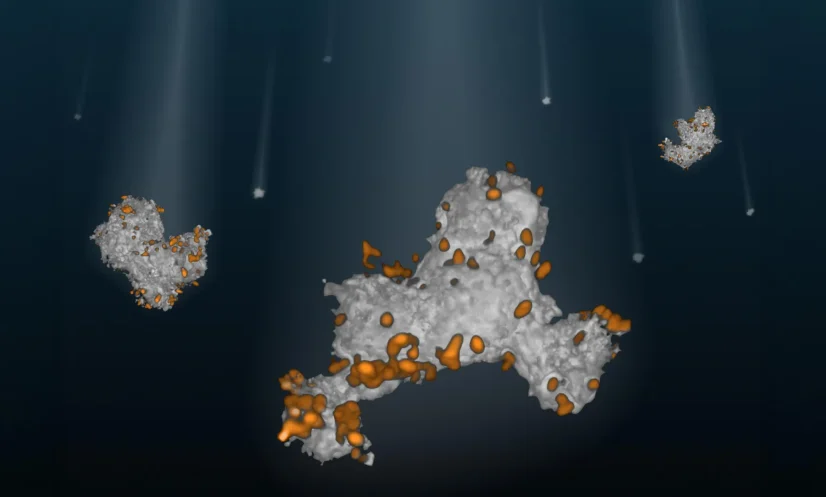
Sticky marine snow particles can transport more than six times as much carbon to the deep ocean as less viscous particles, according to a new study that sheds light on how oceans help regulate Earth’s climate.
Marine snow, a continuous shower of tiny particles drifting from the upper ocean towards the seafloor, consists of dead organisms, animal waste, mucus, silt and the remains of microscopic plankton.
As these particles sink, they carry large amounts of carbon from surface waters into the deep ocean, where it can remain stored for hundreds or even thousands of years.
Researchers estimate that marine snow removes more than 10 billion tonnes of carbon from surface waters annually. However, only about two billion tonnes reach depths where the carbon can remain stored for extended periods.
A team of researchers from the University of California San Diego’s Scripps Institution of Oceanography and the University of Lincoln has now identified the stickiness, or viscosity, of marine snow as a major factor determining how much carbon reaches the deep sea.
The findings, published on October 8 in the journal Science, show that highly viscous particles resist bacterial breakdown for longer and can sink deeper before disintegrating.
Bacteria feed on marine snow as it descends, gradually breaking down the particles and releasing their carbon back into the surrounding water. However, the researchers found that bacteria mainly colonise less viscous areas near the particles’ surfaces, while thicker, stickier regions deeper inside are harder to penetrate.
“Bacteria can latch on to less viscous portions of each particle, but cannot reach more viscous regions until they break it down,” said Bryce Inman, a researcher involved in the study.
He compared the process to a worm moving through an apple, where the flesh is easier to penetrate than the tougher core.
Laboratory experiments showed that particles with higher viscosity remained intact longer and resisted bacterial degradation and fragmentation. Computer simulations further indicated that these particles could travel greater distances into the ocean before breaking apart.
The research team estimates that highly viscous marine snow can deliver more than six times as much carbon to the deep ocean as particles with a thinner consistency.
The study followed a four-year research effort that began in 2021, when Inman, then a postdoctoral researcher at Scripps Oceanography, sought to examine the microscopic interactions between bacteria and mucus-like materials.
The team eventually developed a technique combining three-dimensional confocal microscopy with specially designed fluorescent molecules in 2025. The method enabled scientists to observe the internal structures of individual marine snow particles and track how bacteria move through them.
The imaging approach, detailed in a companion study published in Nature Communications, revealed a complex microscopic environment in which differences in viscosity influence bacterial activity.
The discovery could have implications beyond ocean carbon storage. Similar interactions between bacteria and mucus occur in coral reefs, kelp forests, plant root systems and the digestive systems of humans and other animals.
Researchers believe the new imaging technique could help scientists better understand these biological environments and the role of mucus in supporting ecosystems and living organisms.
“Mucus has a surprising amount of structure,” Inman said, noting that the material contains microscopic bulges and crevices that influence how bacteria interact with it.
The findings provide a new explanation for why some marine particles carry carbon much deeper into the ocean than others, adding an important piece to scientists’ understanding of the ocean’s role in the global carbon cycle.