


 Play store

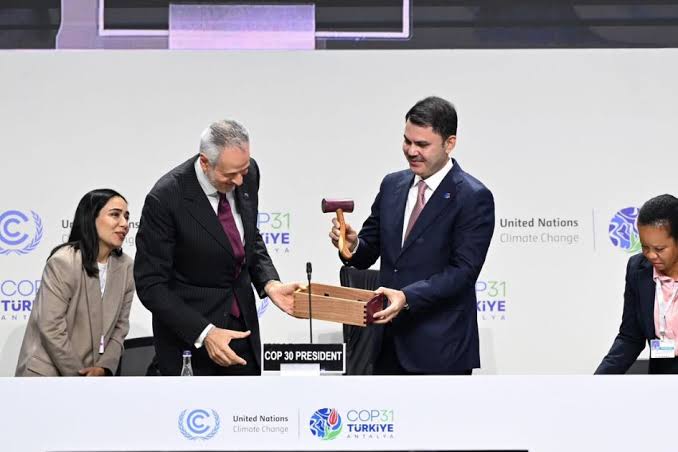
ANTALYA: The 31st United Nations Climate Change Conference (COP31) opened in Türkiye on Monday with a strong call for world leaders to translate their climate commitments into concrete action amid global economic slowdown, geopolitical instability, energy security concerns and mounting natural disasters.
The two-week conference, being held in Antalya, is placing particular emphasis on moving beyond agreements and declarations towards practical action plans, investment and effective implementation of climate commitments.
COP31 President Murat Kurum declared the conference an “implementation-focused COP”, saying that the world must now turn its climate pledges into tangible results. While considerable commitments have already been made to address climate change, ensuring their implementation remains the biggest challenge, he said.
The formal proceedings began at Antalya’s historic conference venue, bringing together world leaders, government representatives, officials of international organisations, scientists and climate experts.
In his inaugural address, Kurum said climate change could no longer be viewed as an isolated crisis. It was deeply interconnected with armed conflicts, geopolitical tensions, debt burdens, food insecurity and technological inequalities, with one crisis often aggravating another.
Highlighting the growing threats of drought, floods and water scarcity across the world, he said drought in one part of the world could eventually affect what people eat at the other end of the globe.
The impacts of climate change, he noted, were not confined to individual countries or regions but extended to global food supplies, economies and people’s livelihoods.
Kurum said the Paris Agreement’s goal of limiting global warming to 1.5 degrees Celsius must remain the world’s principal guiding objective. The scientific warnings and realities surrounding climate change must be acknowledged without hesitation at the Antalya conference, he added.
The World Meteorological Organization’s (WMO) State of the Global Climate Update 2026, released on the opening day, presented an alarming picture of the deteriorating climate situation.
According to the report, the 12 warmest years on record have occurred in recent times, with the last four years setting successive temperature records. It also underscored the urgent need for coordinated and accelerated action to address the growing impacts of climate change.
Kurum, who previously served as Türkiye’s environment and climate minister, placed particular emphasis on transforming the energy sector and expanding electrification.
In this connection, he highlighted Türkiye’s proposed global “35 by 35” electrification initiative, which aims to increase electricity’s share of global final energy consumption to at least 35 per cent by 2035.
The initiative envisages achieving the target through greater use of renewable energy, improved electricity transmission and distribution networks, and the expansion of clean technologies in the transport sector.
Kurum expressed hope that the initiative would help ensure more affordable electricity for consumers, generate employment and strengthen energy security.
Climate finance also featured prominently in the opening address. Referring to commitments made at the Baku climate conference, Kurum stressed the need to ensure $300 billion annually in climate finance for developing countries by 2035.
He also called for accelerated progress towards the broader target of mobilising $1.3 trillion annually in global climate finance.
Australia’s Climate Minister and COP31 Negotiations President Chris Bowen said the conference offered an important opportunity to demonstrate the effectiveness of international cooperation.
He said one of the key objectives of COP31 should be to translate climate commitments into tangible investments, infrastructure development, employment opportunities and improved energy security.
Simon Stiell, Executive Secretary of the United Nations Framework Convention on Climate Change (UNFCCC), highlighted the economic consequences of high fossil fuel prices and inflation.
He said renewable energy had saved the global economy $265 billion in the first six months of the current year alone.
Implementing climate commitments and building disaster-resilient infrastructure were directly linked to the economic and social interests of every country, he observed.
Food security, agriculture and public health received particular attention during the first day’s discussions.
Climate change is increasingly threatening agricultural production, food supplies and public health. The possible impact of a strong El Niño event could further intensify food insecurity in different parts of the world.
The conference expressed concern that nearly 50 million people could face severe food insecurity under the emerging circumstances.
A major initiative to address climate-related health risks was also launched on the opening day.
The COP31 Presidency, Türkiye’s Ministry of Health, the World Health Organization (WHO) and ATACH jointly launched the ‘Antalya Initiative for Resilient Health Systems’.
The initiative aims to strengthen the resilience of healthcare systems and improve their capacity to respond to health risks arising from climate change.
Meanwhile, a high-level dialogue involving women and young farmers was organised in collaboration with the International Fund for Agricultural Development (IFAD) and the Food and Agriculture Organization of the United Nations (FAO).
The discussions focused on expanding the use of technology in agriculture, increasing productivity and strengthening farmers’ capacity to adapt to climate change.
Türkiye also announced the launch of the ‘Turquoise Nexus Initiative’ to accelerate technological transformation in the food and agriculture sectors.
The initiative seeks to promote technological innovation, international cooperation and the development of climate-resilient food systems.
COP31 discussions and related programmes will continue over the next two weeks, with countries expected to negotiate key issues including climate finance, adaptation, mitigation, energy transition, food security and addressing climate-related loss and damage.
Bangladesh’s Prime Minister Tarique Rahman is scheduled to arrive in Türkiye on Tuesday to attend the conference.
As one of the countries most vulnerable to climate change, Bangladesh is expected to highlight the need for increased international support for climate finance, adaptation and measures to address loss and damage.
The country’s preparations for graduation from the least developed country (LDC) category, alongside the growing challenges of climate vulnerability, could also become an important part of its engagement at COP31.
Although Bangladesh contributes relatively little to global greenhouse gas emissions, it faces enormous economic and social costs from the consequences of climate change.
Against this backdrop, ensuring the delivery of climate finance commitments by developed countries and securing support based on the specific needs of vulnerable nations are expected to remain among Bangladesh’s key priorities at the Antalya conference.