Play store

The government’s plan to relocate the Bangladesh Secretariat to Sher-e-Bangla Nagar has run into a dispute over land ownership, with teachers and students of Sher-e-Bangla Agricultural University (SAU) demanding the return of 31.58 acres they claim belong to the institution.
The government plans to construct 14 12-storey buildings on the former site of the Dhaka International Trade Fair, aiming to begin operations at the new Secretariat by 2029.
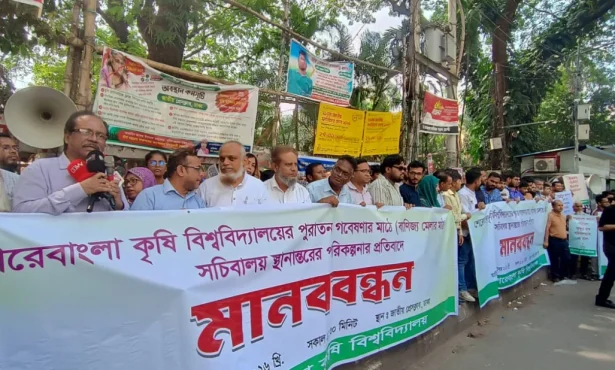
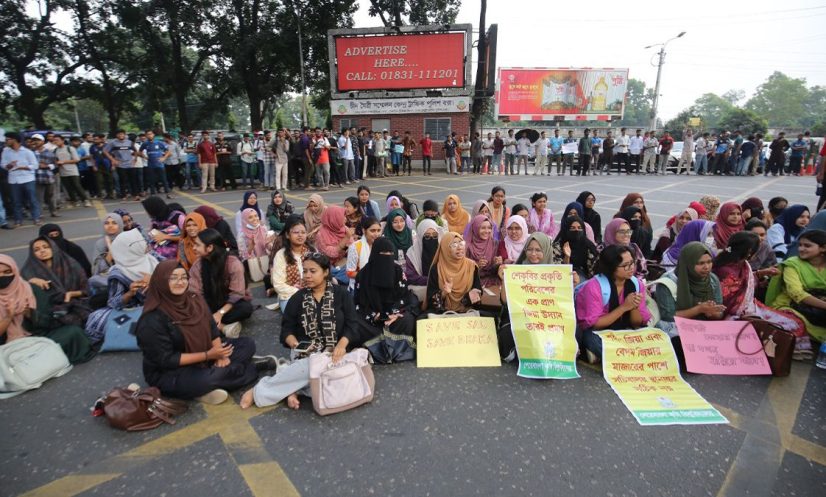
However, university teachers and students have launched protests, claiming the land is needed for agricultural education and research.
An investigation by Protidiner Bangladesh found that the land was acquired in 1961, before Bangladesh’s independence, for the development of Ayub Nagar, later renamed Sher-e-Bangla Nagar. Architect Louis I Kahn included a designated Secretariat area in his master plan for the administrative city.
The dispute has escalated into prolonged demonstrations, causing severe traffic congestion and public suffering in Agargaon. Protesters have also halted government construction-related activities, creating uncertainty over the project’s implementation.
The Cabinet approved the Secretariat relocation proposal and conceptual architectural design on October 18. The Public Works Department (PWD) began soil testing on October 27, but protesters stopped the work and took testing equipment and two vehicles to the university campus.
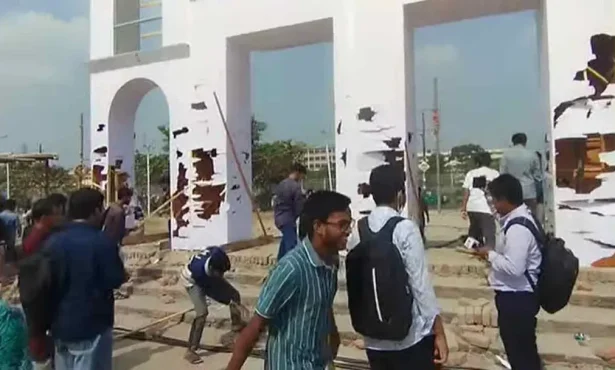
The following day, the entrance gate of the fairground and an under-construction structure were vandalised. The fair authorities subsequently filed a case, alleging damages worth Tk 30-35 lakh. Road blockades since October 27 have disrupted traffic on major roads in Agargaon.
According to Cabinet Division data, the existing Secretariat on Abdul Gani Road occupies 17.57 acres and has 13 buildings, eight of which were constructed before independence.
Several buildings date back to 1937-39, while another was built in 1947. Concerns have been raised over their earthquake resistance and the safety of government offices.
The existing complex has around 1.876 million square feet of office space. The government says more than one million additional square feet are needed to accommodate ministries’ growing requirements and bring offices operating outside the Secretariat under one roof. Currently, 16 ministries operate from locations outside the main complex.
Under the conceptual design, 14 12-storey buildings with three basement levels will be constructed on 31.58 acres, providing a total of 3.316 million square feet of office space.
The complex will have parking facilities for 3,800 vehicles, including 200 spaces above ground. Other facilities will include a mosque, two multipurpose halls with a capacity of 350 people each, a cafeteria and a post office.
Around 30% of the project area is expected to be allocated to greenery and water bodies. The Department of Architecture prepared the conceptual design in line with Louis I Kahn’s original master plan. Underground roads and underpasses are also planned to ease traffic around the complex.
However, detailed designs, cost estimates and implementation procedures are yet to be finalised, raising questions about whether the project can be completed by the 2029 deadline.
SAU teachers and students claim the former trade fair ground is university property that was temporarily used by the government in the 1980s to host the international trade fair. They say the land was never returned after the fair was relocated to Purbachal in 2022.
They argue that losing the land would seriously affect the university’s academic and research activities amid an existing shortage of research facilities.
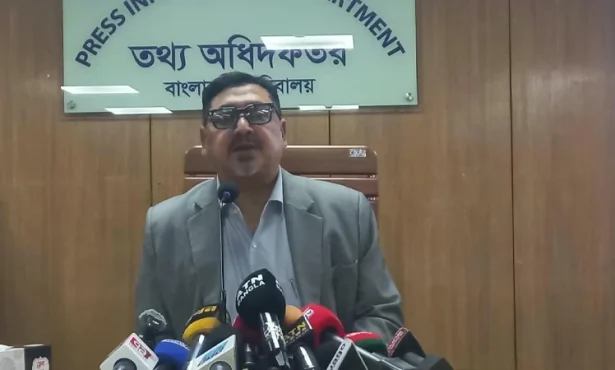
Housing and Public Works Secretary Md Obaidur Rahman, however, told journalists that the land belongs to the PWD, not the university. He said the students’ ownership claims would be examined.
PWD Chief Engineer (Grade-1) Khalekuzzaman Chowdhury told Protidiner Bangladesh that the land was acquired in 1961 for the development of an administrative city and historically belonged to the PWD.
He said all structures in the area had been built by the department and that the government had decided to establish the Secretariat in an area reserved for the purpose under the original master plan. He stressed that the government decision must be implemented.
Sher-e-Bangla Nagar was originally named Ayub Nagar after then Pakistani President Field Marshal Ayub Khan. During the 1960s, it was planned as an alternative administrative capital for East Pakistan, with the renowned American architect Louis I Kahn entrusted with designing the project.
Following Bangladesh’s independence in 1971, the area was renamed Sher-e-Bangla Nagar in honour of A K Fazlul Huq.
Kahn’s original 1963 master plan divided the administrative city into three major zones: the Assembly Citadel, the Institutional Citadel and the Secretariat complex.
The Assembly Citadel included the National Parliament House and three hostels for legislators, ministers and secretaries from East and West Pakistan. The Institutional Citadel was planned to accommodate the Supreme Court, a national library, sports facilities, schools, a hospital and an open marketplace.
The third section was designated for the Secretariat, an important component of Kahn’s master plan. The present government is seeking to implement that original vision by relocating the Secretariat to Sher-e-Bangla Nagar.