


 Play store

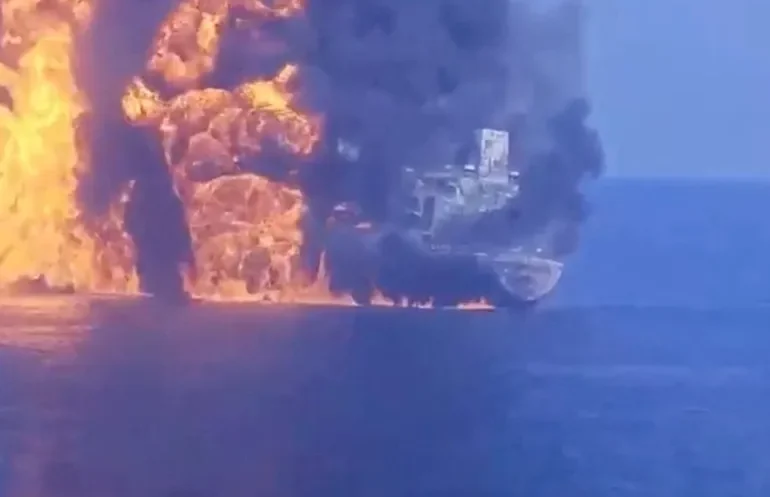
TEHRAN: Gulf nations remained on high alert on Wednesday after the United States struck Iran’s Qeshm Island in the Strait of Hormuz, with Kuwait reporting drone threats and Bahrain intercepting Iranian attacks.
Kuwait’s military said its air defences were responding to hostile drone threats, urging residents to follow security and safety instructions. Bahrain also said it intercepted aerial attacks early Wednesday, a day after Iran’s Revolutionary Guards claimed to have targeted a US military base in the country.
The latest incidents have heightened tensions around the strategic waterway, a vital route for global energy shipments, despite a lull in fighting following US-Israeli strikes on Iran in late February.
The conflict has increasingly spilled over into Gulf countries hosting US military installations as Tehran intensifies retaliatory attacks.
Iran’s official IRNA news agency earlier cited a regional official as saying the US strike on Qeshm Island caused no serious damage.
US fighter jets used precision munitions to target an Islamic Revolutionary Guard Corps (IRGC) missile launch site on the island, an American official told AFP on condition of anonymity, describing the strike as retaliation for Iranian attacks on US personnel and assets.
Washington and Tehran have been locked in a confrontation over control of the Strait of Hormuz, with the US military seeking to protect vessels navigating the waterway amid Iranian efforts to restrict access.
Although neither side has moved towards a full resumption of hostilities, tensions remain high.
US President Donald Trump said on Tuesday he was taking seriously reports that Iran was developing plans to use a so-called “dirty bomb” in Washington.
CNN, citing seven unnamed US officials, reported that Iran was plotting to target senior administration figures with a bomb containing chemical or radioactive materials. However, the officials did not say Tehran planned to carry out such an attack.
“If there is (such a threat), they will pay a price the likes of which no other country has ever paid before,” Trump said, adding, “I hope it’s not, but we take it very seriously because they happen to be crazy.”
Iranian Foreign Minister Abbas Araghchi dismissed the report as “Iraq War-style propaganda”.
Earlier on Tuesday, explosions rocked Bahrain’s capital as mobile phone alerts urged residents to seek shelter.
Bahrain’s armed forces said they had intercepted and destroyed several Iranian aerial attacks before they could reach their targets. Iran’s Revolutionary Guards, meanwhile, claimed to have struck a US-operated radar system at Sheikh Isa Air Base.
The Guards’ Sepah news website said combat drones carried out a precision strike on the radar system in response to alleged repeated violations of Iranian airspace by US military drones. It also claimed to have intercepted and captured a US drone south of Qeshm.
Bahrain, which hosts the US Navy’s Fifth Fleet, was heavily targeted earlier in the conflict but had gone weeks without attacks until Iranian drone strikes on Friday and Sunday.
“I was on my way to work when the warning sirens went on,” Abdulrahman Abdullah, a Bahraini civil servant in his forties, told AFP on Tuesday.
“Fear and anxiety rise as attacks increase… We hope things will go back to how they were.”
The escalation came as the United States deployed the USS Theodore Roosevelt to the region, bringing the number of American carrier strike groups there to three.
The deployment adds to a substantial US naval presence, including two other supercarriers, the George H W Bush and the George Washington, along with more than a dozen destroyers.
Iranian drone attacks have resumed ahead of an unprecedented trilateral summit this week involving Trump and his Chinese and Russian counterparts.
Chinese authorities said Trump, Xi Jinping and Vladimir Putin would discuss “world peace” at the talks in Shenzhen. Trump has said he intends to raise the Iran war during the meeting.