


 Play store

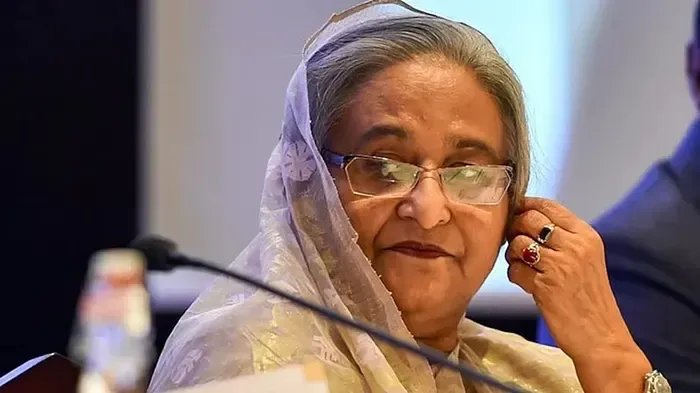
Her move comes at a sensitive time, as India is attempting to rebuild relations with Bangladesh’s new government.
According to an Outlook India report, Dhaka has reacted sharply to the issue. Bangladesh’s Ministry of Foreign Affairs has accused India of allowing a fugitive convicted of crimes against humanity to use Indian territory to make statements against Bangladesh’s sovereignty and political leadership. Dhaka has once again demanded Hasina’s extradition.
India, meanwhile, has sought to distance itself from the episode. Its Ministry of External Affairs said it had no role in organising the event and did not endorse the political views expressed by Hasina.
Sheikh Hasina fled Bangladesh for India in August 2024 after weeks of student-led protests brought an end to her 15-year rule. She has remained in India ever since. A Bangladeshi tribunal later sentenced her to death in absentia over the suppression of the protests under her government. Hasina has rejected the charges as politically motivated.
Hasina’s announcement that she intends to return to Bangladesh, made in a speech marking the second anniversary of the mass uprising, matters not simply because of what may happen in December, but because of how the announcement could reshape Bangladesh’s political landscape over the coming months.
Since Hasina’s ouster, the Awami League has been pushed to the margins of formal politics. The party’s activities have been banned, while many of its leaders have fled abroad, been arrested or become subject to legal proceedings.
The February election and the subsequent rise of a BNP government led by Tarique Rahman had appeared to signal the consolidation of a post-Hasina political order. Hasina’s announcement has unsettled that assumption.
For Awami League supporters, the possibility of her return provides a potential rallying point for renewed political mobilisation and suggests that the party’s political story may not yet be over.
For her opponents, however, Hasina’s continued political relevance creates a common adversary around whom otherwise fragmented political forces could unite.
This is why December could become politically significant in Bangladesh regardless of whether Hasina actually boards a flight to Dhaka. The deadline itself may shape political calculations.
If she does return, the BNP government would face an extremely difficult choice. Arresting her would allow the government to enforce its stated legal position. Giving her political space, on the other hand, could create an opening for the Awami League to return to the political arena.
The government has already challenged Hasina to return immediately rather than wait until December.
But the deeper question is larger: Can the Awami League survive without Hasina—and can it survive with her?
The party retains deep roots in Bangladesh. Yet its identity has become closely intertwined with its long-serving leader. A political comeback centred entirely on Hasina could reassure her loyal supporters, but it could also make it more difficult for the Awami League to reinvent itself as a political force.
India’s relationship with the Hasina government was exceptionally close. During her tenure, cooperation expanded significantly in areas including security, connectivity and trade. Bangladesh also took several steps on issues involving India’s northeastern states and border security that were widely welcomed in New Delhi.
Hasina’s sudden departure created a new political reality along India’s eastern frontier.
New Delhi must now maintain its longstanding relationship with Hasina while simultaneously managing relations with the BNP government in Dhaka. When the former prime minister uses Indian territory to make direct political statements aimed at Bangladesh, maintaining that balance becomes even more difficult.
Several unresolved issues remain between India and Bangladesh, including water sharing, trade and migration.
The renewal of the Ganges Water Sharing Treaty is approaching, while the long-discussed Teesta water-sharing agreement remains unresolved. At the same time, Bangladesh is seeking to diversify and rebalance its foreign relations, including through closer engagement with China.
Against this backdrop, Hasina’s continued presence in India could strengthen perceptions in Bangladesh that New Delhi remains emotionally or strategically aligned with the Awami League.
Such perceptions could complicate any effort to establish an effective working relationship between New Delhi and Tarique Rahman’s government.
They could also cast a shadow over potential interactions between Tarique Rahman and India around the BRICS summit.
Asset or Liability: For India, Sheikh Hasina is increasingly viewed as both an asset and a liability. Her presence gives New Delhi a channel to Bangladesh’s former political establishment and potentially preserves a degree of diplomatic influence. But the same presence makes it harder for India to convince Bangladesh’s new government that it accepts the political transformation brought about by the 2024 mass uprising.
For Bangladesh, meanwhile, the issue cannot be reduced simply to a dispute with India.
The country remains deeply divided over Hasina’s political legacy and the events that led to the collapse of her government. If she returns, protests, counter-protests and renewed violence could follow.
The attack on the home of former Bangladesh cricketer and Awami League leader Shakib Al Hasan after he appeared at an event in India alongside Hasina offered an early indication of just how tense the situation remains.
At present, Hasina is in India while the BNP government holds power in Dhaka. Between them lies a relationship that neither side can afford to ignore.
India’s challenge is to convince Bangladesh that providing Hasina with refuge does not necessarily amount to supporting her political comeback.
Dhaka, for its part, must pursue its legal and political claims against Hasina while avoiding a situation in which the Hasina issue casts a long shadow over its relationship with its largest neighbour.
For New Delhi, therefore, the real test is not simply whether it can keep Sheikh Hasina safe. The bigger challenge is whether India can protect her without allowing become the defining-or the determining- issue in India-Bangladesh relations.