Play store

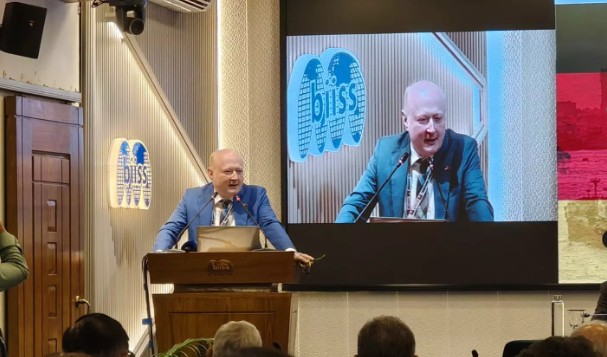
DHAKA: Bangladesh needs to improve its investment climate, diversify its economy and develop a skilled workforce to attract more foreign investment, German Ambassador to Bangladesh Dr Rüdiger Lotz has said.
In an exclusive interview with a news agency, Lotz said Bangladesh and Germany had maintained close relations for 55 years, with considerable opportunities to expand cooperation in trade, investment, development, politics and culture.
“We have a strong partnership, and I believe there is still considerable room to do more,” he said, stressing that good governance, simplified regulations and stronger efforts to combat corruption were essential to attracting foreign investors.
“A company interested in investing here should not have to approach 40 different authorities to obtain the necessary permissions. The process needs to be simplified,” he observed.
On economic diversification, Lotz said the readymade garment (RMG) sector would remain the backbone of Bangladesh’s economy for years, but the country needed to explore other promising industries, including leather, agribusiness, agro-processing, pharmaceuticals, information technology, logistics and shipbuilding.
He said political stability was also important for investment, although occasional social unrest would not necessarily discourage German companies, most of which had established long-term business operations and supply chains in Bangladesh.
The ambassador also emphasised the need to ensure decent wages and working conditions for workers, saying social and environmental compliance had become a business necessity as European consumers increasingly demanded sustainably produced goods.
On energy cooperation, Lotz said Germany was supporting rooftop solar projects in Bangladesh through grants and loans. He cited a jute factory where German assistance helped install around 18 megawatts of solar power, enabling almost the entire facility to operate on solar energy.
He welcomed the government’s ambition to increase renewable energy’s share to 20-30 per cent by 2030, saying Bangladesh had considerable potential for solar power. Renewable energy currently accounts for around three per cent of the country’s energy mix.
On Bangladesh’s ambition to become one of the world’s 20 largest economies, he highlighted economic diversification, infrastructure and education as key priorities. Referring to South Korea and Vietnam, he said both countries had invested heavily in education to achieve economic transformation.
“Education is, of course, a long-term investment. You will not see the results immediately. If you start educating children today, you may see the results 25 years later. But it has to be done,” he said.
Lotz also said Germany would need around 400,000 workers annually in the coming years to fill vacancies arising from its ageing population. Bangladesh could benefit from these opportunities by developing skilled workers and improving vocational training and German-language proficiency.
He expressed hope that a new online application system would reduce waiting times for German student visas from as long as two years to just a few weeks during the course of next year.
Under the proposed system, applicants will have to upload their documents during the application process, helping the embassy identify genuine students and speed up verification.
Beyond economic cooperation, Lotz praised Bangladesh’s vibrant contemporary art scene and expressed interest in promoting exchanges between Bangladeshi and German artists. He also highlighted the role of the Goethe-Institut and Germany-supported Machan Art Center in expanding cultural opportunities.