


 Play store

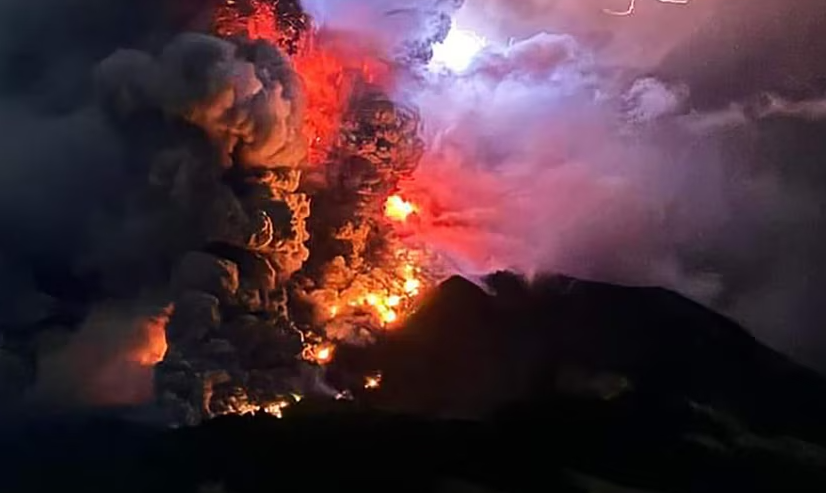
More than 150,000 passengers have been stranded after a volcanic eruption forced Indonesian authorities to temporarily suspend operations at six airports.
Jakarta’s Soekarno-Hatta International Airport was the first to close on Sunday morning after volcanic ash from Anak Krakatau was detected in the airspace near the airport.
Transport Minister Dudy Purwagandhi said 467 flights had been affected so far and urged airlines to consider diverting flights to alternative airports where possible.
The volcano began erupting late on Friday, triggering continuous seismic activity, lava fountains and loud booming sounds across surrounding areas. Authorities said two further eruptions occurred early on Sunday.
The Transport Ministry said the suspension of airport operations had mainly disrupted flights to and from Singapore, as well as other international destinations, including Doha, Sydney and Kuala Lumpur.
Purwagandhi said the decision to temporarily close additional airports was taken after tests showed that volcanic ash had spread towards West Java.
He urged airlines to speed up ticket refund procedures for passengers affected by flight cancellations and provide timely information to travellers with upcoming flights to prevent overcrowding at airports.
According to Indonesia’s Meteorology, Climatology and Geophysics Agency, known as BMKG, volcanic ash reached heights of up to 20,000 feet, or about 6,000 metres, east of the volcano over Java. On the western side, towards Sumatra, ash rose as high as 50,000 feet, or about 15,000 metres.
Authorities said there was no tsunami warning linked to the latest volcanic activity.
Anak Krakatau is located in the Sunda Strait between the Indonesian islands of Java and Sumatra.
The Health Ministry has urged people in affected areas to remain indoors and wear face masks to protect themselves from possible respiratory, eye and skin problems caused by volcanic ash.
Local newspaper *Kompas* reported that several schools cancelled activities on Saturday after students and residents complained of eye irritation caused by the ash. Some fishermen also cancelled planned fishing trips, reporting similar problems.
One resident, Aldi Candra Prayogi, told the newspaper that since Friday evening it had felt as though “small grains of sand” had entered his eyes, forcing him to use eye drops to ease the irritation.
He said the ash was so thick that he had to sweep the front yard of his house every five minutes.
Anak Krakatau, meaning “Child of Krakatoa”, has been intermittently active since emerging from the sea in the early 20th century within the caldera formed by the devastating 1883 eruption of Mount Krakatoa.
The volcano collapsed in December 2018, triggering a tsunami that killed more than 400 people and injured or displaced thousands along the coastlines of Sumatra and Java.
Scientists later found that some of the huge sections of rock that slid from the volcano during the collapse were between 70 and 90 metres high.
Indonesia lies along the Pacific Ring of Fire, a vast belt of volcanoes, earthquake zones and tectonic plate boundaries stretching about 40,000 kilometres around the Pacific Ocean.
The region accounts for roughly 90 percent of the world’s earthquakes and contains about 75 percent of the world’s active volcanoes. Source: BBC News