


 Play store

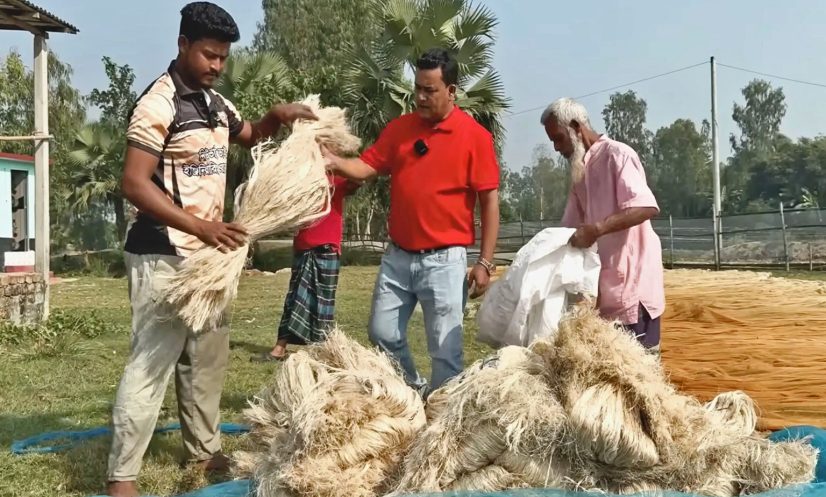
Bangladesh could produce around 37,800 tonnes of banana fiber annually and generate more than $94 million in export earnings if the emerging sector is effectively commercialized, according to a 2024 study.
The potential is significant for Bangladesh, where bananas account for about 20% of all fruit crops. The country ranked 27th globally in banana production in 2024, producing approximately 813,600 tonnes, according to World Population Review data. India topped the global ranking with around 37.6 million tonnes.
Banana fiber, extracted mainly from post-harvest banana stems, is gaining attention as a versatile and biodegradable material. It can be used to make textiles, blended yarn, sarees, curtains, mats, bags, ropes, paper, packaging materials and various handicrafts.
The fiber is already being used in Bangladesh to produce products such as the celebrated Kolaboti saree and a growing range of environmentally friendly handicrafts.
The 2024 study found that Bangladesh has considerable potential to expand banana fiber production because bananas are cultivated on about 54,756 hectares of land. The country generates an estimated 3.78 million tonnes of banana pseudo-stem biomass annually, from which around 1% can potentially be extracted as fiber.
Banana fiber also offers an advantage in terms of raw materials because it is produced from agricultural waste, unlike jute, which requires dedicated cultivation. However, the market price of banana fiber is currently more than twice that of jute fiber.
Bangladesh is the world’s second-largest producer of jute fiber and the world’s top jute exporter. It produces an estimated 1.3 million to 1.5 million tonnes of jute annually, accounting for roughly 30% to 40% of global production.
A 2025 study found that banana fiber has high tensile strength and good flexibility, while its inner fibers have a relatively soft, silk-like texture. Jute, by comparison, has a coarser texture.
Entrepreneurs expand production
A growing number of Bangladeshi entrepreneurs are investing in banana fiber production, although technological limitations and a lack of standardization remain major challenges.
Many entrepreneurs initially relied on locally manufactured fiber-processing machines. However, some of these machines produce inconsistent or lower-quality fiber, limiting the prices manufacturers can obtain. Industry operators say modernization and better technology are needed to improve quality and productivity.
Parveen Akhter, an entrepreneur from Narail in southwestern Bangladesh, said it costs around Tk200 to Tk350 to produce one kilogram of banana fiber, including labour and electricity.
She collects discarded banana stems from nearby orchards, cleans them and processes them to extract the fiber. According to Akhter, a machine generally requires two workers—one to operate it and another to prepare the banana stalks.
After processing, she sells the fiber to export buyers for around Tk500 to Tk600 per kilogram.
Another entrepreneur, Md Hafijul Islam, owner of New Bhai Bhai Engineering Workshop in Gazipur, has built a nationwide network of banana fiber producers. He collects fiber from around 250 entrepreneurs and exports it to China while also manufacturing fiber-processing machines.
His factory employs around 20 to 25 people who produce hundreds of handicraft items, including baskets and flower vases. These products are sold at tourist destinations such as Cox’s Bazar, Sylhet and Kuakata.
Islam also supports more than 1,000 women who braid banana fiber at home, allowing them to earn additional income for their families.
He began working in the sector in 2016 and started manufacturing his own processing machines in 2021 after observing banana fiber technology being used in China and India.
His machines cost between Tk30,000 and Tk120,000, depending on production capacity. He also provides training and offers entrepreneurs a 10-year buy-back agreement under which they can sell their processed fiber back to him.
Entrepreneurs say producing banana fiber is relatively straightforward but labour-intensive. It takes roughly five to eight banana stems to produce one kilogram of fiber.
The finished fiber is generally divided into three grades. A-grade fiber can fetch around Tk600 per kilogram, while B-grade fiber sells for Tk350 to Tk500 and C-grade fiber for around Tk180.