Play store

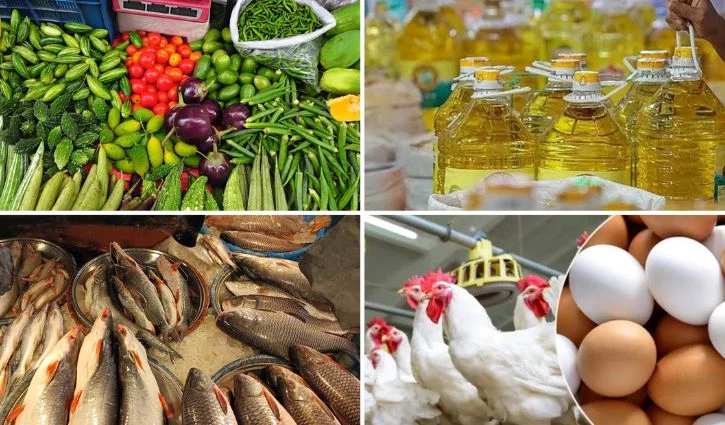
The recent increase in fuel prices has begun to push up the cost of everyday essentials in Dhaka, with higher transport expenses raising costs at different stages of the supply chain from production centres to wholesale and retail markets.
Prices of several vegetables have increased by Tk5–20 per kilogram, while various types of fish have become Tk20–50 more expensive. At the same time, supplies of one- and two-litre bottles of soybean oil have declined in some markets, adding further pressure to an already expensive essentials market.
A visit to Karwan Bazar, Mohammadpur and New Market on Friday found that transport costs have risen since the government increased fuel prices last Sunday.
Diesel now costs Tk135 a litre, up from Tk115, while petrol and octane are priced at Tk160 and Tk165 respectively.
Traders said higher freight charges for bringing vegetables and other goods from different districts to Dhaka are gradually being reflected in retail prices, although the increases vary from product to product.
Eggplant is now selling for Tk80–100 a kilogram, cucumber Tk70–80, bitter gourd Tk80, local carrot Tk120, snake gourd Tk70, yardlong beans Tk80–100, okra Tk70–80, pumpkin Tk40, green papaya Tk30 and pointed gourd Tk70. Tomatoes are priced at Tk120–150 a kilogram, depending on quality.
Fish prices have also risen. Farmed rohu is selling for Tk450–500 a kilogram, pangas Tk250–270, tilapia Tk250–300 and medium-sized koi Tk200–250.
Local shing is priced at Tk500–600, pabda Tk400–450, shrimp Tk800–1,000, small mixed local fish Tk600–700, mola Tk600–700 and tengra Tk500–600. Rupchanda costs Tk1,400–1,500, boal Tk700–900, while one-kilogram Padma hilsa is selling for Tk2,000–2,200.
Chicken and egg prices also remain high. Broiler chicken costs Tk180–200 a kilogram, Sonali chicken Tk350–370, beef Tk800 and mutton Tk1,200. A dozen eggs is selling for around Tk150, with some retailers charging Tk160.
Supplies of bottled soybean oil, particularly one- and two-litre bottles, have declined in some markets. Traders said five-litre bottles are also somewhat less available.
Edible oil refiners and producers raised the price of bottled soybean oil by Tk5 a litre earlier this month, bringing the price to Tk204. Retailers said supplies were initially normal after the price increase but have since tightened in some markets.
Some traders said suppliers had indicated that companies were considering another price increase, although there has been no official announcement and supply shortages are not uniform across all markets.
Flour prices have also increased. Over the past month, loose flour has risen by around Tk5 a kilogram and loose refined flour by up to Tk10. Loose flour is now selling for about Tk50 a kilogram and refined flour for Tk65–70.
The higher prices are also changing shopping habits. Many consumers are setting a fixed budget before going to the market and buying smaller quantities than before.
Private-sector employee Ariful Islam of Mohammadpur said he now decides what to buy based on how much money he has. If fish is expensive, he buys chicken, and if chicken is also costly, he turns to eggs or other alternatives.
Housewife Akleema Akter of Rayerbazar said she used to buy fish, chicken and eggs for a week at a time but now purchases only enough for two or three days.
For people with irregular incomes, the pressure is even greater. Day labourer Abul Kashem of Hazaribagh said he has to shorten his shopping list when work is scarce, often cutting one item to afford another.
Retailers said customers are also buying less. Chicken seller Didarul Islam of Karwan Bazar said some customers who came for a kilogram now buy only half a kilogram after hearing the price.
Egg seller Jasim Hawladar of Mohammadpur Krishi Market said customers who once bought two or three dozen eggs are now often buying only six or one dozen.
Fish sellers said they too cannot easily reduce prices because wholesale purchase costs, transport, labour and shop rents remain high.
The immediate impact of higher fuel prices has been felt in the transport sector. Traders said freight charges for trucks and covered vans have increased on several routes, raising the cost of bringing goods from production areas to Dhaka and then distributing them through wholesale and retail markets.
The impact is particularly noticeable for perishable goods coming from distant districts.
However, higher fuel prices do not necessarily mean all goods will become more expensive at the same rate. Retail prices also depend on production costs, seasonal availability, demand, transport distance and wholesale and retail market conditions.
Market observers fear that if transport costs remain high for a prolonged period, the pressure could gradually spread to other essential goods and services. Higher irrigation and production costs could also affect agricultural prices later.
SM Nazer Hossain, vice-president of the Consumers Association of Bangladesh, said fuel price increases affect the essentials market through higher transport costs. This can raise prices while simultaneously reducing consumers’ purchasing power and demand.
He said authorities should monitor the market for unjustified price increases and examine where additional costs are being added to the supply chain.