Play store

Former Bangladesh Bank governor Dr Ahsan H Mansur has called for prioritising professional competence, experience, leadership skills and independent decision-making over political considerations in appointing the central bank governor.
He said institutional independence was essential to ensure an effective central bank, but the governor’s actions must also be subject to an effective accountability framework.
“An effective central bank requires institutional independence. The governor must be allowed to make policy decisions without political or other undue pressure. However, independence does not mean freedom from accountability,” he said.
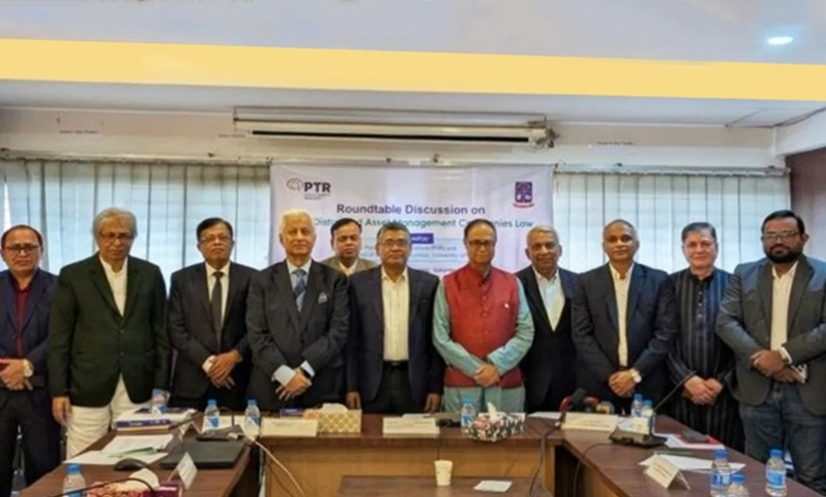
He made the remarks at a roundtable discussion titled ‘Draft Distressed Asset Management Companies Law’ at the Abdullah Farouk Conference Hall of the Faculty of Business Studies at Dhaka University on Saturday.
Policy Think and Research (PTR) and the university’s Department of Banking and Insurance jointly organised the event.
Mansur stressed the need to appoint the central bank governor based on professional qualifications, extensive experience, leadership capacity and the ability to take independent decisions rather than political affiliation or status.
He also called for ensuring professionalism in the Bangladesh Bank board and policymaking structures, saying members should be selected in a way that enables them to serve the interests of the overall banking sector rather than individuals or particular groups.
Highlighting the need for independent asset management companies to address the banking sector’s existing problems, the former governor said such institutions could play an important role in managing distressed assets and non-performing loans (NPLs).
Proper valuation and management of non-performing assets would ease pressure on banks’ balance sheets and create opportunities to restore their financial strength, he said.
However, he emphasised that transparency, accountability and effective regulatory oversight must be ensured in the operation of asset management companies.
He called for strong legal and institutional safeguards to prevent irregularities, conflicts of interest and the misuse of such companies for personal gains.
Stressing the need for a comprehensive roadmap rather than isolated initiatives to reform the banking sector, Mansur said structural weaknesses could be addressed through a combination of effective laws, an independent central bank, transparent governance and accountable institutions.
He also called for ensuring an environment free from political and personal interests in implementing reforms.
Speaking at the discussion, Agrani Bank PLC Chairman Syed Abu Naser Bakhtiar Ahmed shared his experience as the bank’s managing director and highlighted how its financial condition had changed over the years.
He said the bank’s loan portfolio and NPL situation were unfavourable when he took charge in 2004. By the time he left in 2010, the loan portfolio had reached around Tk 30,000 crore, while the NPL ratio had declined to approximately 10 per cent.
However, when he returned to the bank in 2024, he found that its loan portfolio had fallen to around Tk 25,000 crore and the NPL ratio had climbed above 50 per cent.
He attributed the deterioration partly to lending without proper scrutiny, political influence and pressure from the board of directors.
“Once the NPL situation reaches a critical level, recovery cannot happen quickly. Therefore, irregularities must be prevented from the outset through proper borrower assessment, verification of repayment capacity and accountability in management,” he said.
He noted that bank funds essentially represented people’s deposits and should not be made available indiscriminately to individuals or groups that could take loans and subsequently default.
He called for ending the practice of providing loans based on political identity or influence without assessing borrowers’ business experience and financial capacity.
The impact of loan write-offs on government revenue should also be considered seriously, he added.
Highlighting challenges in the industrial sector, Bakhtiar Ahmed said market demand, production capacity, workers’ skills and operational viability should be assessed before setting up new industrial enterprises.
He observed that excessive growth in the number of similar industrial establishments had made it difficult for many businesses to remain competitive.
High production costs and shortages of skilled workers were also weakening industrial capacity, he said, adding that an effective industrial policy, skills development and regular monitoring were essential to attract foreign investment.
Legal and economic expert Mohammad Shahjahan Siddiqui attended the roundtable as the keynote speaker.
Economist and banking expert Professor Dr Toufiq Ahmed Choudhury and Agrani Bank Chairman Syed Abu Naser Bakhtiar Ahmed were also present, among others.