Play store

Bangladesh suffered economic losses worth Tk540.9 billion due to load-shedding between August and October this year, as electricity supply fell 2,378.6 gigawatt-hours short of demand during the period, according to a new study.
The power shortage disrupted production in industries and other sectors, hampering economic activities across the country.
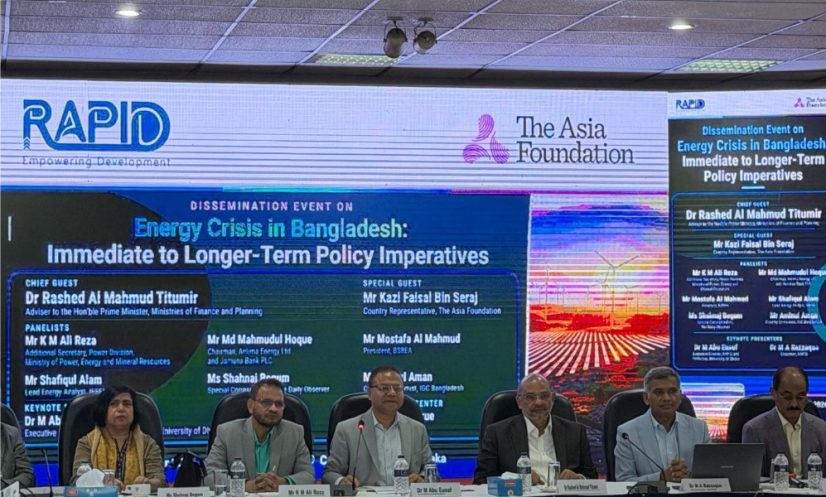
The findings were revealed in a study conducted by the Research and Policy Integration for Development (RAPID) and The Asia Foundation, titled Energy Crisis in Bangladesh: Immediate to Longer-Term Policy Imperatives, published on Sunday.
According to the study, the electricity supply deficit ranged between 3% and 10% of demand during the three-month period. The resulting economic losses were equivalent to around 0.88% of Bangladesh’s gross domestic product (GDP) in the 2025-26 fiscal year.
The study estimated that every unit (kilowatt-hour) of electricity not supplied causes an average economic loss of Tk227. In the industrial sector, the loss amounts to Tk310 per unit.
The impact extends beyond factory production, affecting supply chains, trade and other related economic activities.
Researchers estimated that the economic losses caused by load-shedding over the three months were nearly 12 times the fuel cost of using liquefied natural gas (LNG) for power generation.
The study cautioned against overlooking the wider economic costs of electricity shortages while focusing solely on saving fuel costs in power generation.
It also highlighted a direct link between gas supply to power plants and load-shedding. An additional 100 million cubic feet of gas supplied to power plants daily could reduce the electricity deficit by around 11.6 gigawatt-hours a day.
Meanwhile, a one-degree Celsius rise in temperature increases electricity demand by 14.2 gigawatt-hours, the study found.
Despite having sufficient installed power generation capacity, Bangladesh cannot fully utilise it due to fuel shortages and other constraints. Between August and October, maximum power generation never exceeded 58% of installed capacity.
The country’s installed generation capacity is around 8,300 megawatts higher than peak demand, even after accounting for the required reserve capacity.
The study also pointed to Bangladesh’s heavy dependence on gas and oil, which account for 76% of its electricity generation. The corresponding shares are 30% in Pakistan and just 3% in India.
Researchers warned that such dependence on limited fuel sources makes electricity supply vulnerable, particularly as domestic gas production continues to decline.
To address the crisis, the study recommended improving power plant efficiency, ensuring adequate gas supplies according to demand and carrying out regular maintenance of power plants.
It also called for expanding renewable energy use and improving electricity transmission and distribution systems.