Play store

Bangladesh and Pakistan have signed a five-year memorandum of understanding (MoU) to expand government-to-government (G2G) trade in essential commodities and agricultural products, opening up new opportunities for bilateral trade and diversifying Bangladesh’s import sources.
The agreement between the Trading Corporation of Bangladesh (TCB) and the Trading Corporation of Pakistan (TCP) aims to strengthen supply chains, ensure food security and facilitate the procurement of essential commodities based on the needs of both countries.
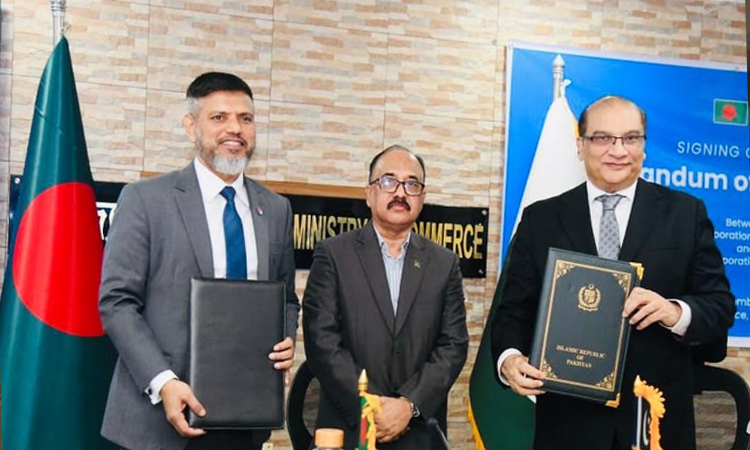
The MoU was signed on Sunday at a ceremony at the conference room of the Ministry of Commerce at the Secretariat, according to a press release.
TCB Chairman Brigadier General Mohammad Faisal Azad signed the agreement on behalf of Bangladesh, while Pakistan’s High Commissioner to Bangladesh Imran Haider signed on behalf of Pakistan.
Commerce Secretary Sharf Uddin Ahmed Choudhury and officials from both countries were present.
Under the agreement, the two countries will be able to trade rice, wheat, sugar, edible oils, pulses, agricultural products and inputs based on mutual consent.
The potential commodities include different varieties of rice, refined and raw sugar, canola, soybean, sunflower, rice bran and palm olein oils. Other items include sesame, potatoes, onions, lentils, chickpeas, tea, pineapples, jackfruit, dates and fertilisers.
However, the MoU does not constitute a commitment to immediately import or export any specific product. Either party seeking to procure a commodity will have to submit a written proposal detailing its quality, quantity, specifications and expected delivery schedule.
Separate agreements will then be negotiated for individual products, covering prices, quantities, quality standards and delivery schedules.
Speaking at the ceremony, Commerce Secretary Sharf Uddin Ahmed Choudhury said the MoU would establish a direct and structured commercial relationship between the state-owned trading organisations of the two countries.
He said the arrangement would create opportunities for cooperation in importing and exporting essential commodities and agricultural products while protecting the economic interests of both sides.
He also stressed the need for regular communication between TCB and TCP, timely evaluation of commercial proposals and support from the respective commerce ministries to ensure effective implementation.
Pakistan’s High Commissioner Imran Haider said the agreement would make the procurement and supply of essential commodities more organised by establishing direct institutional links between the two organisations.
He said Pakistan had surplus stocks of several agricultural products, including basmati rice, onions, potatoes and spices, and was ready to supply them to Bangladesh according to its requirements.
Highlighting recent progress in bilateral relations, Haider said cooperation between the two countries had expanded in trade, education and connectivity.
He noted that Pakistan had withdrawn anti-dumping duties on hydrogen peroxide imported from Bangladesh and retained a duty-free quota for importing 10,000 tonnes of Bangladeshi tea annually.
He also mentioned that the first shipment of Bangladeshi pineapples had reached Karachi from Dhaka in October.
TCB Chairman Brigadier General Mohammad Faisal Azad said the MoU would go beyond a formal document or an expression of goodwill and translate into tangible commercial outcomes through joint efforts.
He said the agreement would provide an institutional platform for exploring mutually beneficial trade opportunities, facilitating procurement and strengthening cooperation between TCB and TCP.
The two organisations would work together to identify specific products, secure competitive prices, maintain quality standards and ensure timely delivery in line with the requirements of both countries, he added.
The MoU will remain effective for five years from the date of signing and will automatically be renewed for another five years unless either party decides otherwise. Either side can terminate the agreement by giving at least three months’ written notice through diplomatic channels.
Officials and stakeholders believe the arrangement could provide Bangladesh with an alternative source of essential commodities during supply shortages, price volatility or disruptions in traditional international markets.
However, the actual benefits for the domestic market will depend on the conclusion of product-specific agreements, competitive import prices, quality assurance and timely deliveries.
The agreement is expected to provide a new institutional framework for expanding bilateral trade while creating alternative sourcing opportunities to strengthen Bangladesh’s food security and supply chains.