


 Play store


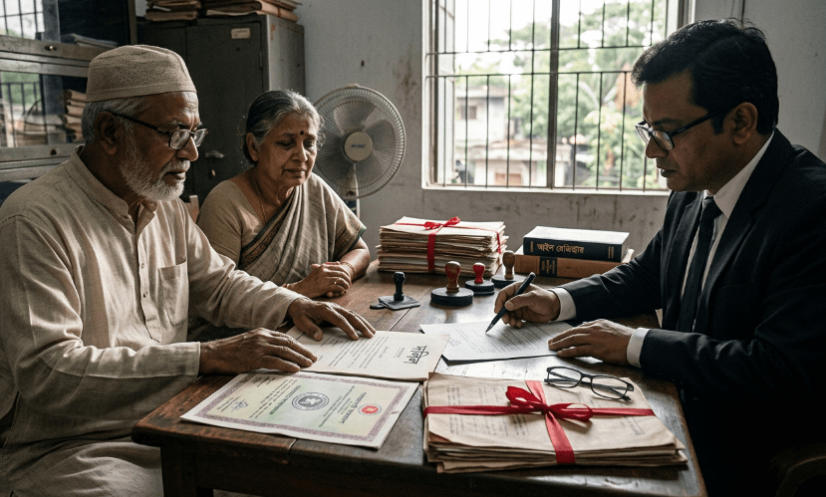
Bangladesh’s recently passed “Transfer of Property (Amendment) Act, 2026” has triggered a contentious debate over property rights, elderly protection and Islamic personal law. The controversy is understandable, but it should not be allowed to degenerate into a political or religious confrontation. What is needed is a careful examination of the law, its objectives and its compatibility with established principles of Heba.
The amendment allows a person to transfer property while retaining the right to use and enjoy it throughout his or her lifetime. It covers transfers among parents and children, grandparents and grandchildren, and spouses. If the recipient dies before the donor, the recipient’s legal heirs may inherit the property, while the donor’s reserved right of use and enjoyment remains protected.
The measure has been welcomed by lawyers and rights activists as an important safeguard for elderly property owners. Surely, there are good reasons for such protection.
In Bangladesh, elderly parents sometimes transfer their homes or other assets to children through gift deeds and subsequently find themselves without adequate security. In some cases, vulnerable parents are persuaded or pressured into signing deeds and later face neglect, abandonment or disputes over the property. Once ownership has been transferred and mutation completed, recovering control can be extremely difficult.
Besides, the beneficiaries in most cases take recourse to deceit and duplicity to obtain a Heba. Very often the Heba instrument is used to avoid paying the Govt. set registration fee for transfers by falsifying as “Gift”. Secondly, Heba is executed secretly without a loud announcement by a parent to deprive his/her own child while colluding with other children under pressure is a very common phenomenon now-a-days that shatters many families into pieces. A sweet relation turns into hostility for rest of the life. Both the instances are anti Islamic and strictly prohibited. Thus, it undermines the spirit of Heba.
This is a genuine social problem, and the law seeks to address an obvious gap by giving statutory recognition to the donor’s lifetime right to use and enjoy the property. Yet the objections raised by sections of the ulema and Islamic political groups cannot simply be dismissed. The principal concern relates to ”Heba”, the Islamic concept of voluntary and unconditional gifting. Heba is intended to promote generosity, goodwill, family responsibility and social harmony. It is fundamentally a voluntary act and should not be the product of coercion or manipulation.
The new law, however, introduces a statutory right for the donor to retain lifetime enjoyment of property after transferring it. This is not necessarily identical to the traditional concept of Heba. Indeed, Law Minister Md. Asaduzzaman acknowledged that there is a point of contention concerning lifetime enjoyment rights, while maintaining that the legislation contains safeguards to prevent conflict with Islamic principles. That distinction should be at the centre of the debate.
The amendment does not necessarily abolish Heba or invalidate existing forms of property transfer under Muslim personal law. Rather, it creates a legal mechanism to protect a donor’s continuing use and enjoyment of property after a transfer. Whether particular provisions are fully compatible with Islamic jurisprudence is a legitimate question for scholars and legal experts to examine. But calling the entire law “anti-Islamic” without identifying precisely which provisions violate established principles does little to advance that discussion.
There is also an important irony in the controversy. If elderly parents are being coerced into signing Heba deeds or are abandoned after transferring their property, such practices themselves undermine the spirit of Heba. An Islamic gift is supposed to be voluntary and rooted in goodwill and family responsibility. Exploiting an elderly parent for property is plainly inconsistent with those values.
The state, meanwhile, has a legitimate duty to protect citizens from fraud, coercion and exploitation. Protecting an elderly donor’s right to remain in and enjoy their home should not automatically be interpreted as interference in religious doctrine.
At the same time, lawmakers must exercise caution. Property transfer, inheritance and religious personal law are closely connected in Bangladesh. Any legislation affecting these areas should be drafted and implemented in a manner that avoids unnecessary conflict with established religious principles.
This is why the government’s willingness to discuss the legislation further with Islamic scholars and other stakeholders is important. Such consultations should not be merely symbolic. They should examine the precise legal relationship between the new provision and Heba and determine whether additional safeguards or amendments are necessary.
The opposition and religious groups also have a responsibility to engage constructively. Their concerns deserve to be heard, but they should be supported by clear legal and theological arguments rather than political slogans. If genuine contradictions exist, they should be identified and addressed through Parliament and appropriate legal mechanisms.
The broader issue is equally important. Bangladesh’s population is ageing, while traditional family structures are changing. For many older people, their home and property remain their principal source of independence and security. A legal framework that prevents them from becoming destitute after transferring property to their children can therefore serve an important social purpose.
The challenge is to strike the right balance. The government should protect elderly and vulnerable property owners without unnecessarily interfering with religious personal law. Islamic scholars should recognise the reality of property-related exploitation while ensuring that legitimate religious concerns are not overlooked. Lawyers and civil-society organisations should contribute practical expertise on implementation and protection.
Ultimately, social welfare and religious values need not be competing objectives. Heba itself rests on principles of generosity, goodwill and family responsibility. A law designed to prevent elderly donors from losing the security of their homes and assets can serve a complementary social purpose, provided it does not improperly alter established religious rules.
The new law should therefore neither be blindly celebrated nor hastily condemned. Its provisions should be examined carefully, its safeguards tested in practice and legitimate concerns addressed through consultation.
Bangladesh needs dialogue rather than division on this issue. If the government, lawmakers, ulema and legal experts can work together to resolve areas of uncertainty, the amendment can become an instrument of protection rather than another source of controversy. The ultimate objective should be simple: “to protect the dignity and security of elderly property owners while respecting the country’s religious and legal traditions”. That is the balance Bangladesh should seek.