


 Play store

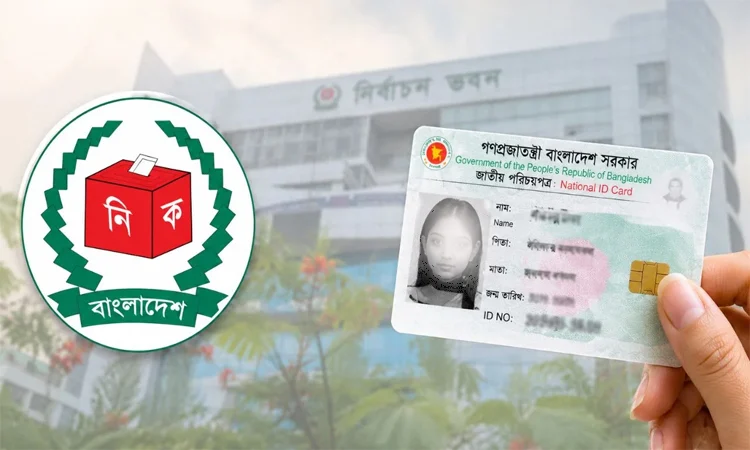
The Election Commission (EC) has settled 6,442,832 applications for correcting National Identity Card (NID) information out of 6,570,842 received so far, leaving 128,010 applications pending, according to the latest available data.
The data from the EC’s National Identity Registration Wing, updated until October 18, also show that 1,355,157 applications have been rejected for various reasons, highlighting the commission’s efforts to ensure accuracy in the country’s national identity database.
With 80,000 to 90,000 new applications arriving every month, the commission is now focusing on clearing the remaining backlog, speeding up the disposal process and preventing fraudulent attempts to alter NID records.
To improve the delivery of services, the EC has introduced deadlines for processing applications, expanded the authority of election officials at the upazila and district levels, and strengthened regular monitoring by senior officials.
EC officials said applications submitted up to 2024 had been settled, while the disposal of applications received in 2025 was nearing completion. However, the steady flow of new applications, along with repeated and ineligible requests, continues to put pressure on the system.
The commission is also tightening scrutiny of applications involving changes to dates of birth and other sensitive personal information to prevent irregularities and ensure that corrections are supported by verifiable documents.
According to EC data, 68,269 applications submitted in 2026 under category ‘Gha’ remain pending. Another 983 applications received in 2025 are awaiting disposal under the same category, bringing the total to 69,252.
The regional breakdown shows considerable variation in the number of pending applications.
Dhaka has 10,615 pending applications, followed by Cumilla with 10,559, Mymensingh with 8,332, Rajshahi with 6,875, Chattogram with 6,688, Sylhet with 6,469, Khulna with 5,871, Faridpur with 5,140, Rangpur with 4,477 and Barishal with 4,226.
The figures indicate a relatively heavier backlog in Dhaka and Cumilla, underscoring the need for region-specific monitoring and more efficient case management.
The EC has introduced specific deadlines for processing applications and expanded the scope for disposing of cases at the upazila and district levels. Senior management officials and relevant directors are also monitoring progress regularly to ensure that applications are processed within the stipulated time.
EC Senior Secretary Akhtar Ahmed told BSS that accuracy remained the primary objective of the application disposal process.
He said the commission wanted to ensure that voter registration information was recorded correctly from the outset, reducing the need for subsequent corrections.
Applications lacking sufficient grounds are being rejected after scrutiny, while officials have been instructed to complete the disposal process within the prescribed timeframe, he said.
A large number of applications were also settled through a special initiative last year, he added.
Akhtar Ahmed said some applications no longer required correction, while discrepancies had also been detected in applications submitted by expatriate Bangladeshis through local representatives. Such cases were being examined carefully before decisions were made, he said.
The EC has strengthened monitoring of applications seeking changes to dates of birth in NID records, placing greater emphasis on educational certificates that can be verified online.
The commission recently sent a letter to all regional election officers to reinforce compliance with the relevant instructions.
Under a circular issued on August 13, applications for date-of-birth corrections supported by online-verifiable Junior School Certificate (JSC), secondary or equivalent certificates can be placed under category ‘Ka’ and settled by the concerned upazila or thana election officer. Certificates issued by the Bangladesh Open University are excluded from this provision.
The directive also requires regional election officers and additional regional election officers to monitor the activities of officials under their jurisdiction.
They must randomly examine at least three applications processed by each authorised officer every month and submit reports on their findings.
Reports covering the period from August 13 to 31 were required to be submitted by September 21. Subsequently, monthly reports must be sent within the first week of the following month.
The measures are intended to improve the accuracy of decisions, strengthen accountability and reduce the risk of unauthorised changes to sensitive personal information.
Director (Operations) of the National Identity Registration Wing Md Saiful Islam told BSS that many applications did not meet the requirements for correction.
He said discrepancies sometimes emerged in requests to change dates of birth, including cases in which the age difference between a father and his child was only 10 years.
In other cases, the proposed correction would mean that an individual had been younger than 18 when registered as a voter. Such inconsistencies could provide grounds for rejecting an application, he said.
Saiful Islam said some applicants submitted fresh requests under different categories after their earlier applications had been rejected. This practice generated repeated applications for similar purposes and could make the pending caseload appear larger than the number of distinct cases requiring resolution.
Regular meetings are being held and letters sent to the officials concerned to expedite the disposal of pending applications, he said.
A service-oriented attitude among officials, a stronger sense of responsibility and regular monitoring had also contributed to progress in settling applications, he added.
Alongside efforts to clear the backlog, the EC has reiterated its firm stance against fraud involving NID information.
Senior Secretary Akhtar Ahmed said individuals accused of NID-related fraud were being handed over to law enforcement agencies. Administrative action was also being taken against commission officials or employees found to be involved in such activities.
The commission is conducting media campaigns to raise public awareness about NID-related fraud, he said.
Rather than acting only after complaints are lodged, the EC is also exploring ways to prevent fraudulent activities before they occur. The feasibility of introducing a technology-based system to detect and prevent such attempts is being examined, he added.
Akhtar Ahmed expressed hope that the introduction of such a system would further reduce NID-related fraud.
The National Identity Registration Wing is also warning members of the public against falling victim to fraudulent groups. Its helpdesk provides advice to people seeking information about NID services and related risks, Saiful Islam said.
Despite the settlement of more than 6.44 million applications, the volume of new requests remains a major challenge for the commission.
With 80,000 to 90,000 applications arriving every month, speeding up the disposal process alone may not provide a sustainable solution. The EC must also ensure that information is accurate at the point of registration, applicants provide authentic documents and officials follow consistent verification procedures.
Reducing unnecessary applications, preventing repeated submissions and improving public awareness about the requirements for correcting NID information could also help ease the pressure on the system.
The commission’s immediate priority is to clear the remaining backlog without compromising the accuracy of its decisions. In the longer term, its success will depend on building a more reliable national identity database, strengthening accountability at every stage of the correction process and reducing the need for future amendments.