


 Play store

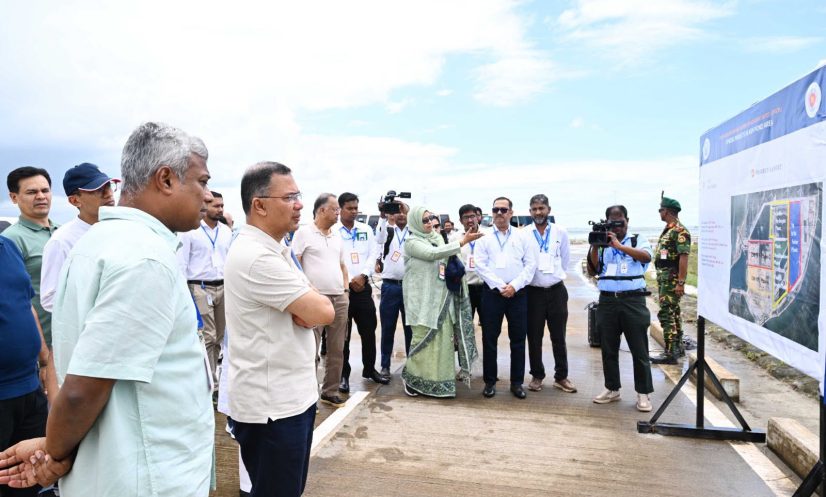
Prime Minister Tarique Rahman has stressed efficient use of existing energy infrastructure, greater transparency and accountability in project management, regular maintenance and a long-term integrated energy plan to ensure Bangladesh’s energy security.
“Alongside meeting the country’s growing electricity demand, we must diversify our energy sources,” he said during a visit to the 1,200-megawatt Matarbari Ultra-Supercritical Coal-Fired Power Plant in Maheshkhali upazila on Saturday.
“Economic viability, environmental impact and the long-term interests of the people must be given the highest priority in power generation and the operation of large-scale infrastructure,” he said.
The prime minister made the remarks after receiving a detailed briefing on the power plant’s operations, generation capacity, fuel supply, maintenance, safety measures and future development plans.
He arrived at the Matarbari power plant’s helipad at around 10:45am and proceeded to the project’s administrative building, according to his Assistant Press Secretary KM Nazmul Haque.
During the briefing, officials apprised him of the plant’s current generation and operational status, production capacity, fuel management, operational efficiency, maintenance arrangements, safety measures and supporting infrastructure.
Tarique Rahman stressed the importance of developing an integrated energy and industrial hub around Matarbari, linking the power plant with the deep-sea port and other planned infrastructure.
He said the planned and efficient use of these facilities could help strengthen energy security, accelerate industrialisation and expand economic activity.
The prime minister also emphasised regular maintenance and effective management of existing infrastructure to ensure that major public investments deliver their intended economic returns.
Officials informed him that the Matarbari power plant is being operated entirely by local engineers and workers. Expressing satisfaction, Tarique praised their skills and capabilities and encouraged them to continue their efforts.
The plant has two 600MW units, giving it a combined generation capacity of 1,200MW, and uses ultra-supercritical technology. The project also includes a coal-handling port, transmission lines, access roads and other supporting infrastructure. It was implemented with loan assistance from the Japan International Cooperation Agency (JICA).
Following the briefing, the prime minister inspected different facilities of the project and several proposed development sites. He also planted a neem sapling on the project premises.
At around 12:25pm, he travelled to a proposed site for a 70MW solar power project, where officials briefed him on the project’s plans and potential generation capacity.
He was subsequently shown sites earmarked for a proposed LNG-based power plant, a petrochemical project and a new refinery.
The prime minister also inspected infrastructure related to LPG, LNG and coal terminals and reviewed plans for further development of the Matarbari energy hub.
He visited the proposed site for a temporary LPG jetty and locations earmarked for future Units 3 and 4 of the coal-fired power plant. Officials briefed him on the proposed facilities and infrastructure requirements.
Tarique later inspected the coal jetty and observed the Matarbari deep-sea port, LNG terminal and other facilities linked to the power plant.
Officials explained how the port infrastructure is being used for coal transportation and unloading and how its operations are integrated with the power plant.
The visit comes as Bangladesh faces the challenge of meeting rising electricity demand while reducing pressure from fuel imports and ensuring the financial and environmental sustainability of its energy sector.
The prime minister’s emphasis on diversification, accountability and integrated infrastructure development signals a focus on making better use of existing investments while planning future energy projects around long-term economic and national interests.
After completing the inspection, Tarique Rahman left Matarbari by helicopter for Banshkhali at around 1:05pm.
Home Minister Salahuddin Ahmed, Power, Energy and Mineral Resources Minister Iqbal Hassan Mahmood Tuku, Finance Minister Amir Khosru Mahmud, State Minister for Power and Energy Aninda Islam Amit, Prime Minister’s Defence Adviser Brig Gen (retd) Dr AKM Shamsul Islam, Additional Press Secretary Atikur Rahman Ruman, Special Political Secretary Belayet Hossain Mridha and other senior officials accompanied him.