


 Play store

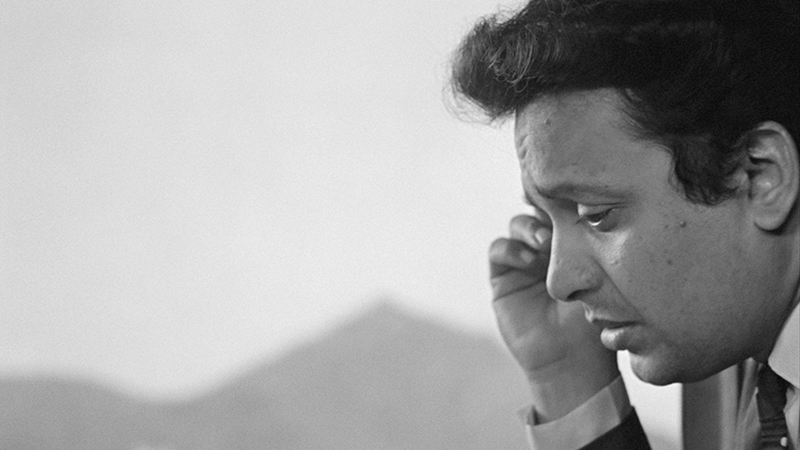
In 2024, 44 years after his death, Uttam Kumar returned to the silver screen as a ghost in director Srijit Mukherji’s light-hearted fantasy film Oti Uttam. Using visual effects and clips from his existing films, the legendary actor was brought back as a black-and-white spirit of himself, guiding a young man through a difficult phase in his love life.
The film was an unusual experiment, but it failed to impress critics, leaving many largely indifferent. Yet it became an unexpected box-office success, demonstrating that Uttam’s magic still has the power to enchant audiences, even more than four decades after the magician himself was gone.
Few artistes in the history of Indian cinema have cast as long a shadow, in both life and death, as Uttam Kumar. He was one of those rare matinee idols who transcended box-office success during his lifetime to become an integral part of Bengali culture and identity. He never grew old—he was only 53 when he died on July 24, 1980—and has consequently remained “forever young” in the collective Bengali consciousness, even as he turns 100 on September 3.
The One-Man Industry
In Tollygunge, south Kolkata—the heart of Bengali cinema, where generations of film studios have operated—there stands a statue of only one actor: Uttam Kumar.
The Bengali film industry has produced an extraordinary list of legends, including Satyajit Ray, Mrinal Sen, Ritwik Ghatak, Tapan Sinha, Buddhadeb Dasgupta, Soumitra Chatterjee, Suchitra Sen and Sabitri Chatterjee. Yet it is Uttam’s name that remains almost synonymous with Bengali cinema.
He was a one-man hit machine who kept the industry thriving from the 1950s until his death. Even after his passing, when Bengali cinema entered a prolonged period of creative and financial decline, Uttam’s name and legacy remained a source of strength for an industry struggling to survive.
It would hardly be an exaggeration to say that, even today, the name Uttam Kumar is synonymous with Bengali cinema.
There is a memorable scene in Satyajit Ray’s Nayak (1966), in which the protagonist Arindam Mukherjee, a top film star played by Uttam, asks his manager, portrayed by Nirmal Ghosh, why his latest film is not doing well at the box office.
“I’m in it. Isn’t that enough?” Arindam asks.
For nearly three decades, that was almost all that was needed to guarantee a hit: the name Uttam Kumar. And when Uttam was paired with Suchitra Sen, it became an even stronger formula. “Uttam-Suchitra” was virtually a guarantee of box-office success.
His presence could turn mediocrity into commercial success, rendering the criticism of serious reviewers almost irrelevant. Even weak films were often elevated by his talent and screen presence. Nayika Sangbad (1967), Kalankita Nayak (1970), Jiban Jigyasha (1971), Jay Jayanti (1971) and Ananda Mela (1976) are among the examples.
But success did not come overnight.
Uttam’s first eight films, released between 1948 and 1952, were miserable failures. He persisted nonetheless, quietly enduring the taunts hurled at him in the studios, including “flop master general” and “the new Durgadas”. Durgadas Banerjee was one of Bengali cinema’s leading stars, having successfully transitioned from the silent era to talkies.
Unlike the aristocratic Durgadas, Uttam—then known as Arun Kumar Chattopadhyay—came from a middle-class family and had no influential connections in the industry.
What he possessed was an unyielding determination to succeed.
In 1951, he abandoned the staid-sounding “Arun Kumar” and adopted the more dynamic and glamorous name “Uttam Kumar”. But it was not until Nirmal Dey’s Basu Paribar (1952) that he finally scored his first hit.
The film, co-starring Sabitri Chatterjee and Supriya Choudhury—two legendary actresses who would have a profound influence on his life and career—catapulted the 25-year-old Uttam to stardom.
Basu Paribar was followed by another major hit, Sharey Chuattor (1953), again directed by Nirmal Dey. The film marked the first romantic pairing of Uttam and Suchitra Sen and launched arguably the most iconic screen partnership in Bengali cinema.
Over the next 22 years, they appeared together in 30 films, including classics such as Agnipariksha (1954), Shap Mochan (1955), Sagarika (1956), Harano Sur (1957), Pathey Holo Deri (1957), Indrani (1958), Saptapadi (1961) and Bipasha (1962).
Together, they became two of the biggest stars in Bengali cinema—and, at the box office, virtually a single identity: “Uttam-Suchitra” or “Suchitra-Uttam”.
Uttam himself once acknowledged Suchitra’s importance, saying, “Had Suchitra not been by my side, I would not have become Uttam.”
The Making of a Star
During the golden age of Bengali cinema, Uttam became the benchmark against which romantic heroes and stars, past and future, would be judged.
Yet he did not conform to the conventional image of a leading man. He was not classically handsome like some of his contemporaries, including Soumitra Chatterjee, Biswajit Chatterjee and Subhendu Chatterjee. Nor did he possess the rugged appeal of actors such as Anil Chatterjee, Basanta Choudhuri or Samit Bhanja.
Uttam was tall, but had a snub nose, thick lips and an unremarkable physique.
What he possessed in abundance was that elusive quality known as star appeal or screen presence.
It is often said that a person either has that quality or does not. Uttam, however, was something of an exception. His early failures suggest that his screen presence was not simply an innate gift, but something he developed through discipline, skill and dedication.
The carefully casual pompadour, the cigarette dangling elegantly from his lips, the pout, the frown, the slow half-turn of his head and, above all, the sudden dazzling smile have lost none of their appeal over the decades.
Uttam understood the mystique of stardom better than almost anyone.
Unlike Soumitra, who participated in political rallies and marched alongside protesters, Uttam carefully protected his star image, preserving the sense of otherworldliness associated with the silver screen even in his personal life.
However much the public adored him, they were never allowed to come too close to the man behind the star. Uttam understood that the less audiences knew about the person, the easier it was for the magic of the screen to endure.
But he did not depend on stardom alone.
He was a consummate craftsman and was rarely satisfied with his own work. In many ways, he demanded the impossible of himself and worked relentlessly to achieve it.
He was meticulous in his preparation, studying the dynamics of a scene thoroughly before appearing on set.
The story goes that one evening, while attending his usual adda, singing songs and enjoying a drink or two, Uttam suddenly announced that he had to leave. His friends were surprised—it was unusually early for him to depart.
He explained that he had a scene with Sabitri Chatterjee the following morning and needed to go home and prepare. Otherwise, he feared, she would simply walk away with the scene.
Sabitri’s Influence
Sabitri Chatterjee remains one of the most formidable actors of Indian cinema, a towering figure from the golden age of Bengali films between the 1950s and 1970s. She had a profound influence on Uttam’s craft.
Even some of the biggest stars of the era admitted to being intimidated by her talent.
Soumitra Chatterjee once said that among all his co-stars, he had to be at his absolute best when working with Sabitri.
“She was so powerful, she could leave you dumbstruck in the middle of a scene,” he said.
Uttam and Sabitri appeared together in more than 30 films—as many as Uttam and Suchitra. To Uttam’s credit, he always held his own against her formidable talent.
If his partnership with Suchitra cemented his stardom, his work with Sabitri deepened and expanded the artiste within him.
“Sabitri offered him the choice of compelling audiences to accept alternative patterns and relationships. It gave Uttam the opportunity to move in several interesting directions, test his creative personality with a variety of images and demonstrate skills that were lost in the seductive superficialities of the earlier films,” wrote Swapan Mullick in his book Mahanayak Revisited: The World of Uttam Kumar.
Expanding Horizons
The easiest path for Uttam would have been to follow the box-office formula, producing romantic dramas and comedies for the rest of his career.
But his talent was too versatile to be confined to a single image.
At a time when screen heroes were often presented as larger-than-life figures and any hint of imperfection was considered potentially damaging to a career, Uttam—the biggest star of them all—was unafraid to portray darker and flawed characters.
At the height of his fame, following two massive successes as a romantic hero, Saptapadi (1961) and Bipasha (1962), he played a murderer in the crime thriller Sesh Anka (1963).
The film was both a critical and commercial success, allowing audiences to see a darker dimension of Uttam’s acting.
A decade later, after a string of hits including Shakti Samanta’s Amanush (1974), in which he played a disgraced but honourable drunk; the romantic comedy Mouchak (1975); the acclaimed Agnishwar (1975); and Sanyasi Raja (1975), Uttam delivered perhaps his most unsettling performance in Bagh Bondi Khela (1975).
He played Bhabesh Banerjee, a suave and silver-tongued businessman who claims to have left his criminal past behind and wants to reconnect with his son and atone for his past.
But in flashbacks, audiences see another Bhabesh: a brutal and unrepentant man who mistreats his wife and shamelessly gives in to his baser instincts.
It was a remarkable performance in a largely forgettable film.
Uttam had reportedly been warned against taking the role because of concerns that his fans might not accept him as an outright villain.
He was also among the few actors who, at the height of his career, chose to take supporting roles for artistic reasons, including in the 1960 films Maya Mrigaya and Khoka Babur Pratyabartan.
Uttam Meets Ray
It was perhaps inevitable that the greatest actor of the Bengali screen would eventually work with Bengal’s greatest filmmaker.
Satyajit Ray may not have followed many of Uttam’s biggest commercial successes, but he had seen enough of his work to cast him in the lead role of a film that appeared to reflect aspects of the star’s own life.
Before making Nayak, Ray had worked with Soumitra Chatterjee on six films over six years. By then, Soumitra had emerged as perhaps the only actor who could credibly be considered Uttam’s rival.
Yet when Frontline once asked Soumitra whether he had resented Uttam being chosen for such an iconic role, his answer was unequivocal: “Never. Nayak’s role was made for Uttam Kumar alone.”
Ray later explained his choice in writing:
“It was a part I thought he [Uttam] would find easy to identify with, being that of an ordinary middle-class youth who gets a break in films and quickly rises to the top.”
In many ways, Nayak was a rags-to-riches story with echoes of Uttam Kumar’s own extraordinary journey—from a middle-class boy with no industry connections and a string of early failures to the undisputed “Mahanayak” of Bengali cinema.
A century after his birth, and 46 years after his death, Uttam Kumar remains not merely a star of the past, but a living cultural phenomenon.
The magician may be gone. The magic remains.