Play store

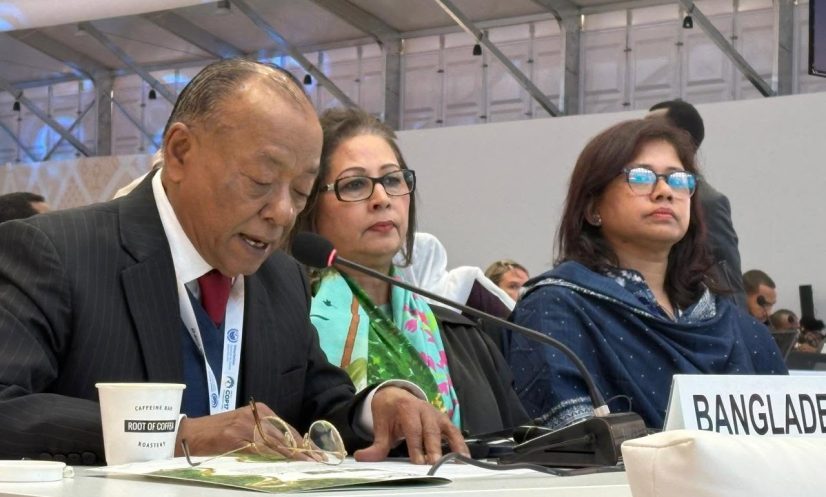
Environment, Forest and Climate Change Minister Abdul Awal Mintoo has called for greater investment in land protection, saying climate resilience and food security cannot be achieved without addressing land degradation.
“Land must be treated as an economic and development priority rather than an environmental expense,” he said while delivering Bangladesh’s statement at a ministerial dialogue on “Innovative Financial Mechanisms for Healthy Land and Drought Resilience” during Finance Day at the 17th Conference of the Parties to the United Nations Convention to Combat Desertification (UNCCD COP17) in Ulaanbaatar, Mongolia.
Mintoo said Bangladesh was taking steps to reduce land degradation by prioritising soil fertility, expanding forest coverage and addressing waterlogging, hillside erosion, coastal salinity and riverbank erosion in national planning.
He said Bangladesh was also transforming agriculture into a technology-driven and climate-resilient sector while expanding access to credit and agricultural loans for farmers.
The minister urged multilateral development banks and development finance institutions to use guarantees, first-loss capital and blended finance to improve access to financing for smallholder farmers and land restoration initiatives.
Highlighting Bangladesh’s domestic financing efforts, Mintoo said the country had been financing climate and land resilience through the Climate Change Trust Fund since 2009.
The fund, one of the earliest mechanisms of its kind among developing countries, has mobilised more than $495 million so far, he said.
The financing has supported the development of 12 new stress-tolerant crop varieties and the distribution of more than 19,400 tonnes of drought- and salinity-tolerant seeds among farmers.
However, he noted that demand for such support now exceeds the fund’s annual allocation.
Mintoo stressed that international financing should complement domestic initiatives by filling existing funding gaps rather than replacing national resources.
He proposed innovative financing mechanisms, including debt-for-nature and debt-for-climate swaps and green bonds, to mobilise resources for land restoration.
Such financing could support managed groundwater recharge in northern Bangladesh, agriculture, afforestation, climate-smart farming and coastal mangrove restoration under the National Green Mission, which aims to plant 250 million saplings, he said.
Highlighting the importance of regional cooperation, Mintoo said changes in upstream water flows were increasing salinity and drought risks in delta countries such as Bangladesh.
He called for stronger transboundary water-sharing arrangements among countries sharing river basins, along with joint initiatives to exchange information on water scarcity and land degradation.
“Bangladesh stands ready both to give and receive cooperation. We seek commitments that are specific, adequately financed, and time-bound, so that land finance moves from the margins to the centre of decision-making,” he said.
Mongolian President Khurelsukh Ukhnaa inaugurated the high-level segment of UNCCD COP17.
Mongolia’s Foreign Minister and COP17 President Battsetseg Batmunkh, United Nations Deputy Secretary-General Amina J. Mohammed, UNCCD Executive Secretary Yasmine Fouad, and ministers and heads of delegations from various countries attended the event.