


 Play store

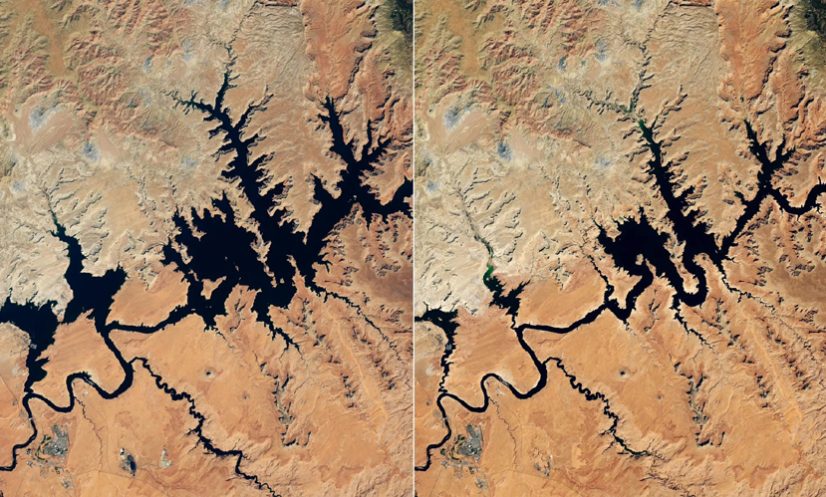
A snow drought and unusually warm conditions across the Colorado River Basin sharply reduced water flows into major reservoirs in the US West in 2026, pushing Lake Powell to a record-low level.
The weak mountain snowpack in the Upper Colorado Basin during the 2025-26 winter produced far less snowmelt than usual. By summer, reduced runoff had significantly cut inflows to Lake Powell, the second-largest reservoir in the United States.
Satellite images captured by the NASA-USGS Landsat 8 satellite showed the dramatic decline. On September 10, Lake Powell’s water surface stood at 3,517.24 feet, below its previous record low of 3,519.92 feet set on April 13, 2023. Water levels continued to fall into early September.
The reservoir looked markedly fuller in a Landsat image taken on September 1, 2017, when Lake Powell was near one of its highest levels of the past decade.
Lake Mead, downstream from Lake Powell, also reached a record-low level in August.
The Colorado River system is a critical source of water and electricity for the US Southwest. More than 40 million people depend on the river, including residents of Las Vegas, Phoenix, Los Angeles and San Diego. It also supplies water to about 5 million acres of farmland.
Mountain snow is particularly important to the Colorado River because much of the basin is arid or semi-arid. A substantial portion of the river’s annual flow originates as high-elevation snow that melts during spring and early summer.
The Upper Colorado Basin received unusually little snow during the 2025-26 winter, while periods of record warmth further reduced the snowpack. The resulting weak spring runoff provided little relief to already depleted reservoirs.
The US Bureau of Reclamation (USBR) began taking measures in April to stabilize Lake Powell and prevent it from falling below the elevation needed for hydropower generation.
The agency increased releases from Flaming Gorge Reservoir in Utah and Wyoming to help support Lake Powell while reducing releases from Lake Powell into Lake Mead.
USBR also canceled a planned April controlled flood intended to rebuild sandbars that provide habitat for fish. In August, officials also skipped a planned “cool mix” release designed to protect native species.
The record-low reservoir levels come amid a prolonged drought across the US Southwest that has persisted since around the beginning of the 21st century. Scientists have described the extended dry period as a megadrought, placing continued pressure on the region’s limited water supplies.
NASA-supported monitoring systems are helping water managers track changing drought conditions across the Colorado Basin. At the river’s headwaters, the Western Land Data Assimilation System provides information on soil moisture, snow water equivalent and evapotranspiration.
Near Lake Powell, the Drought Severity Evaluation Tool, developed with the Navajo Nation, tracks local drought indicators, precipitation and vegetation health, providing additional data for managing water resources across the region.