


 Play store

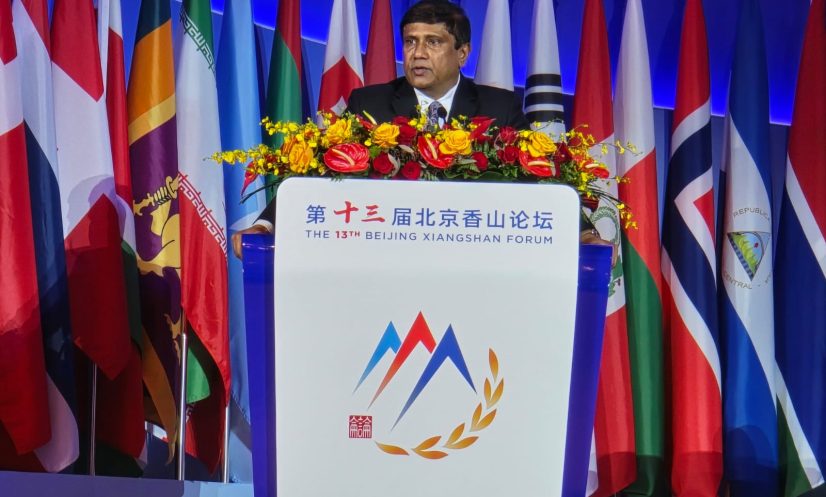
Prime Minister’s Defence Adviser Brigadier General (retd) Dr AKM Shamsul Islam has called for a stronger role for developing countries in shaping the global security architecture, stressing dialogue, resilience and South-South cooperation.
He made the remarks while speaking at the fourth plenary session of the 13th Beijing Xiangshan Forum in Beijing, China, on the theme “The Role and Vision of Developing Countries”.
The forum was held from September 15 to 17 at the Beijing International Convention Centre under the theme “Build Consensus on Stability, Advance Security Governance Together”. It brought together defence and military leaders, representatives of international organisations and security experts from around the world.
In his speech, Shamsul Islam said the global security environment was changing rapidly due to armed conflicts, geopolitical rivalry, technological changes, economic uncertainty and climate-related pressures.
He stressed the need to ensure the security and prosperity of developing countries and their effective participation in international decision-making.
Referring to Bangladesh’s domestic priorities, the defence adviser said the country, under the leadership of Prime Minister Tarique Rahman, was focusing on strengthening democratic values, economic recovery, institutional reforms, investment, job creation and human resource development.
He said Bangladesh’s five-year strategic framework places emphasis on inclusive growth, balanced regional development, stronger infrastructure, social protection, energy security and an investment-friendly environment.
On Bangladesh’s foreign policy, Shamsul Islam said the country’s “Bangladesh First” approach prioritises sovereignty, national interests, national security and public welfare. At the same time, he said Bangladesh adheres to the principle of “friendship to all, malice towards none”.
He emphasised the importance of maintaining strategic autonomy and building balanced partnerships based on mutual respect and shared interests.
On the Chittagong Hill Tracts, the defence adviser said the 1997 Peace Accord had created a framework for political reconciliation, development and confidence-building after a prolonged period of conflict.
However, he said unresolved issues, armed and criminal activities, mutual distrust and instability in border areas continued to pose challenges to sustainable peace and development.
In this context, he reaffirmed Bangladesh’s commitment to dialogue, inclusive governance, locally responsive development, the rule of law and regional cooperation based on respect for sovereignty and non-interference in internal affairs.
Speaking about Bangladesh-China relations, Shamsul Islam said Prime Minister Tarique Rahman’s visit to China in June had given fresh momentum to the two countries’ Comprehensive Strategic Cooperative Partnership.
He highlighted China’s contributions to Bangladesh in infrastructure, connectivity, industrialisation, energy, trade, science and technology, green development, disaster management, education, technical training and human resource development.
He also stressed the importance of market expansion, responsible investment, technology transfer, industrial and supply-chain cooperation, and skills development to strengthen the capabilities of developing countries.
The defence adviser said developing countries should not merely remain followers of global security decisions but should have both the right and responsibility to help shape the international security system.
He called for greater dialogue and peaceful settlement of disputes, stronger national resilience and enhanced South-South cooperation.
He identified strong institutions, diversified economies, food and energy security, cyber resilience, disaster preparedness and skilled populations as important foundations of strategic autonomy.
Representing Bangladesh, he outlined three priorities for the future international system: strengthening preventive diplomacy, early warning and regional crisis management; building collective resilience through cyber cooperation, responsible use of emerging technologies, combating transnational crime, climate adaptation, disaster preparedness and protection of critical infrastructure and supply chains; and strengthening accountable institutions, livelihoods, education, infrastructure and local trust alongside security measures in conflict-prone and vulnerable areas.
Following his speech, an open question-and-answer session was held, during which international delegates and experts raised a range of issues. The Bangladesh defence adviser responded to their questions.
The Beijing Xiangshan Forum, which marked its 20th anniversary this year, has evolved into a major international dialogue platform on security and defence. The 2026 edition featured four plenary sessions and eight parallel sessions covering international order, regional security, maritime security, emerging military technologies and other global security issues.