


 Play store

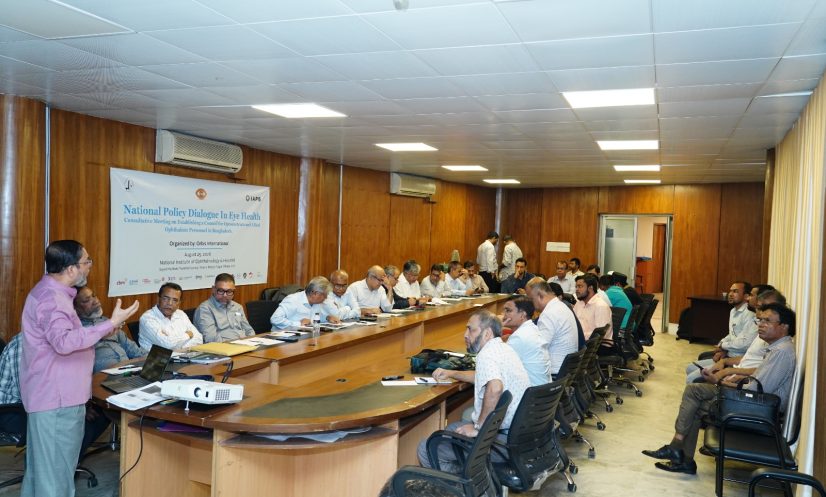
Stakeholders in eye health have reached a consensus on the need for an optometry council to expand eye care across the country and bring the service of ophthalmic personnel under regulation.
The consensus was reached at a national dialogue in eye health held at National Institute of Ophthalmology & Hospital in the capital on Tuesday.
Participants at the dialogue suggested mainstreaming optometrists and other ophthalmic personnel but at the same time they emphasised setting boundaries for them regarding their work scope, particularly prescribing medicines.
“There should be a body to determine which will be the prerequisites for entry into optometry education, if optometrists will prescribe medicines or if they will practice independently or work under an ophthalmologist,” said National Institute of Ophthalmology and Hospital (NIO&H) Director (In charge) Prof Dr ASMM Quadir.
Echoing his view, Ophthalmological Society of Bangladesh (OSB) Secretary General Prof Md Zinnu Rain said there should be a limitation put on optometrists regarding prescribing medicine.
“An optometrist is never allowed to prescribe antibiotics or steroids,” he said.
OSB President Dr Md Tauhidur Rahman suggested bringing uniformity in courses for ophthalmic personnel at different levels and setting boundaries for them.
“We have to move ahead bringing all the components of eye care together. And the government has a big role here,” he said.
OSB Treasurer Dr Syeed Mehbub Ul Kadir said the government should take initiative to mainstream optometrists as they still have no place in government health facilities though these professionals in India play an important role in eye care service delivery.
He, however, suggested developing a mechanism to ensure that optometrists remain within their stipulated work scope.
Orbis International organised the event titled “National Policy Dialogue in Eye Health: Consultative Meeting on Establishing a Council for Optometrists and Allied Ophthalmic Personnel in Bangladesh”.
Dr Munir Ahmed, Country Director of Orbis Bangladesh and Honorary Country Chair of the International Agency for the Prevention of Blindness (IAPB) for Bangladesh, conducted the dialogue.
Focusing on the need for mainstreaming ophthalmic personnel, he said Bangladesh lags far behind in delivering eye care services with the lack of manpower in the field being one of the major reasons.
Dr Munir said without necessary manpower Bangladesh will find it hard to achieve the World Health Organization SPECS 2030, launched in the country recently.
WHO SPECS 2030 is a global health initiative to increase effective refractive error coverage by 40 percentage points by 2030.
Dr K Zaman BNSB Eye Hospital Executive Director Sharifuzzman Parag said around 20 percent of the population in Bangladesh now seek eye care but the facilities and manpower are insufficient to cater to them.
CSF Global Senior Program Manager Johurul Islam Jewel said recognising optometrists is a must for expanding eye care services. He suggested formation of an optometry council under the Ministry of Health and Family Welfare.
OSB Vice-President Prof Md Sayedul Hoque, Rajshahi Medical University Registrar Prof Dr Md Shah Alam, Bangladesh Optometric Society President Md Didarul Islam, University of South Asia’s School of Public Health & Life Sciences Dean Dr Anisur Rahman, Chittagong Eye Infirmary & Training Complex (CEITC) Medical Director Dr Rajib Husain, Deep Eye Care Foundation Executive Director Dr Khairul Islam, Bangladesh Jatiya Andha Kalyan Samity (BJAKS) Cumilla General Secretary Dr AKM Abdus Salim, among others spoke at the dialogue.