Play store

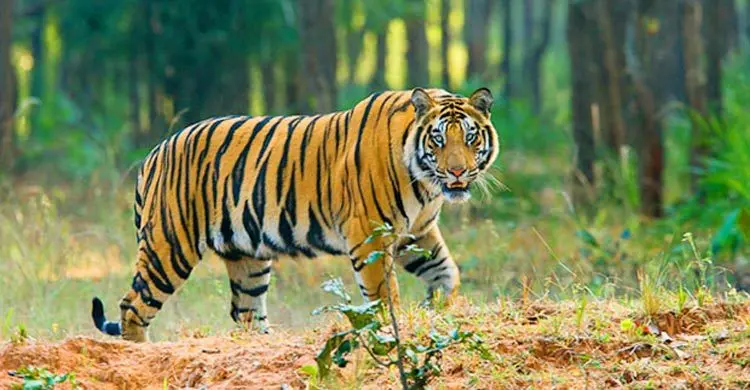
Bangladesh has recorded a welcome increase in the population of the endangered Royal Bengal Tiger in the Sundarbans, with the number of tigers rising by 11 over the past seven years, according to the latest surveys. The development, announced on World Tiger Day on Tuesday, has been hailed as a major conservation success while experts caution that significant challenges remain.
The Sundarbans, the world’s largest mangrove forest and a UNESCO World Heritage Site, serves as Bangladesh’s natural shield against cyclones and tidal surges. It is also the primary habitat of the country’s national animal, the Royal Bengal Tiger.
For years, tiger numbers had been declining due to climate change, habitat degradation, poaching and increasing human activities inside the forest. In response, the Forest Department, supported by government agencies and conservation partners, introduced a series of measures aimed at protecting the species and improving its breeding environment.
Recent surveys conducted independently have confirmed that these efforts are yielding positive results, with the tiger population increasing by 11 compared with seven years ago.
Despite the encouraging trend, conservationists warned that the recovery remains fragile.
Professor Dr. Abdullah Harun Chowdhury of the Environmental Science Discipline at Khulna University said excessive human movement inside wildlife habitats could seriously disrupt tiger breeding.
“If people continue to move freely through tiger habitats, it can create significant obstacles to their reproduction,” he said.
Noor Alam Sheikh, convener of the conservation platform Amra Sundarban Rokkhay (We for Sundarbans Protection), stressed that long-term success would depend on ensuring secure habitats, sufficient prey and an undisturbed breeding environment.
“To further increase the tiger population, it is essential to guarantee safe habitats, adequate food sources and uninterrupted breeding conditions,” he said.
Forest officials attributed the increase in tiger numbers to strengthened conservation initiatives and stricter biodiversity protection measures.
Md. Rezaul Karim Chowdhury, Divisional Forest Officer (DFO) of the East Sundarbans Division in Bagerhat, said the implementation of effective conservation programmes had created a comparatively safer environment for tigers.
“The tiger population has increased as a result of various effective conservation measures, and the Sundarbans is now relatively safer for the species,” he said.
The government has also launched new initiatives to reduce human-tiger conflict. According to State Minister for Environment, Forest and Climate Change Dr. Sheikh Faridul Islam, authorities are constructing a special eco-friendly rope barrier along a 74-kilometre stretch of the forest boundary to prevent tigers from straying into nearby villages.
The barrier is expected to help minimise encounters between humans and tigers while enhancing the safety of both local communities and wildlife.
Wildlife experts noted that sightings of Royal Bengal Tigers in the Sundarbans have become more frequent in recent years, reflecting the improving health of the ecosystem.
However, they emphasised that sustaining the positive trend will require continued vigilance, stronger habitat protection, effective anti-poaching measures and active participation from local communities living around the forest.
As Bangladesh marks World Tiger Day, the increase in the Sundarbans tiger population is being celebrated as a significant conservation milestone, offering renewed optimism for the future of one of the world’s most iconic and endangered big cats.