


 Play store

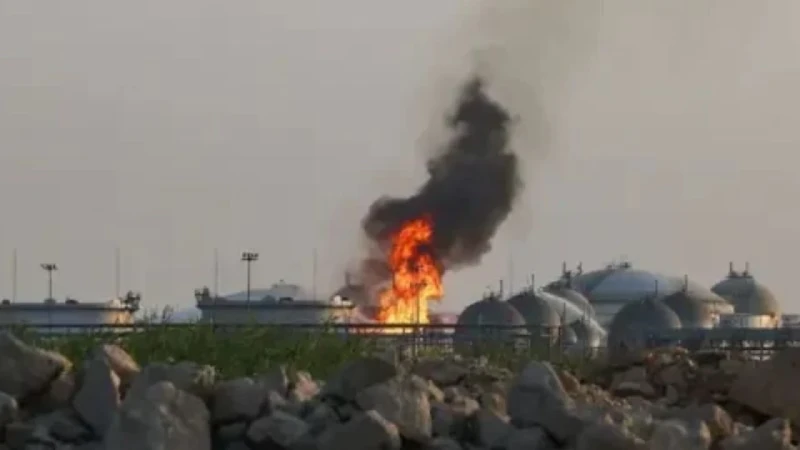
Yemen’s internationally recognised government has announced the launch of a broad military offensive aimed at retaking all territory controlled by the Houthi movement, amid a renewed escalation in fighting and cross-border attacks involving Saudi Arabia.
President Rashad al-Alimi said in a televised address on Sunday that the government would begin military operations to reclaim the country’s remaining territory and restore state authority across Yemen.
“Today, I announce the launch of military operations to reclaim the remaining territory of the republic and establish the authority of the state and its institutions across the national territory,” al-Alimi said.
The announcement followed a series of reported attacks between the Iran-backed Houthis and the Saudi-led coalition in recent days.
The Houthis claimed they had launched ballistic missiles and drone strikes against facilities belonging to Saudi oil giant Aramco in Riyadh and the oil-rich Khurais area of eastern Saudi Arabia.
Houthi military spokesman Yahya Saree said the attacks were carried out in response to about 50 coalition strikes on Houthi-controlled areas over a 12-hour period.
The claims have not been independently verified, and Saudi authorities have not publicly confirmed the reported attacks.
Meanwhile, the Houthi-controlled Al-Masirah television reported further Saudi-led coalition strikes against Houthi positions, saying at least two people were injured in Sunday’s attacks.
The Yemeni government had also reported strikes on Houthi positions in Sanaa, Saada and areas near Taiz.
Houthis advance around Taiz
Taiz has emerged as one of the key flashpoints in Yemen’s renewed conflict. Although the city remains under the control of the internationally recognised government, the Houthis reportedly severed a major supply route linking Taiz with the government’s interim capital, Aden.
Three Yemeni military officials told AFP that the Houthis had seized control of the area and the supply route, effectively isolating Taiz.
Farea Al-Muslimi, a researcher at Chatham House, told AFP that cutting Taiz off from Aden had been a key Houthi military objective and that the group had achieved it, although it had not yet taken full control of the city.
The Houthis have controlled Yemen’s capital, Sanaa, for more than a decade. Government and coalition forces have continued operations aimed at weakening Houthi military capabilities in Sanaa and Saada, while security sources say the group has nevertheless continued making gains in several areas.
Yemen’s conflict began in 2014, when the Houthis seized Sanaa and subsequently expanded their control over large parts of northern Yemen. The following year, Saudi Arabia led a coalition that intervened militarily in support of the internationally recognised government.
After several years of relative calm, fighting has intensified again amid the wider regional conflict.
The Houthis’ reported expansion along Yemen’s Red Sea coast has raised concerns over regional maritime security and energy routes. The group’s growing territorial reach could also strengthen Iran’s strategic position in the region while increasing the likelihood of renewed direct military confrontation between the Houthis and Saudi Arabia.
Any sustained escalation would carry serious humanitarian risks. Yemen remains one of the world’s most fragile and crisis-affected countries, and renewed large-scale fighting could further threaten civilians, disrupt essential supplies and deepen the country’s longstanding humanitarian crisis.