


 Play store

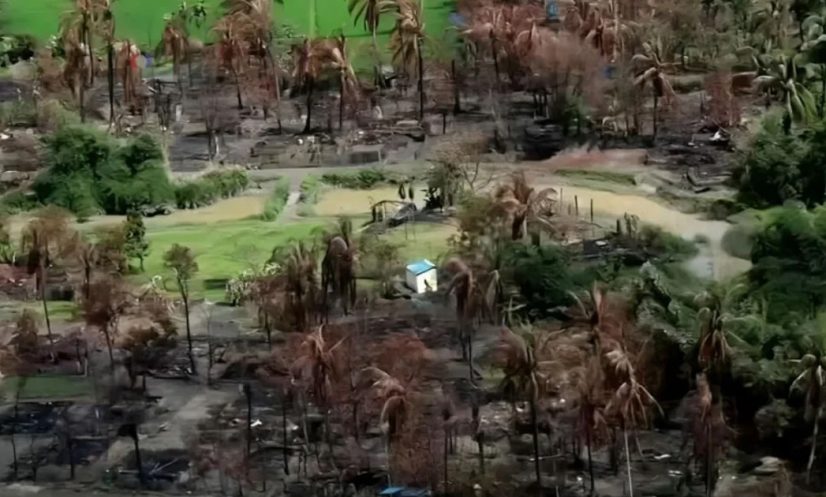
The Arakan Army (AA) has been accused of persecuting Rohingya, forcing them into labour and seizing their land in Myanmar’s Rakhine State, according to an investigation by The Guardian.
The investigation, based on satellite imagery, UN research and testimonies from Rohingya survivors, found that after taking control of northern Rakhine in 2024, the armed group destroyed Rohingya villages and built military barracks, detention camps and new settlements on their homes and farmland.
In the Hnget Thay area of Buthidaung Township near the Bangladesh border, satellite images showed around 120 grey structures on land where Rohingya families had cultivated rice until 2024. The structures are part of a detention camp reportedly run by the AA.
Displaced Rohingya families from surrounding areas have been confined to the camp and are reportedly not allowed to enter or leave without permission. The Guardian said its investigation identified at least 10 such camps established by the AA across northern Rakhine.
Rohingya survivors described similar experiences in other areas. Muhammad Ares, 18, who is now living in a refugee camp in Bangladesh, said heavy fighting broke out after the AA entered his area and many civilians were killed. He said their village was later burned down and displaced residents were forcibly taken to camps.
“They have turned our homeland into a network of forced-labour camps and military bases,” Ares was quoted as saying.
Rohingya farmers and boatmen from Wet Nyo Taung, along the Mayu River, also said they lost their homes, farmland and orchards when the area was burned in April 2024.
Mohammad Sadik, 26, said large trees and fruit orchards were cut down to clear the land, while old village structures were demolished and replaced with new buildings. Survivors said some residents were forced to dismantle their own homes and provide the timber and other materials for AA facilities.
One such facility was a military barracks known as the “AP Battalion”, where young Rohingya were allegedly forcibly recruited. Sadik said residents were also forced to clear roads, dig trenches and perform manual labour inside camps.
According to an internal UN report cited by The Guardian, at least 800 hectares of land belonging to 23 Rohingya villages have been seized since 2024 for camps, settlements for other communities or military infrastructure. The UN has also documented at least 29 cases involving the seizure of Rohingya land or their displacement during the same period.
More than 155,000 Rohingya have fled to Bangladesh since 2024, according to the report. Bangladesh now hosts more than 1.2 million Rohingya refugees, most of whom fled Myanmar during the military crackdown in 2017.
A UN expert on Myanmar, speaking to The Guardian on condition of anonymity, said a process was underway to eliminate the Rohingya presence in northern Rakhine. Despite the difficult conditions in the camps, the expert said Rohingya were unlikely to be allowed to return to their homes.
The Guardian’s investigation and UN reports also contain allegations of torture, sexual violence, arbitrary detention, forced labour, forced military recruitment and extortion by the AA. Similar allegations have previously been made against Myanmar’s military.
The AA has denied allegations of war crimes, saying it targets only members of Myanmar’s military and Rohingya armed groups.
Nicholas Koumjian, head of the Independent Investigative Mechanism for Myanmar, said attacks against Rohingya appeared to be aimed at creating “facts on the ground”. However, he said his investigation had not yet established that the AA was responsible for the destruction of Rohingya land.
Stanford University international law professor Tom Dannenbaum said the coordinated coercion and displacement of Rohingya could potentially amount to a war crime involving population transfer.
The International Court of Justice began hearings in January in the genocide case concerning the Rohingya. The court is expected to deliver its ruling this month on whether Myanmar committed genocide against the Rohingya in 2017.
Source: The Guardian