


 Play store


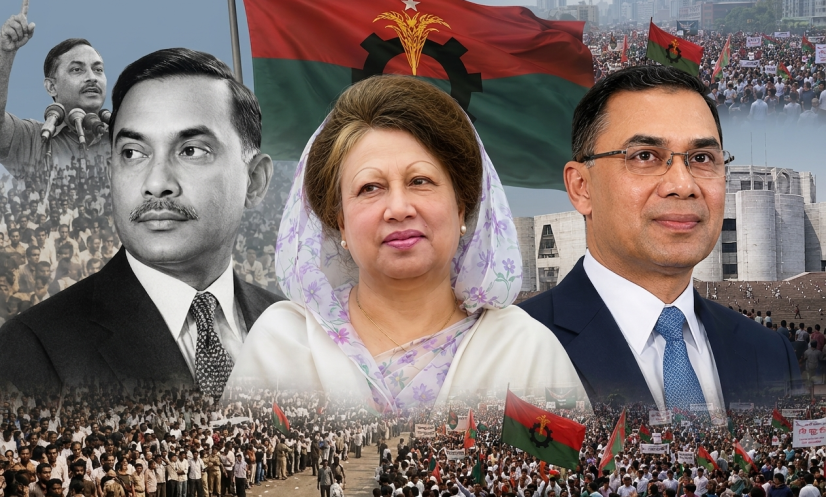
The swearing-in of Tarique Rahman as Prime Minister following the February 12, 2026 parliamentary election marks more than a change of government. It represents the latest chapter in the nearly five-decade journey of the Bangladesh Nationalist Party (BNP), a party whose history has been defined by periods in power, prolonged opposition, street movements and relentless struggles for establishing democracy and political rights.
Founded by President Ziaur Rahman on September 1, 1978, the BNP emerged during a period of political uncertainty. It quickly established itself as a major force, winning 207 of the 300 seats in the 1979 parliamentary election. Zia built the party around Bangladeshi nationalism, national sovereignty, economic self-reliance and a multi-party political framework.
Zia’s development approach placed particular emphasis on rural Bangladesh. His government promoted agricultural production, irrigation, canal excavation, rural infrastructure, press freedom and food self-sufficiency, seeking to make development less Dhaka-centric. His administration also promoted tree plantation and environmental initiatives, creating an early link between rural development and environmental protection.
Zia’s political legacy remains contested. Supporters credit him with restoring political pluralism and reopening space for political activity and the press after the one-party BAKSAL period. His assassination in 1981 abruptly changed the BNP’s trajectory.
The party’s next defining chapter was written in opposition. After General Hussain Muhammad Ershad seized power in 1982, Khaleda Zia emerged as the BNP’s principal leader and became one of the leading figures of the anti-autocracy movement. Alongside other opposition forces, the BNP rejected elections under Ershad and mobilised against military rule. The movement culminated in December 1990 with Ershad’s resignation and the transfer of power to a neutral interim administration.
Khaleda Zia then led the BNP to victory in the 1991 election and became Bangladesh’s first woman prime minister. One of her most consequential achievements was the restoration of the parliamentary system through the 12th constitutional amendment. Her government also introduced free and compulsory primary education, free education for girls up to secondary level and stipends for female students. These measures helped accelerate female enrolment and contributed to wider social change.
Her governments also left an environmental imprint. The BNP credits the 1995 Bangladesh Environment Conservation Act and the establishment of environmental courts to Khaleda’s administration. Her government also promoted social forestry and tree-planting programmes.
The BNP’s record, however, was far from unblemished. Political confrontation intensified during Khaleda’s first term and culminated in the 1996 electoral crisis. The caretaker-government system was subsequently introduced as a mechanism for ensuring credible elections. The BNP returned to power in 2001, but its second term was marred by allegations of corruption, political violence and the rise of militancy, including the nationwide bomb blasts of 2005.
After its defeat in the 2008 election, the BNP entered its longest period in opposition. The party increasingly relied on rallies, hartals, blockades and alliances to challenge the Awami League government. It boycotted the 2014 election and contested the 2018 election amid allegations of intimidation and irregularities. Khaleda Zia was jailed in 2018 in corruption cases that the BNP described as politically motivated, while Tarique Rahman remained abroad and gradually became the party’s principal strategist.
During those years, the BNP’s political demands increasingly centred on voting rights, freedom of expression, press freedom, judicial independence and restoration of democratic institutions. Whether the party always upheld those principles consistently while in power remains a subject of political debate. But its prolonged opposition helped make these issues central to its political narrative.
That narrative converged with the student-led July-August 2024 uprising. The movement began as a campaign for reform of public-sector job quotas, led principally by students, before expanding into a nationwide uprising demanding the resignation of former prime minister Sheikh Hasina. The BNP and its affiliated organisations joined the movement as it broadened, supporting the students’ programmes and calling for national unity. The UN human rights investigation also recorded the BNP’s call for political unity against the government on July 26.
The BNP’s contribution should nevertheless be viewed within the wider context of a mass uprising driven primarily by students and ordinary citizens. Its organisational network and participation strengthened the anti-government mobilisation, but the uprising was not the achievement of any single political party. The movement ultimately forced Hasina to resign and flee to India on August 5, 2024.
For Tarique Rahman, the uprising represented the culmination of years of opposition politics. As BNP chairman, he had become the central figure in the party’s campaign for democratic reforms, civil liberties and electoral rights. His return as Prime Minister now gives him the opportunity to translate those opposition demands into state policy.
The environment is another area where the BNP seeks to connect its past with its future. From Ziaur Rahman’s tree-planting and rural development initiatives and Khaleda Zia’s environmental legislation to Tarique Rahman’s pledge for large-scale afforestation, river restoration, renewable energy and climate-resilient agriculture, the party has sought to present environmental protection as part of its development philosophy. Its current plan includes planting 250 million trees over five years.
The deaths of Ziaur Rahman in 1981 and Khaleda Zia in December 2025 have left Tarique Rahman carrying a political inheritance built over generations. His challenge is not merely to preserve that legacy but to redefine it for a younger, more urban and technology-driven Bangladesh.
The BNP has now travelled from Zia’s early experiment in nation-building, through Khaleda’s democratic movement and governments, to Tarique’s return from prolonged political exile. After decades of alternating between power and opposition, its ultimate test is whether it can turn the politics of resistance into accountable, inclusive and sustainable governance.
The views expressed in this article are the author’s own and do not necessarily reflect Sarabangla English Edition’s editorial stance.