


 Play store

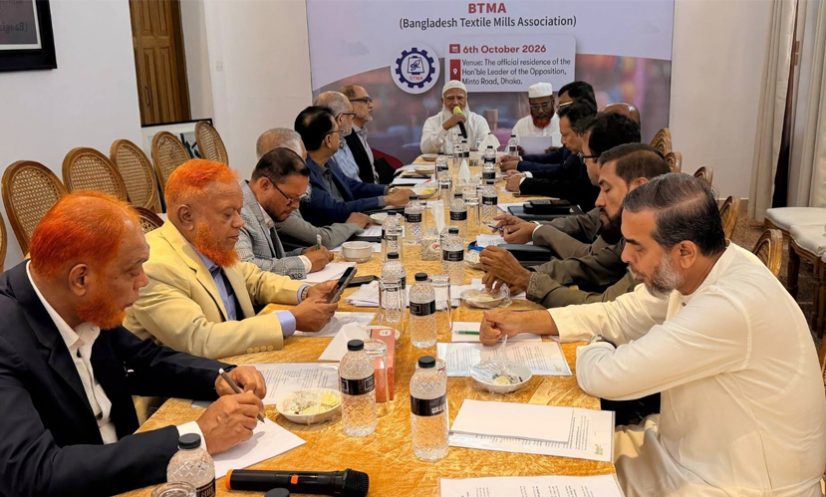
Bangladesh Jamaat-e-Islami Ameer and Leader of the Opposition Dr Shafiqur Rahman has assured leaders of the Bangladesh Textile Mills Association (BTMA) that the problems and challenges facing the textile sector will be raised in Parliament and discussed with the government as necessary.
He made the assurance during a meeting with a BTMA delegation at the official residence of the Leader of the Opposition on Minto Road in the capital on Tuesday.
The meeting discussed incentives for the textile sector, gas and electricity supplies, challenges following Bangladesh’s graduation from the least developed country (LDC) category, taxes and duties, and various policy-related complications.
Jamaat Secretary General and former lawmaker Mia Golam Parwar disclosed the details at a press briefing after the meeting.
Quoting Dr Shafiqur Rahman, Mia Golam Parwar said Jamaat did not consider opposing every government initiative to be its political role as the opposition.
“We want to play the role of a constructive opposition. We will support government initiatives that serve the public interest and the welfare of the country. If any decision goes against public interest, we will point out the government’s shortcomings, criticise them and, if necessary, organise protests and resistance,” he said.
Mia Golam Parwar said BTMA leaders had presented various problems and challenges facing the sector and that the Jamaat chief had listened to them attentively.
Dr Shafiqur Rahman highlighted the need to ensure raw materials for export-oriented industries, protect the capacity of the domestic primary textile industry, increase local value addition, safeguard employment, save and preserve foreign currency, protect government revenue, and prevent misuse of bond facilities and illegal imports.
The opposition leader said a balanced and coordinated policy approach could help strengthen Bangladesh’s primary textile industry sustainably while further consolidating the country’s export capacity and industrial base.
He said the issues raised by BTMA would be placed before Parliament in the interest of the important sector and discussed with the government where necessary.
Mia Golam Parwar said the industrial and manufacturing sectors were among the key drivers of Bangladesh’s economy and that the textile industry was closely linked to the readymade garment sector.
Therefore, he said, the government, opposition and relevant stakeholders needed to take coordinated steps to resolve the sector’s legitimate problems.
At the press briefing, BTMA Vice-President Shafiqul Islam Sarker said the textile sector currently involved investments of around US$32 billion and played a crucial role as the backward linkage industry for Bangladesh’s garment sector.
He said the association had been discussing the sector’s problems with the government for a long time.
“We have held several meetings with the prime minister and relevant government authorities, and some of the problems have already been resolved. Discussions on the remaining issues are continuing,” he said.
He said Tuesday’s meeting focused particularly on incentives, gas and electricity supplies, challenges following LDC graduation, increased taxes and various policy-related complications.
Shafiqul Islam Sarker said the gas and electricity supply situation had improved to some extent, but several factories were still facing difficulties.
He stressed the need for quick resolution of the problems.
He also said discussions were continuing with the government on issues related to the misuse of energy bonds and yarn, among other matters.
Mia Golam Parwar said Jamaat had listened to BTMA leaders’ concerns seriously and assured them that the issues would be raised in Parliament and discussed with the government in the interest of the people and the national economy.
Asked about reports that the longstanding practice of having the Leader of the Opposition as the chief guest at the closing ceremony of the textile and garment-related Batexpo fair would not be followed this year, Mia Golam Parwar said there had traditionally been a practice of having the prime minister as the chief guest at the opening ceremony and the Leader of the Opposition at the closing ceremony.
He said the practice was not merely a formality but also reflected democratic political culture and mutual respect among state institutions.
Noting that there appeared to be some deviation from the practice this year, he said Jamaat had drawn the attention of the relevant authorities to the matter.
However, he clarified that Dr Shafiqur Rahman had neither demanded nor requested to be made the chief guest at any event.
Mia Golam Parwar said no important sector of the economy should be confined within the narrow boundaries of partisan politics.
He stressed the need for coordination between businesspeople, industrial entrepreneurs and all sides of the state.
BTMA President and Amber Cotton Mills Managing Director Shawkat Aziz Russell, Vice-President and Purbani Yarn Dyeing Managing Director Shafiqul Islam Sarker, Director and Jalal Ahmed Spinning Mills Deputy Managing Director Md Shahid Alam, former Vice-President and Hossain Dyeing and Printing Mills Unit-2 Managing Director Hossain Mehmood, Director and Saiham Cotton Mills Managing Director Engineer Syed Ishtiaq Ahmed, former Director and Mosharraf Composite Textile Mills Managing Director Md Mosharraf Hossain, Secretary General Brig Gen (retd) Md Zakir Hossain, NDC, PSC, Joint Secretary General Muhammad Ziaur Rahman, Deputy Secretary General Ziaul Hasan Chowdhury and President’s PS Arif Raihan Robin attended the meeting on behalf of BTMA.
Jamaat Assistant Secretary General and Central Publicity and Media Department Secretary Advocate Ehsanul Mahbub Zubayer, Central Executive Council members Mobarak Hossain, Nurul Islam Bulbul, MP, and Md Selim Uddin, as well as Maisha Group Managing Director Mozammel Haque Bhuiyan, among others, attended the meeting on behalf of Jamaat.