


 Play store

Despite political tensions, administrative complexities and multiple challenges, the BNP-led government has moved forward with a series of initiatives aimed at fulfilling its election pledges during its first 180 days in office.
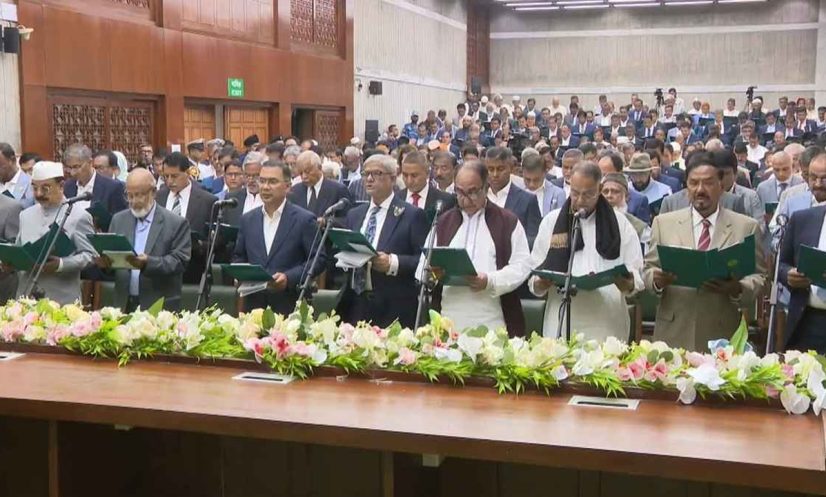
Six months ago, the BNP formed a single-party government after securing a landslide victory in the 13th parliamentary election.
The government took office at a time when rebuilding the economy, maintaining law and order and managing energy shortages were among its major challenges.
Government officials, however, say significant progress has been made across several public welfare sectors and that the overall balance of achievements is positive.
One of the government’s major achievements has been Prime Minister Tarique Rahman’s foreign engagements, particularly his visits to Malaysia and China.
The reopening of Malaysia’s labour market to Bangladeshi workers is also being highlighted as a significant diplomatic and economic achievement.
Mahdi Amin, spokesperson for the Prime Minister’s Office, said the government remains committed to building an inclusive, safe, humane and equitable Bangladesh in line with the prime minister’s vision.
Government ministers and senior BNP leaders describe the first 180 days as the beginning of a new phase of state reform.
Under Tarique Rahman’s leadership, they say, the government has focused on accountability, human values, sustainable development and institutional reform.
During its first six months, the government has taken initiatives in economic stabilisation, agricultural recovery, social protection, education, healthcare, investment, employment, institutional reform and strengthening Bangladesh’s international standing.
The prime minister’s Press Wing said a press conference on the government’s first six months in office would be held at the Prime Minister’s Office on Monday.
An e-book and a booklet detailing the government’s initiatives and achievements are also being prepared. A dedicated website is also expected to be launched to provide information on the government’s performance.
The BNP won 213 seats in the February 12 parliamentary election, while Jamaat-e-Islami secured 68 seats. The new cabinet was sworn in on February 17, with 50 members, including 24 state ministers and 16 new full ministers.
Economic and social initiatives
According to government sources, a five-year strategic plan has been prepared to create nearly one crore jobs between 2026 and 2031. The General Economics Division has proposed a target of 9.327 million new jobs at home and abroad.
Government food stocks have also reached more than 2.4 million tonnes, including around 1.96 million tonnes of rice and nearly 296,000 tonnes of wheat, strengthening the country’s food-security position.
The government has introduced a range of social protection and welfare programmes targeting farmers, women, students, athletes, migrant workers, elderly people and low-income households.
These include the Family Card, Farmer Card and Expatriate Card, as well as loan facilities for women entrepreneurs and young people.
The government has also announced agricultural loan waivers for small farmers, food assistance at Tk15 per kilogram, startup financing and other support measures.
In education and healthcare, initiatives include smart classrooms, curriculum reforms, free dengue testing and expanded healthcare services. Sports programmes such as the “Notun Kuri Sports” initiative have also been launched.
Infrastructure and green development
The government has announced plans to introduce electric buses in Dhaka, develop AI-based traffic management, automate cargo release at Chattogram Port and construct new inter-district bus terminals.
It has also announced a five-year programme to plant 250 million trees, expand rooftop solar power generation, develop modern cold-storage facilities for agricultural products and generate electricity from waste.
Foreign policy and diplomacy
The government says it is pursuing a “Bangladesh First” foreign policy based on equality, mutual interests and national sovereignty.
During Prime Minister Tarique Rahman’s June visit to Malaysia, the two countries discussed labour migration, investment, trade and the welfare of Bangladeshi migrant workers. Malaysia has decided to reopen its labour market to Bangladeshi workers from the final week of August.
During his June 24–26 visit to China, more than 20 agreements and memorandums of understanding were reportedly signed covering trade, infrastructure, strategic cooperation and people-to-people connectivity.
The government also considers Bangladesh’s selection of a candidate for president of the 81st session of the UN General Assembly a diplomatic achievement.
Parliamentary and institutional reforms
The 13th Parliament has passed 105 bills during its first 52 working days, according to government figures.
The government has also claimed progress in judicial reform, law enforcement and the arrest of long-absconding convicted criminals. Efforts are reportedly continuing to bring back fugitives through international cooperation.
At the same time, the government says it is working to make law-enforcement agencies more politically neutral, accountable and people-oriented.
Austerity in government
The government has also emphasised austerity and a reduction in official extravagance.
Photographs of political leaders have reportedly been removed from government event banners and backdrops. Special VIP chairs, excessive honorifics and personality-centric practices have also been discouraged.
The prime minister has reportedly been using his personal vehicle instead of a government car and bearing the costs of fuel, drivers and household staff himself. The number of vehicles in his convoy has also been reduced.
Government spending on dinners, official hospitality, foreign delegations and other non-essential areas has been cut, while greater emphasis has been placed on using domestic products and reducing administrative waste.
Prime Minister Tarique Rahman is also reportedly depositing 10 percent of his monthly basic salary into the state treasury. His monthly basic salary is Tk115,000, meaning he contributes Tk11,500 each month.
Challenges remain
The government acknowledges that significant challenges remain, particularly in the energy sector.
Mahdi Amin said a recent failure of an FSRU had created a serious fuel and gas supply crisis. He said the government was working to ease public suffering and restore stability.
According to him, Tarique Rahman has personally discussed securing gas supplies through Malaysia’s Petronas. Discussions are also continuing on domestic mineral exploration and increasing energy supplies.
He said 50 senior executives from 25 leading US companies recently visited Bangladesh to discuss investment opportunities, including in the power and gas sectors.
Government’s assessment
Mahdi Amin said the government had made visible progress in a relatively short period, including waiving loans of up to Tk10,000 for around 1.3 million marginal farmers, introducing social protection cards, supporting religious leaders, expanding employment opportunities and reforming education and healthcare.
He acknowledged that the government faced numerous challenges but said it had responded through multiple initiatives while remaining connected with the people.
“The government is committed to building an inclusive Bangladesh where every citizen enjoys equal opportunities,” he said.
Political observers, meanwhile, say six months is too short to fundamentally transform a country. However, they believe the government has made a promising start and that continued implementation of its reform agenda will be crucial.
Overall, the BNP government’s first 180 days have been marked by ambitious reforms, welfare initiatives, diplomatic engagements and efforts to reduce state expenditure.
While economic, energy and administrative challenges remain, the government maintains that its initial six months have laid the groundwork for a more accountable, inclusive and people-oriented state.