Play store

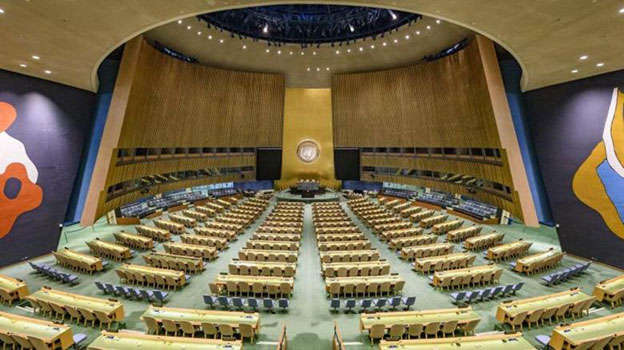
When more than 130 world leaders arrive in New York for the high-level segment of the UN General Assembly next week, it will be rare to hear hard-hitting, headline-grabbing political statements from the podium.
Speeches before the 193-member General Assembly, along with the UN press briefings that occasionally follow, are often long-winded and monotonous. There are, however, a few memorable exceptions.
When Libyan leader Muammar Gaddafi visited the United Nations in September 2009, The Guardian reported that he “grabbed his 15 minutes of fame at the UN building in New York and ran with it”. He ran with it so hard that he stretched it to an hour and 40 minutes—six times longer than his allotted speaking time—to the dismay of UN organisers.
Gaddafi fully lived up to his reputation for eccentricity, bloody-mindedness and extreme verbosity. He tore up a copy of the UN Charter in front of startled delegates, accused the Security Council of being an al-Qaeda-like terrorist body, called for former US President George W Bush and former British Prime Minister Tony Blair to be put on trial over the Iraq war, demanded $7.7 trillion in compensation for the ravages of colonialism in Africa, and wondered whether swine flu was a biological weapon created in a military laboratory.
Incidentally, according to one news report, there were 112 different spellings of the Libyan leader’s name in English and Arabic, including Muammar el-Qaddafi, Muammar Gaddafi, Muammar al-Gathafi, Muammar El Kadhafi, Moammar el Kazzafi, Moamer, El Qathafi, Mu’Ammar, Gadafi and Moamar Gaddafi, among others.
The Wall Street Journal even ran a cartoon poking fun at the multiple spellings. In the cartoon, a visiting reporter conducting a one-on-one interview in Tripoli tells the Libyan leader: “My editor sent me to find out whether you are Qaddafi, Khaddafi, Gadafi, Qathafi or Kadhafi?”
A memorable Soviet-US confrontation took place in the General Assembly Hall in October 1960, at the height of the Cold War. But this time, the confrontation was between the Soviet Union and the Philippines, then considered a close US ally.
Filipino delegate Lorenzo Sumulong lashed out at the Soviet Union, saying that the peoples of Eastern Europe and elsewhere under Soviet domination had been deprived of the free exercise of their civil and political rights and had, so to speak, been swallowed up by the Soviet Union.
Incensed by the remarks, Soviet leader Nikita Khrushchev, who was leading the Soviet delegation, hit back with a vengeance. He described Sumulong as “a jerk, a stooge, and a lackey” and a “toady of American imperialism”—words rarely heard in the General Assembly or Security Council these days.
Forget the North Korean refrain about “running dogs of imperialism”.
But an equally legendary story from that confrontation is the longstanding rumour that Khrushchev removed his shoe and repeatedly banged it on his desk in an attempt to be recognised on a point of order.
The only evidence was a single photograph that circulated widely and was dismissed by some as a fake concocted by US intelligence—long before the age of digital technology and Photoshop.
British Prime Minister Harold Macmillan, who was at the podium, reportedly responded to Khrushchev’s angry outbursts by jokingly telling the Speaker: “I should like that to be translated, if I may,” prompting loud laughter.
UN speeches are simultaneously translated into the organisation’s six official languages—Arabic, Chinese, English, French, Russian and Spanish—but never the banging of shoes.
In another bygone era, Ugandan leader Idi Amin caused a stir when he tried to praise British Prime Minister Edward Heath. He told the General Assembly that Heath was just like Adolf Hitler—before quickly correcting himself and insisting that he meant Winston Churchill.
Back in October 2006, Thailand’s civilian government was overthrown in a military coup while Prime Minister Thaksin Shinawatra was in New York to address the General Assembly.
Instead of returning home, where he was likely to face corruption charges, Thaksin flew to London, where he remained in virtual political exile.
The bloodless coup against the democratically elected government forced the United States to review its military relations with Thailand and suspend aid to one of Washington’s longstanding political allies in Southeast Asia.
The administration of US President George W Bush, which was seeking UN sanctions against the military government in neighbouring Myanmar, described the Thai coup as a “U-turn” for democracy in the politically stable region.
There was, perhaps, an unwritten lesson for visiting leaders: during General Assembly week, the safest strategy was to include all their military leaders—the chiefs of the army, navy and air force—in their UN delegations, ensuring that they remained within sight at the General Assembly Hall rather than staying back home and taking over the government.
During General Assembly sessions, the IPS office on the UN’s fourth floor was occasionally a meeting place for representatives of liberation movements accredited to the organisation, including the Palestine Liberation Organisation (PLO) and FRETILIN, the Revolutionary Front for an Independent East Timor.
One regular visitor was Jose Ramos-Horta, who served as foreign minister in the government-in-exile established by FRETILIN. He later became a recipient of the 1996 Nobel Peace Prize and president of East Timor from 2007 to 2012.
According to a widely circulated anecdote, Ramos-Horta was once having dinner at a restaurant in the UN neighbourhood frequented by delegates. As was customary, waiters politely asked guests which country they were from.
When asked, he proudly said he was from East Timor, a former Portuguese possession that remained under Indonesian control from 1975 to 1999.
“So, you are an Eskimo?” the waiter asked, displaying his geographical ignorance.
“No, no, no,” Ramos-Horta replied. “I am not an Eskimo. I am from a country called East Timor.”
After completing his first presidency in 2012, Ramos-Horta was appointed the UN Secretary-General’s Special Representative and Head of the United Nations Integrated Peacebuilding Office in Guinea-Bissau (UNIOGBIS) in January 2013.
When I met him outside the UN headquarters on First Avenue, I double-checked the anecdote with him. He confirmed that it had indeed happened.
A security officer once recalled another remarkable incident. A prime minister from an African country was addressing the General Assembly when a group of African students began heckling him.
As is customary with hecklers, the boisterous group was removed from the visitors’ gallery, questioned, photographed and banned from entering the UN premises.
About five years later, however, one of those hecklers returned to the United Nations—this time as the foreign minister of his country—and addressed the world body himself.
Besides Gaddafi, several military leaders have addressed the General Assembly, including Fidel Castro of Cuba, Amadou Toumani Toure of Mali, who seized power in a 1991 coup but later became a democratically elected president, and Jerry Rawlings of Ghana, who seized power in 1979 and ordered the execution of former heads of state before later becoming a civilian president through democratic elections.
PLO leader Yasser Arafat also made it to the UN. But some of the world’s most controversial leaders—including Iraq’s Saddam Hussein, Syria’s Hafez al-Assad and his son Bashar al-Assad, and North Korea’s Kim Il Sung and his grandson Kim Jong Un—never addressed the General Assembly.
When the charismatic Marxist revolutionary Ernesto Che Guevara, then second-in-command to Cuban leader Fidel Castro, came to the United Nations to address the General Assembly in 1964, the UN headquarters itself came under attack—literally.
Che Guevara’s speech was briefly drowned out by the sound of an explosion.
Anti-Castro forces in the United States, backed by the Central Intelligence Agency (CIA), had mounted a campaign to prevent him from speaking. A 3.5-inch bazooka was fired at the 39-storey Secretariat building from the direction of the East River while a vociferous anti-Castro, anti-Che Guevara demonstration was taking place outside the UN headquarters on First Avenue and 42nd Street.
The rocket launcher, apparently far less sophisticated than today’s shoulder-fired missiles and rocket-propelled grenades, missed its target, rattled the building’s windows and fell into the river about 200 yards from the building.
One newspaper described it as “one of the wildest episodes since the United Nations moved into its East River headquarters in 1952”.
Longtime UN staffers would later recall that the failed 1964 attack occurred as Che Guevara delivered a blistering criticism of US foreign policy and denounced a proposed nuclear de-armament pact for the Western Hemisphere.
It was among the first known politically motivated attacks against the United Nations.
After his speech, Che Guevara was asked about the attack. Chomping on his trademark Cuban cigar, he reportedly joked: “The explosion has given the whole thing more flavour.”
When a reporter told him that New York City police had arrested a woman described as an anti-Castro Cuban exile after she pulled out a hunting knife and jumped over the UN wall, apparently intending to kill him, Che Guevara replied: “It is better to be killed by a woman with a knife than by a man with a gun.”
For all the grand speeches, diplomatic manoeuvring and carefully scripted declarations that define the annual UN General Assembly, these stories offer a reminder that the world body has also witnessed moments of anger, absurdity, humour and even outright danger. And sometimes, those are the moments that remain longest in the memory. Source: IPS