Play store

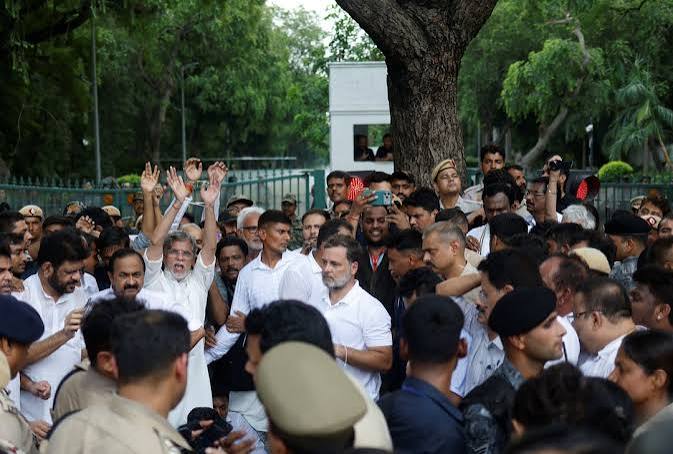
The Indian National Congress – the main opposition to the far-right Bharatiya Janata Party (BJP) of Prime Minister Narendra Modi – is seeking to convert a shifting global mood into domestic advantage.
Congress is trying to capitalise on the apparent subsiding of the far-right wave that recently forced out populist incumbents in Brazil, Hungary and Serbia, with Democrats gaining majorities in both chambers of the US legislature in the midterm elections.
The second Bharat Summit, to be held in Hyderabad on November 12-14, is the clearest signal of Congress’s evolving strategy to align with the rising global tide against majoritarian politics.
Convened by the Congress-ruled Telangana provincial government and timed to coincide with the 137th birth anniversary of Jawaharlal Nehru – India’s first prime minister, who laid the foundations of a constitutionally secular state – the high-profile huddle is billed as the “first major international gathering of progressive leaders” following those landmark electoral results.
Rahul Gandhi, a Congress member and leader of the opposition in the Indian parliament, is expected to use the platform to outline an “alternative vision” rooted in “principled multilateralism” and in the legacy of Non-Aligned and Afro-Asian solidarity, according to a pre-summit note released to the media.
The summit – to be attended by major political figures from the US, South America, Europe, and Asia – also aims to establish a one-of-a-kind Global South-Global North platform.
Analysts cite street-level discontent inside India as part of the evidence that the majoritarian nationalist wave of the past decade – for which Modi has been a poster boy – is finally receding.
Kenneth Bo Nielsen, a South Asia expert at the University of Oslo, tells TRT World that tens of thousands of students and young people in India have mobilised in successive waves since the summer, most recently in October and November.
The pattern of protests in India follows the pattern of demonstrations against populism elsewhere in the world.
Gen Z-led actions over exam leaks forced an education minister’s resignation, while subsequent demonstrations have targeted large-scale voter-list revisions, which opposition parties claim risk disenfranchisement.
Experts say Modi’s long rule, 12 years and counting, has entrenched majoritarianism and ostracised Muslims, who form about 15 percent of India’s total population of over 1.4 billion.
Sam Pitroda, chairman of the Indian Overseas Congress, tells TRT World that the party’s fight in India is not against any individual.
“It is against the entire complex system that has essentially hijacked democracy. The institutions are captured. Civil society is not allowed to function. The media is manipulated,” he says.
He links the situation to a world beyond Indian borders.
“This is a problem in many countries where authoritarian forces have taken over to systematically centralise power. World over, rich and powerful have come together,” he says.
According to Praveen Rai, a political analyst at the Delhi-based Centre for the Study of Developing Societies, structural differences between India and the rest of the world must not be ignored.
The BJP’s roughly 37 percent national vote share in the 2024 elections versus Congress’s 21 percent, combined with the ruling party’s organisational and financial strength, means Congress can “pick and choose” lessons from electoral mandates in the US, Brazil and South Korea, he tells TRT World.
But Congress cannot pick a leaf out of Democrats’ victories in the US due to many differences in political-party systems, he adds.
Still, Rai identifies one transferable message from recent US results: political parties can succeed by campaigning on economic issues and avoiding socially divisive debates, thereby winning over ideological adversaries.
He points to Abdul El-Sayed’s Michigan Senate victory in the US as a practical illustration for Indian Muslims: contesting from non-Muslim-dominated seats, while focusing on economic concerns rather than walking into communal polarisation traps.
Jorinde van der Horst, a PhD scholar studying authoritarianism in India, tells TRT World that defeating Modi’s far-right coalition requires a “broad political alliance of all anti-fascist forces”.
The example of Luiz Inacio Lula da Silva’s victory in Brazil shows that such an alliance can be stitched together without diluting the progressive message too much, she adds.
“In India, Congress has for long been foregrounding secularism… but (it) has not really presented an economic model that would somehow transcend neoliberalism,” she says, adding that Congress remains “more of a centrist catch-all party”.
She notes that Congress has also flirted in the past with a soft version of Hindutva – a far-right ideology that defines India’s national identity through a Hindu majoritarian lens – even though the party’s current language is more openly constitutional and secular.
Nielsen insists that open courtship of Muslim voters by Congress is largely unnecessary, as most Muslims will not vote for the BJP in any case.
However, such a strategy will risk handing the ruling BJP party a ready charge of “Muslim appeasement”, he says.
“Perhaps the power of this polarising rhetoric is now waning,” he says.
Anti-Muslim hate on the rise
The stakes for India’s roughly 200 million Muslims are high.
International bodies tracking human rights violations have recorded the BJP government’s normalisation of violence against religious minorities, especially Muslims, through discriminatory policies, hate speech and politically motivated actions.
These include continued unlawful demolitions of Muslim homes, “love jihad” laws punishing Muslim men for marrying girls from other communities, cow slaughter bans fuelling public lynchings, and history textbook revisions erasing Muslim contributions to India.
Pitroda says any outreach effort by Congress should go beyond any single community.
“The Muslim vote is important in India… but it’s not just about Muslims. It’s about minorities, Christians, Jews, Sikhs, tribals,” he says.
“The benefits of development have not really reached a large number of people. Maybe the five percent at the top are milking the system,” he says.
As for global progressive forces nudging Congress on Palestine, Nielsen points to the party’s longer record of pushback against Israel and support for a two-state solution.
Even though India recognised Israel in 1950, its relations with the Zionist state remained lukewarm for the first four decades.
On the other hand, successive Indian governments forged close relations with the Palestinian Liberation Organisation (PLO) and its leader Yasser Arafat.
But the India-Israel relationship received a major upgrade under Modi’s government, with New Delhi becoming the one of the biggest customers for Israel’s military equipment. It also shied away from supporting UN resolutions for a ceasefire in Gaza.
As for India-administered Kashmir – the disputed region whose special constitutional status was revoked by the BJP government in 2019 to the chagrin of the local Muslim population – Van der Horst notes the longstanding ambivalence of Congress.
The party may support restoration of statehood and greater autonomy, even though earlier Congress-led governments in the Muslim-majority region carried their own “complicated history” of “violent governance” and rigged elections, she says. Source: TRT World.