Play store

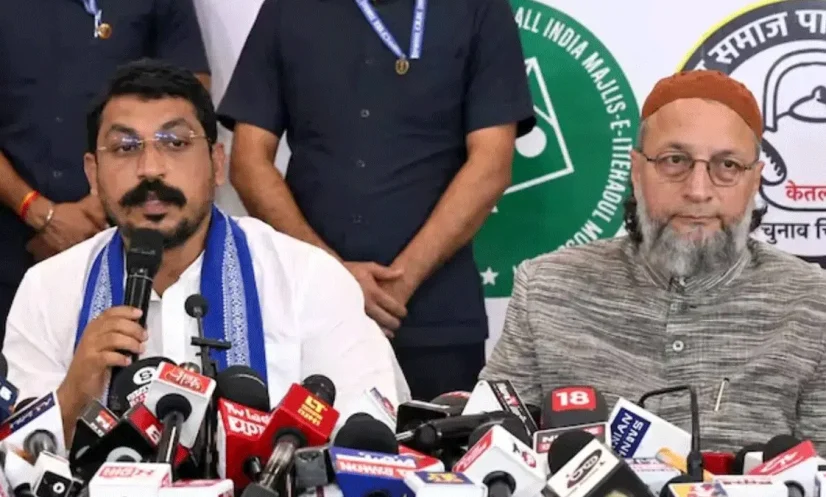
Lucknow, November 12: All India Majlis-e-Ittehadul Muslimeen (AIMIM) chief Asaduddin Owaisi and Azad Samaj Party (Kanshi Ram) president Chandrashekhar Azad have joined hands ahead of the 2027 Uttar Pradesh Assembly elections, seeking to build a new political front to challenge the ruling Bharatiya Janata Party (BJP).
The alliance was formally announced at a joint press conference in Lucknow on Thursday. Owaisi also declared Chandrashekhar Azad as the alliance’s chief ministerial candidate, marking an attempt to establish a third political force outside the BJP-led National Democratic Alliance (NDA) and the Samajwadi Party (SP)-led opposition.
The partnership aims to consolidate Muslim and Dalit voters, who together account for around 41 per cent of Uttar Pradesh’s population.
Muslims constitute approximately 20 per cent, while Dalits make up around 21 per cent.
The development has raised questions about its potential impact on the opposition’s electoral strategy, particularly the SP and the Congress, which are engaged in discussions over seat-sharing for the next assembly elections.
Owaisi had repeatedly expressed his willingness to join hands with the opposition parties to prevent the BJP from securing a third consecutive term in Uttar Pradesh.
However, his efforts to secure a place in the broader opposition alliance reportedly failed to receive a positive response from the SP and Congress.
The AIMIM subsequently turned to Chandrashekhar Azad, a Lok Sabha member from Nagina, whose party has been seeking to expand its political influence among Dalit communities.
Azad said the alliance would focus on empowering young people, farmers and marginalised sections of society.
He also highlighted issues such as declining government employment opportunities and the difficulties faced by educated young people from disadvantaged communities.
Potential challenge to SP-Congress alliance
The new political arrangement could complicate the electoral calculations of the SP and Congress, particularly in constituencies where Muslim and Dalit voters play a significant role.
In the 2024 Lok Sabha elections, the SP-led opposition alliance performed strongly in Uttar Pradesh, with the SP winning 37 of the state’s 80 parliamentary seats.
However, the AIMIM and Azad Samaj Party had limited electoral success in the 2022 Uttar Pradesh Assembly elections.
The AIMIM contested around 95 seats but secured only 0.49 per cent of the votes, while the Azad Samaj Party received approximately 0.13 per cent.
The two parties are now attempting to combine their respective support bases and expand their influence across the state.
SP leaders have played down the significance of the new alliance, expressing confidence in their party’s ability to challenge the BJP.
Congress leaders have also indicated that their party will independently decide its electoral strategy.
Meanwhile, the BJP has dismissed the new alliance, suggesting that it lacks a clear political agenda.
With the 2027 Assembly elections approaching, the extent to which the Owaisi-Azad partnership can consolidate Muslim and Dalit support, influence opposition unity and reshape the state’s electoral equations remains to be seen.