


 Play store

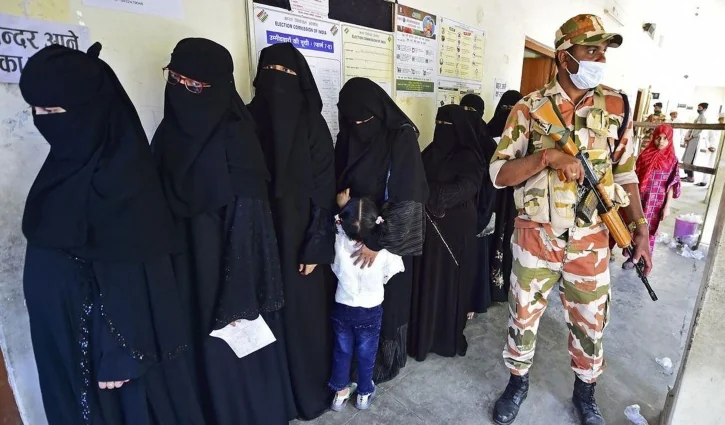
A US government commission on international religious freedom has accused India of disproportionately targeting Muslim citizens through a nationwide voter list revision, alleging that the exercise has led to the exclusion of millions of eligible voters and the deportation of some people.
Asif Mahmood, chairman of the US Commission on International Religious Freedom (USCIRF), said the Indian government was removing Muslim citizens from electoral rolls, labelling them as foreigners and subsequently deporting them.
India’s voter list revision has reportedly removed around 130 million names nationwide, marking the largest deletion of voters in the country’s history.
The commission said available data indicated that Muslims, India’s largest religious minority, had been disproportionately affected by the exercise.
The revision has raised concerns over the voting rights of minority communities, particularly Muslims, who rights organisations say have faced increasing discrimination and exclusionary policies since Prime Minister Narendra Modi’s Bharatiya Janata Party (BJP) came to power in 2014.
India’s Election Commission, however, has defended the exercise, saying it was intended to remove duplicate, deceased, relocated and otherwise ineligible voters.
It has also maintained that people whose names were mistakenly removed can appeal for their reinstatement.
However, critics argue that the voter list revision has become increasingly connected with a separate government campaign to identify and deport suspected illegal immigrants.
The commission stressed that removal from electoral rolls does not, by itself, establish that an individual is a foreign national.
Gene Mills, another USCIRF commissioner, described the alleged deportation of Indian citizens on the basis of their Muslim identity as a serious escalation in the targeting of religious minorities.
He urged the US State Department to designate India a ‘Country of Particular Concern’ (CPC) over alleged systematic violations of religious freedom.
The USCIRF is a bipartisan US government body responsible for monitoring religious freedom worldwide and making policy recommendations to the US administration and Congress. Its recommendations, however, are non-binding and do not automatically translate into government action.
India’s Foreign Ministry has rejected the commission’s criticism, describing it as biased and politically motivated.
New Delhi has repeatedly dismissed such assessments as interference in India’s internal affairs.
The voter list revision has also triggered protests by opposition parties and student groups, which allege that the process could disproportionately affect communities less likely to support the ruling BJP.
US Secretary of State Marco Rubio previously described the matter as an internal political issue in India and said Washington would not comment on it.
Meanwhile, UN experts and international human rights organisations have raised broader concerns over the treatment of religious minorities in India, citing alleged hate speech, discriminatory citizenship policies, demolitions of Muslim-owned properties and restrictions on religious freedoms.
The Indian government denies allegations of discrimination, maintaining that its policies and welfare programmes benefit all communities.