


 Play store

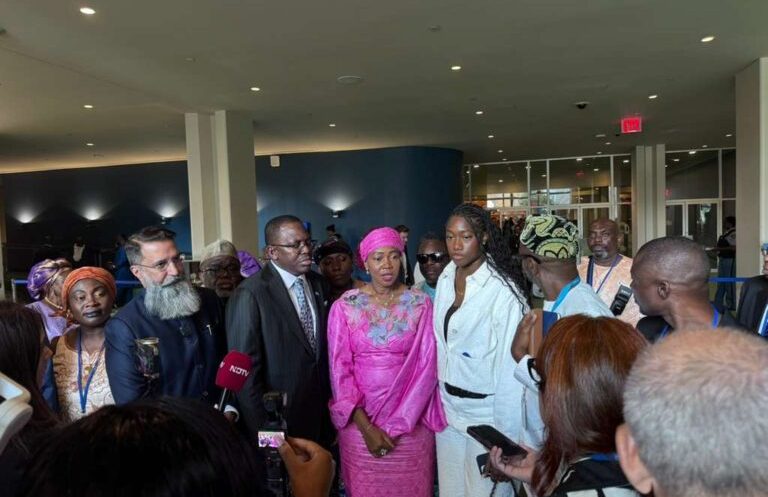
The United Nations General Assembly on Friday unanimously adopted a resolution establishing November 27 as the International Day for the Elimination of Child, Early and Forced Marriage, giving fresh global impetus to efforts to end a practice that continues to affect millions of children, particularly girls.
The resolution, A/80/L.99, was introduced by Sierra Leone and co-sponsored by at least 66 countries, including Cabo Verde, Morocco, Costa Rica, Namibia, India, Rwanda, Sudan and Afghanistan.
The initiative was spearheaded by Bhuwan Ribhu, founder of Just Rights for Children, and championed by Sierra Leone’s First Lady, Dr Fatima Maada Bio.
The resolution calls on governments, UN agencies, civil society organisations and other stakeholders to mark the day through public awareness campaigns, advocacy and educational programmes. It also encourages member states to adopt comprehensive, multi-sectoral national strategies to eliminate child, early and forced marriage.
The UN said the observance would help accelerate progress towards the Sustainable Development Goals by creating a dedicated global platform to strengthen efforts to protect children’s health, education and rights, particularly those of girls.
Addressing the General Assembly, Bio described the resolution as a “call to action” and a reminder of the international community’s “collective responsibility to protect childhood and defend the dignity and rights of every girl”.
“Behind every statistic, a child, early and forced marriage is not merely a number. There is a child, there is a name, there is a dream, and there is a future,” Bio said.
“A girl who should be learning may instead be preparing for marriage. A girl who should be discovering her potential may instead be carrying responsibilities far beyond her years.”
Ribhu, a child rights activist, first called for the creation of an international day in March during the UN Commission on the Status of Women.
He proposed November 27 because it was on that date in 2024 that 250 million Indians pledged to help end child marriage, which he described as the largest mobilisation in history around the issue.
“Today marks the tipping point showing that the end of the crime of child marriage is inevitable and imminent,” Ribhu said. “Now is the time for governments to provide decisive leadership to end child marriage by 2030 and ensure education, protection and development for every child to realise their full potential.”
Ribhu attended the General Assembly as the only civil society representative invited to be present.
Bio stressed, however, that establishing an international day alone would not end child marriage.
“An international day itself cannot by itself end child marriage, but political attention can, strong laws can, effective institutions can, education can… and above all, sustained political will can,” she told Inter Press Service.
She urged governments to focus on implementation rather than simply passing legislation.
“I think every country has to be honest and more action-oriented. When you pass a law, that is one thing, but implementing it should be the agenda,” she said.
Bio cited Sierra Leone as an example of what she described as effective action. The country passed legislation in 2024 criminalising child marriage and has since focused on enforcing the law.
“If every country decides to implement [the law] like Sierra Leone, then what we had here today would be the greatest success in the world,” she said.
Despite widespread legal and international condemnation, child marriage remains a major global problem.
According to the UN Population Fund (UNFPA), one in five women were married or entered an informal union before the age of 18, while an estimated 640 million women alive today were married during childhood.
Girls and women are disproportionately affected. World Bank data show that between 2015 and 2024, about 19 per cent of women globally had been married before the age of 18, compared with 3 per cent of men.
Child marriage is prohibited or condemned under numerous national laws and international agreements, including the Convention on the Rights of the Child. Yet legal protections have not translated into an end to the practice in many countries.
Advocates say the new UN observance could help maintain political pressure and mobilise governments to strengthen legislation, enforcement, education and social protection.
Bio said the international community must now turn the resolution into concrete action.
“Today, the world has spoken with one voice: child, early and forced marriage has no place in our societies,” she said. “This resolution is far more than symbolic—it is a global mandate for action.”
“As mothers, leaders, and advocates, we have a duty to ensure that every girl is free to dream, to learn, and to thrive, unburdened by the chains of forced union.”
Speaking to reporters outside the General Assembly Hall, Bio and Ribhu praised the governments and civil society organisations that had worked for years to advance the issue.
Ribhu called for “decisive action”, including adequately funded national action plans and responsive and accountable institutions capable of enforcing anti-child-marriage laws and dismantling the systems that perpetuate the practice.
“This is the beginning where the world has spoken,” Ribhu said. “Now is the time for action. So we should act. From 27th November, the action begins.”
He pointed to India as an example of progress, saying joint efforts by civil society and government had helped reduce child marriages by more than 10 per cent in recent years, while legal intervention had prevented at least 550,000 such marriages.
“Child marriage has no place in the civilised world, and the end of child marriage is not only possible, but it is going to be imminent,” Ribhu said. Source: IPS