


 Play store

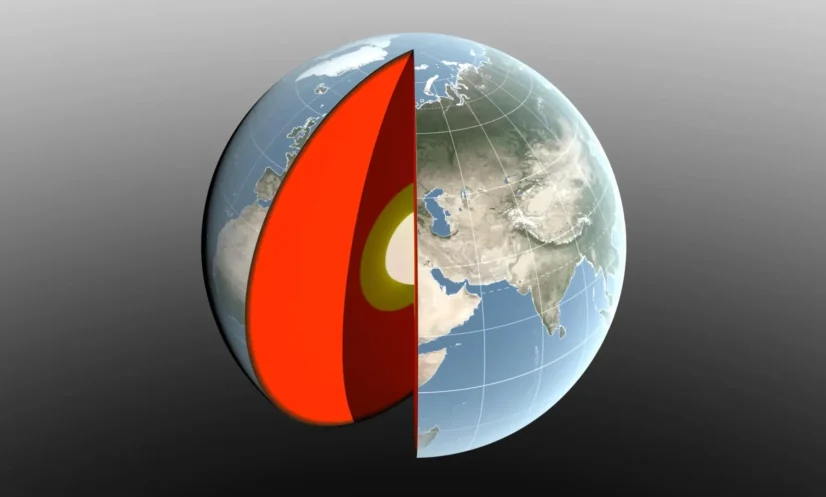
Earth’s center of mass is constantly shifting as water, ice and air move around the planet, with the seasonal changes pushing it several millimetres back and forth relative to Earth’s geometric centre, according to a new NASA-backed study.
Scientists at NASA’s Jet Propulsion Laboratory (JPL) in Southern California have developed a new method to measure these subtle movements more precisely. Their findings were published in Geophysical Journal International.
The research shows that seasonal changes, including melting snow, shifting ocean water and variations in atmospheric mass, redistribute enormous amounts of weight across Earth’s surface and alter the location of its centre of mass.
If Earth were a perfectly solid object, its centre of mass would coincide with its geometric centre. But the movement of water, ice and air causes the centre of mass to move around that point by several millimetres.
Scientists have been trying to determine the precise extent of this movement for decades. Two recent international estimates, published in 2017 and 2023, differed by 0.27 inches (7 millimetres), a discrepancy almost as large as the movement being measured.
JPL geoscientist Donald Argus led the development of the new technique, which uses highly precise satellite observations.
Because satellites orbit Earth’s centre of mass, changes in its position can be detected through tiny variations in the distances between satellites and ground-based tracking stations.
Scientists have long relied on satellites to determine Earth’s centre of mass. Two satellites, LAGEOS 1 and 2, launched in 1976 and 1992, were specifically designed for this purpose.
The 408-kilogram satellites are covered with reflective prisms. Ground stations in more than 20 countries use lasers to track them and measure the returning signals with extreme precision.
However, the tracking stations are unevenly distributed around the globe, creating limitations in the measurements.
The new method combines laser observations with GPS tracking and orbital data from several low-Earth-orbit satellites. Researchers also account for changes in Earth’s crust caused by the shifting weight of water and ice, which can slightly move the ground stations themselves.
Argus developed the technique with researchers from JPL’s satellite orbit determination team, the University of Nevada, the University of Montana and Germany’s Helmholtz Centre for Geosciences.
The researchers estimate that Earth’s seasonal centre-of-mass movement is about half the size previously believed.
Their findings suggest that the amount of water and atmospheric mass moving between the Northern and Southern hemispheres is smaller than earlier estimates indicated.
Although the movement is tiny, scientists say accurately measuring it is important because Earth’s centre of mass is a key reference point for satellite navigation, mapping and measurements of Earth’s surface elevation.
JPL scientist Felix Landerer said understanding the processes that alter Earth’s reference systems could help improve positioning technologies used in areas ranging from global shipping to precision agriculture.
The researchers traced seasonal shifts in Earth’s centre of mass to three major components: oceans, the atmosphere and continental water.
Continental water includes land ice, snow, lakes and rivers, soil moisture and groundwater.
The distribution of these materials changes throughout the year, altering Earth’s balance.
Snow accumulation across North America and Eurasia reaches its peak around March. The additional weight shifts Earth’s centre of mass by about 3 millimetres toward the North Pole.