


 Play store

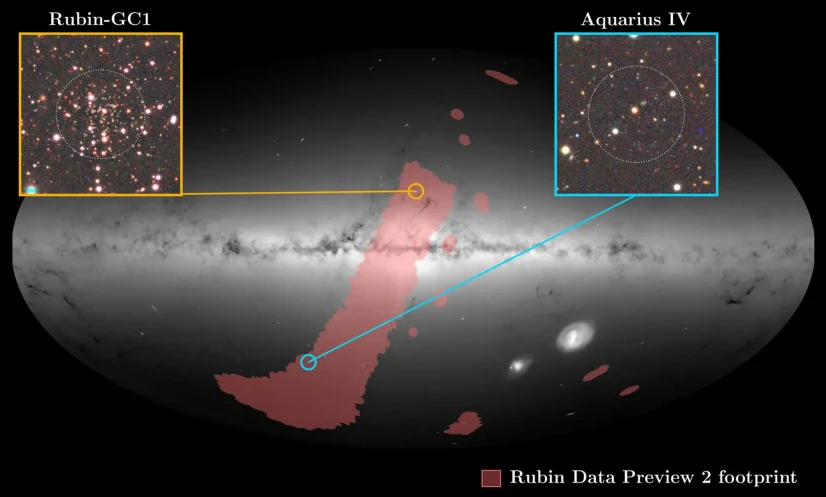
The powerful Vera C Rubin Observatory in Chile has discovered two previously unknown companions of the Milky Way, offering an early indication that hundreds of faint galaxies and star clusters may still be undiscovered around our galaxy.
The discoveries were made using preliminary observations covering only about 7 per cent of the night sky, raising expectations that the observatory’s planned 10-year survey could reveal many more hidden objects.
Located on Cerro Pachón in the Chilean Andes, the observatory is jointly funded by the US National Science Foundation and the Department of Energy.
The two newly identified objects are Aquarius IV, a faint dwarf galaxy located about 355,000 light-years from Earth, and Rubin-GC1, a star cluster obscured by thick clouds of cosmic dust on the opposite side of the Milky Way.
Astronomers have so far identified approximately 65 satellite galaxies around the Milky Way, although estimates suggest that hundreds more could remain undetected.
The discoveries were reported in two studies, including one led by William Cerny, an astronomy student at Yale University’s Graduate School of Arts and Sciences. The Aquarius IV study was published in Research Notes of the AAS, while the Rubin-GC1 study has been accepted by The Astrophysical Journal Letters.
Cerny said the findings were particularly exciting because the observatory had detected such faint objects using only preliminary data.
He said its full 10-year survey was expected to produce many more discoveries, creating new opportunities to test theories of galaxy formation, trace the Milky Way’s evolutionary history and investigate the nature of dark matter.
The observatory began its ambitious Legacy Survey of Space and Time (LSST) in June. The project aims to create an exceptionally detailed record of the changing night sky by repeatedly photographing large areas of the Southern Hemisphere.
Its major scientific objectives include mapping the Milky Way’s halo, a vast region surrounding the galaxy’s main disk that contains stars, gas, dark matter, satellite galaxies and star clusters.
The facility is equipped with an 8.4-metre Simonyi Survey Telescope and a 3.2-gigapixel digital camera, described as the largest digital camera ever constructed.
For the latest studies, researchers analysed preliminary observations collected between April 2025 and January 2026. Despite covering only a small portion of the sky, the images were sufficient to identify the two previously unknown objects.
Marla Geha, a professor of astronomy and physics at Yale University and co-author of both studies, said finding new Milky Way satellites through Rubin Observatory data had long been an exciting prospect for astronomers.
She described the discoveries as remarkable, saying that the long-anticipated prospect had now become a reality.
Scientists expect further observations from Rubin to provide important clues about the formation and evolution of the Milky Way and the distribution of dark matter in the universe.