Play store

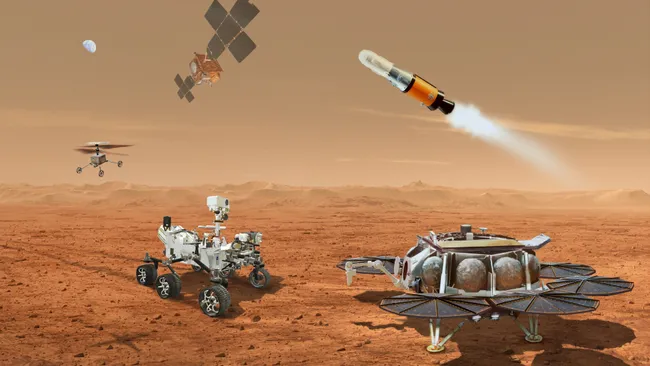
NASA has launched a new initiative to develop a strategy for bringing back to Earth samples collected by its Perseverance rover on Mars, reviving efforts under its troubled Mars Sample Return (MSR) programme.
The new initiative, called the Perseverance Sample Retrieval Architecture (PSRA), aims to identify an affordable and practical way to retrieve the samples and transport them to Earth for scientific examination.
Tiffany Morgan, director of NASA’s Mars Exploration Program (MEP), announced the initiative on November 9 during a virtual meeting of the Mars Exploration Program Analysis Group (MEPAG).
The PSRA team will develop independent recommendations for retrieving the Martian samples, assess proposed mission requirements, review lessons from previous efforts and evaluate existing technological capabilities and procurement options.
Morgan said the strategy team’s work would begin in January 2027, with a final report expected in the winter of 2027-2028.
NASA’s Perseverance rover has been collecting rock and soil samples in Jezero Crater since landing on Mars in February 2021. The car-sized robotic vehicle has stored selected specimens in sealed tubes, placing some in a designated depot on the Martian surface while retaining others inside the rover.
Scientists believe the samples could contain evidence of ancient microbial life and provide important clues about the planet’s geological history.
NASA and the European Space Agency have been working for years on plans to send spacecraft to Mars to retrieve the samples and bring them back for detailed analysis using advanced laboratory equipment on Earth.
Cost remains a major obstacle
The programme has faced serious financial and technical challenges. Independent reviews have repeatedly raised concerns about its rising costs and complex mission requirements.
One assessment estimated that the mission could cost around $11 billion, with the samples unlikely to reach Earth before 2040. NASA considered the proposal too expensive and the timeline unacceptable.
Another review suggested that the samples could potentially be returned by 2035 at an estimated cost of around $8 billion.
How the new PSRA initiative will address these financial and technical challenges remains to be seen.
Importance for future human missions
The importance of retrieving Martian samples also extends beyond scientific research, particularly in preparing for future human missions to the Red Planet.
Speaking at the MEPAG meeting, Bruce Jakosky of the Laboratory for Atmospheric and Space Physics at the University of Colorado Boulder and the University of Washington called for an integrated approach to planning human exploration of Mars.
He referred to recommendations from a workshop organised by Explore Mars Inc. in May, which examined how the Mars Sample Return programme could help reduce risks for future astronauts.
Jakosky said the assessment focused primarily on potential hazards to astronauts and equipment rather than scientific discoveries.
These risks include exposure to hazardous substances in Martian soil, such as perchlorates and chloromethanes, as well as airborne dust that could damage astronauts’ health and cause wear and tear on equipment.
Understanding the composition of Martian soil and identifying potential hazards through returned samples could therefore help NASA prepare for future human exploration of the planet.