Play store

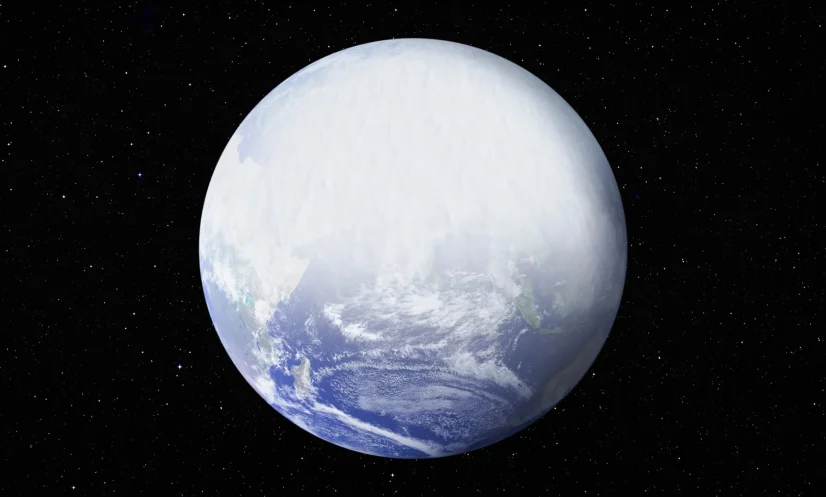
A new ice age may have begun around 2,000 years ago, but rising global temperatures eventually reversed the process, preventing the ice from expanding further, according to new research.
Scientists say remnants of a massive ice sheet in the Canadian Arctic began growing again after reaching their smallest extent around 3,000 years ago. However, by the 1960s, warmer summer temperatures had caused the ice to retreat rather than expand.
The findings suggest that human-driven global warming may have interrupted a natural climate cycle that could otherwise have led to another glacial period.
“It was just getting started, everything was normal, the next glaciation was about to happen — and yet it stopped,” said Nicolás Young, a geochemist at Columbia University’s Lamont-Doherty Earth Observatory. “It’s a very powerful example of how we have jolted the system.”
Published in the journal Science, the study was conducted by Young, fellow geochemist Joerg Schaefer and their colleagues.
The researchers investigated the history of the Laurentide Ice Sheet, an enormous mass of ice that covered much of Canada and the northern United States between approximately 95,000 and 20,000 years ago.
At its peak, the ice sheet extended from north of the Arctic Circle to Illinois, reaching more than two miles in thickness in some areas.
Although most of it disappeared as temperatures rose, a remnant known as the Barnes Ice Cap survives on central Baffin Island in Nunavut, Canada. It covers an area roughly the size of Delaware.
Scientists have long known that the Laurentide Ice Sheet repeatedly expanded and retreated over millions of years. However, it remained unclear whether it had ever shrunk to a smaller size than its present extent before beginning to grow again.
To investigate this, researchers examined ancient plant remains exposed as the Barnes Ice Cap retreated, along with vegetation uncovered beneath smaller melting ice caps in the surrounding region.
Unlike most glaciers, the Barnes Ice Cap is frozen directly to the underlying bedrock and does not slide across the landscape. This allows plants buried beneath advancing ice to remain preserved for thousands of years.
The researchers used radiocarbon dating to determine when the plants had been alive. By measuring the remaining carbon-14 in the samples, they reconstructed when advancing ice had covered different parts of the landscape.
The findings indicate that the Laurentide Ice Sheet reached its minimum extent around 3,000 years ago before beginning to expand approximately 2,000 years ago as temperatures cooled.
Young and his colleagues argue that this sustained expansion marked the beginning of a new glacial period.
Their interpretation differs from earlier climate models, which generally suggested that the next glaciation would not begin for thousands or even tens of thousands of years.
The researchers said the difference partly reflects how the beginning of a glacial period is defined. Rather than waiting for enormous ice sheets to spread across continents, they consider the sustained expansion of an existing ice sheet an indication that glaciation has begun.
The findings also offer new insight into a scientific debate in the 1970s, when some researchers suggested that another ice age might be approaching.
“It actually was happening,” Young said. “They couldn’t quite prove it, but now we sort of have the evidence.”
However, a full-scale glacial period would have taken thousands of years to become noticeable and approximately 30,000 years for the Laurentide Ice Sheet to regain its former continental size.
That process was interrupted as temperatures began rising.
By the 1960s, the Barnes Ice Cap was losing more ice during summer than it could replace through winter snowfall, reversing its earlier expansion.
The researchers say the warming climate effectively halted the developing glacial period before it could progress further.
The consequences could be long-lasting. Climate models suggest that the Barnes Ice Cap could disappear completely within the next few centuries.
Scientists note that Earth is technically still within a long-term ice age, known as the Late Cenozoic Ice Age, which began around 34 million years ago. Within this period, colder glacial phases alternate with warmer interglacial periods, including the present one. The last glacial period ended approximately 11,700 years ago.