


 Play store

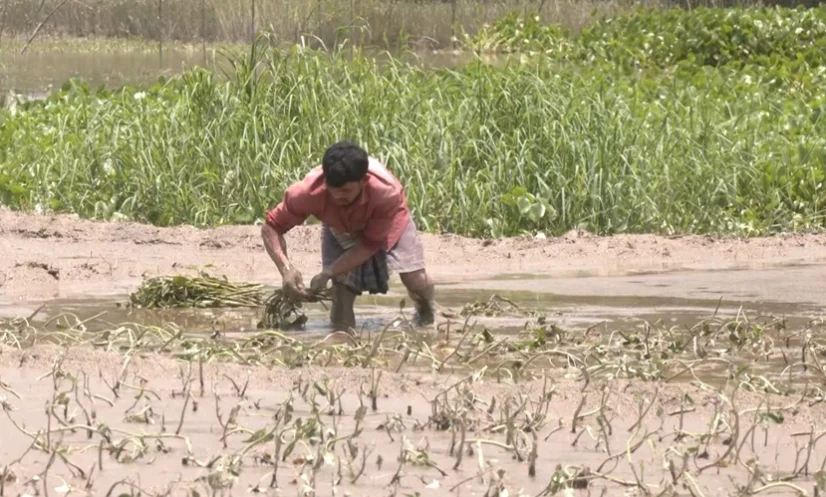
Although floodwaters have receded in Cox’s Bazar, thousands of farmers are still struggling to recover from devastating crop losses, with many saying they need urgent agricultural rehabilitation rather than relief aid.
According to the Department of Agricultural Extension (DAE), prolonged heavy rainfall over the past week inundated about 4,211 hectares of farmland across the district. Preliminary field assessments show that crops on nearly 3,000 hectares have been completely destroyed, affecting around 43,000 farmers.
Deputy Director of the DAE in Cox’s Bazar, Dr. Bimal Kumar Pramanik, said the damaged crops include Aman paddy seedbeds, Aus paddy, summer vegetables and some betel leaf plantations.
He estimated the initial financial loss at more than Tk 800 million (Tk 80 crore). However, as the Aman planting season is still ongoing, farmers are being advised to prepare new seedbeds as quickly as possible.
The agriculture department has informed higher authorities about the losses and expects to provide seed assistance to small and marginal farmers. For those unable to prepare their own seedbeds, the government also plans to establish community-based nurseries to supply seedlings.
For many farmers, however, restarting cultivation remains a daunting challenge.
Ismail Mohammad, a farmer from Chanderpara, said he had invested nearly Tk 800,000 in cultivating leafy vegetables, including spinach and bitter gourd, on four kani of land.
“Everything has been destroyed by the flood,” he said. “Although the water has receded, thick mud remains across the fields. I don’t know whether to clear the mud first or start farming again. I have no idea where I will get the money to restart.”
Thousands of farmers in Cox’s Bazar Sadar, Ramu, Chakaria, Pekua, Matamuhuri, Ukhiya and Teknaf have suffered similar losses. Vast stretches of farmland in the vegetable-producing areas of Ramu, Chakaria and Matamuhuri were submerged by continuous rainfall and hill runoff. Nine days later, the water has gone, but ruined crops and uncertainty remain.
Farmer Absar Uddin of Chakaria said floodwaters destroyed seedbeds worth about Tk 300,000, while fish valued at around Tk 2 million were washed away from his fish enclosure.
In Matamuhuri, farmer Ruhul Kader said the flood destroyed his seedbeds, damaged around 10 maunds of stored paddy and submerged his vegetable fields.
“I am deeply worried about how I will repay my debts and support my family after this loss,” he said.
Mofizur Rahman, a farmer from Muktarkul in Ramu, said he had yet to see any agriculture officials visiting affected fields.
“Agriculture officers should come to the ground immediately, assess individual losses and ensure necessary assistance reaches farmers. The government must play an effective role in supporting marginal farmers during this crisis,” he said.
Another farmer, Faridul Alam, said relief goods were not the priority.
“We are farmers. We don’t need relief—we need the opportunity to stand on our own again,” he said. “If the government provides seeds, fertiliser, agricultural loans and rehabilitation support, we can resume production. We also need long-term measures to reduce the impact of future floods.”