Play store


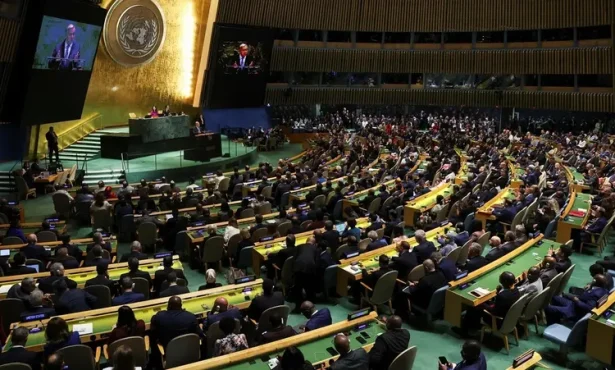
Policymakers, technology leaders and international experts have urged Bangladesh to formulate a comprehensive national roadmap on artificial intelligence (AI) governance and digital diplomacy, saying the country’s upcoming presidency of the 81st Session of the United Nations General Assembly (UNGA) offers a unique opportunity to shape global discussions on ethical AI and inclusive digital governance.
The call came during the second virtual town hall on “National Artificial Intelligence Governance and Diplomacy,” organized by the International Trade, Investment and Technology (ITIT) Wing of the Ministry of Foreign Affairs (MoFA).
Participants stressed that Bangladesh should move beyond being a consumer of AI technologies and instead invest in Bangla-language AI, develop a skilled workforce, strengthen digital diplomacy and engage its global diaspora in AI policymaking.
The discussion was moderated by Dr. Syed Muntasir Mamun, Director General of the ITIT Wing. It brought together representatives from government, academia, technology firms, civil society, youth organizations and international institutions.
A key proposal was the establishment of a Bangladesh Artificial Intelligence Observatory under the Ministry of Foreign Affairs. The proposed body would monitor national and international AI policies, assess Bangladesh’s performance in global digital governance forums, maintain a registry of AI applications across government agencies and conduct AI risk assessments.
Participants also suggested forming five thematic working groups focusing on AI governance and human rights, digital diplomacy, sustainable development, technological sovereignty, and workforce development.
Opening the session, Dr. Mamun clarified that while the Foreign Ministry would not formulate national AI policy, it would provide a platform to connect Bangladesh with global AI governance initiatives. He also announced plans to organize a National AI Summit to bring together policymakers, industry leaders and international partners to discuss the country’s AI strategy.
He said the ministry also intends to engage Bangladesh’s estimated 12 to 13 million expatriates worldwide to incorporate their expertise into national AI planning.
Language technology emerged as a major focus of the discussion. Ratul, Counsellor at the Bangladesh Embassy in Addis Ababa, said language remains one of the biggest barriers for many developing countries. He emphasized integrating Bangla into Natural Language Processing (NLP) systems and Large Language Models (LLMs), arguing that Bangladesh has the potential to become a leader in Bangla-language AI development through international collaboration.
Speakers agreed that linguistic inclusion, digital sovereignty, local data ecosystems and algorithmic transparency are essential for ensuring fairness in AI systems.
Youth participation was another major theme. Riad Hasan Badsha, Vice Chairperson of the Bangladesh Youth Internet Governance Forum, said young people should be treated as active partners in designing AI policies rather than simply as beneficiaries. He also called for AI systems used in education, scholarships and employment to be classified as high-risk applications requiring greater transparency and accountability.
International experts emphasized that AI literacy should become a national priority. Dr. Philippe Reinisch, founder of Austria-based SILKROAD 4.0, said a country’s greatest AI asset is an informed population rather than advanced computing infrastructure. He recommended introducing AI literacy, digital safety and misinformation awareness into school curricula while establishing measurable national standards for teachers and students.
Private-sector representatives noted that AI adoption remains limited among Bangladesh’s small and medium-sized enterprises despite their importance to the economy. They called for affordable AI solutions, financial incentives and supportive policies to improve productivity and competitiveness.
Meanwhile, representatives from Canva announced that Canva for Education will continue to be available free of charge for teachers and students in Bangladesh through Grade 12 and expressed interest in supporting AI skills development and localized educational content.
The meeting concluded with consensus on preparing a National AI Vision, launching an AI Governance and Digital Diplomacy School, mobilizing financing for AI initiatives and submitting policy recommendations to relevant government agencies. Participants said coordinated efforts by government, industry, academia and civil society will be crucial if Bangladesh is to emerge as a meaningful contributor to global AI governance.