


 Play store

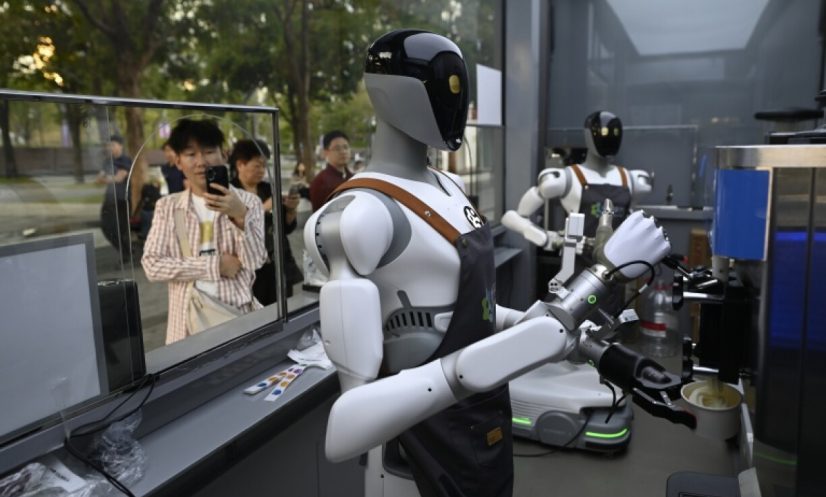
SHENZHEN, China: From serving ice cream and making coffee to sorting parcels and stocking supermarket shelves, humanoid robots are gradually moving beyond showrooms and dance performances to take on real-world jobs in China.
At a park refreshment stand in Shenzhen, a humanoid robot picks up a cup, pulls a lever to create an ice-cream spiral and hands the finished order to a customer, offering a glimpse of China’s ambitions to turn artificial intelligence-powered machines into part of the workforce.
The futuristic spectacle comes as world leaders, including Donald Trump and Vladimir Putin, head to Shenzhen, a major manufacturing hub north of Hong Kong, for this week’s Asia-Pacific Economic Cooperation (APEC) summit.
Chinese engineers are increasingly focused on training robots to perform practical tasks, using vast amounts of human-recorded data captured through head-mounted cameras and sensors to teach machines how to move and interact with their surroundings.
Although robots still struggle with complex tasks such as cleaning and ironing independently, they are beginning to perform simpler jobs in workplaces and public spaces across the country.
“ Mum, look!” a girl exclaimed as she spotted the ice-cream-serving humanoid and its coffee-making companion. Customers pay around $4 for each treat as passersby film the machines in action.
The robotic barista still requires human assistance to refill coffee beans and empty grounds, but its movements are controlled by an artificial intelligence model, according to its maker, AIy Robotics.
The startup said it has deployed 200 humanoid service robots across China, with the coffee machine in the Shenzhen park selling up to 300 cups a day.
“We’re getting data feedback from many real scenarios,” said CEO Guo Yandong, pointing to varying lighting conditions that could help robots adapt to less predictable environments.
Public enthusiasm for artificial intelligence is also strong in China. An Ipsos survey this year found that 83 per cent of Chinese respondents were excited about AI-powered products and services, the highest among 32 countries surveyed. In the United States, the figure was around one-third.
Meanwhile, industrial spending in China on robots powered by so-called “embodied AI”, which enables machines to perceive their surroundings and respond accordingly, surged 230 per cent year-on-year during January-May 2026, according to tax authorities.
China’s manufacturing strength is giving its robotics industry a significant advantage. As the world’s second-largest economy and a manufacturing powerhouse, it has decades of industrial experience, skilled workers and extensive supply chains for components ranging from motors and sensors to batteries.
“China is the workshop of the world,” said Dermot McGrath of strategy and innovation advisory firm ZenGen Labs.
He said robotics companies could draw on China’s manufacturing expertise and supply networks to develop and test components rapidly.
Shenzhen, home to around 18 million people, has clusters of suppliers that allow developers to manufacture, test and deploy components “faster than almost anywhere”, McGrath told AFP.
At a logistics centre in the city, robotic arms developed by local AI startup X Square Robot sort parcels of different shapes on a moving conveyor belt, turning them when necessary to position delivery labels facing upwards.
The machines use different techniques to handle packages, gripping soft bags with specialised grippers and coordinating both arms to move cardboard boxes, said Arnold Pei, vice-president of X Square Robot.
An AI-powered robot should ideally be able to determine what action to take on its own, Pei said, although operating in unpredictable environments such as homes remains more challenging because of variations in lighting, floors and objects.
The race to develop smarter robots is also creating a market for human movement data.
At a supermarket in Dongguan, near Shenzhen, 23-year-old Wang Lin stocked shelves wearing sensor-equipped gloves and a camera-mounted helmet. Her movements were recorded and processed by Strange Attractor, a startup that collects and sells data to companies developing AI models that serve as the brains of robots.
“Robots can replace humans in doing relatively dangerous and repetitive work, for example in factories or at heights,” Wang told AFP, adding that workers could then focus on “more creative work”.
Across China, cobblers, hairdressers, florists, factory workers and cleaners are also recording their skills using similar equipment in exchange for payment.
Strange Attractor said it collects data at around 1,600 locations in China and 1,000 overseas.
Founder Kang Yu described today’s robots as being “like babies” at an early stage of development.
Chinese AI robots remain largely restricted to “well-defined and repetitive” tasks, said Pavlo Zvenyhorodskyi, a China AI specialist at the Carnegie Endowment for International Peace.
But as their capabilities improve, “we will likely see wide deployment of AI-powered robots across the Chinese economy”, he said.
Government support is helping accelerate the development of robotics and other technology ventures, with potential applications ranging from meal-delivery robots to machines that collect airport luggage carts.
At battery giant CATL, humanoid robots developed by China’s Spirit AI have already taken on the hazardous task of plugging in high-voltage connectors.
Strange Attractor founder Kang expects a “massive deployment” of AI-powered robots in China next year.
Some may be used to pick strawberries or help with household chores, he said, but cautioned that their intelligence would remain limited for now. “It’s just the start.”