


 Play store

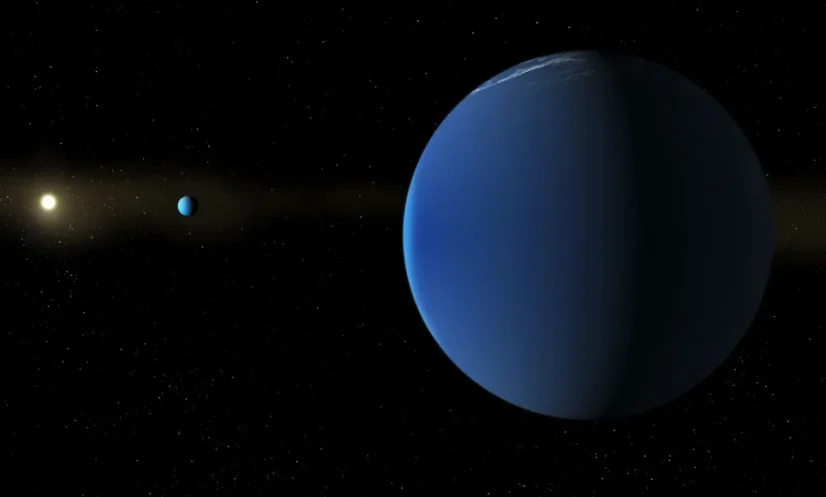
Astronomers have discovered two extraordinary exoplanets that are the puffiest planets ever observed, with densities so low they have been compared to cotton candy and shaving foam.
The findings, published in the July edition of the Monthly Notices of the Royal Astronomical Society, reveal that the two planets are nearly the size of Jupiter but possess less than 6 percent of the giant planet’s mass.
“We liken it in density to something like candy floss or shaving foam,” said George Dransfield, an astrophysicist at the University of Oxford and a member of the research team. “They’re the lightest planets that are Jupiter-sized.”
The planets orbit TOI 791, a Sun-like star located about 1,113 light-years from Earth. They were first detected by NASA’s Transiting Exoplanet Survey Satellite (TESS), which identified the worlds as they passed in front of their host star, briefly dimming its light. By measuring these transits, researchers determined that the planets have radii of about 0.99 and 1.16 times that of Jupiter.
To calculate the planets’ masses, scientists analyzed their unusual orbital interaction. As the two planets repeatedly pass close to one another, their gravitational pull slightly alters each other’s orbits, allowing astronomers to estimate their masses.
“They’re in this fun little dance,” Dransfield said. “We were able to measure the masses of the planets by how much they kick each other’s orbits.”
The research team tracked the planets over several years using the Antarctic Search for Transiting ExoPlanets (ASTEP) telescope. Located in Antarctica, ASTEP was uniquely positioned to observe the planets’ complete 12-hour transits during the region’s extended winter darkness.
“Without this telescope, this discovery would not have happened,” Dransfield said.
The observations showed that the planets have masses of just 9.5 and 18.6 times that of Earth. By comparison, Jupiter is about 317 times more massive than Earth.
Despite their enormous size, the planets have incredibly low densities of just 0.038 and 0.047 grams per cubic centimeter—lower than Jupiter by a wide margin and comparable to cotton candy, which typically has a density of around 0.05 grams per cubic centimeter.
The discovery offers astronomers a rare opportunity to study how such ultra-low-density planets form and evolve, potentially providing new insights into the diversity of planetary systems beyond our solar system.