


 Play store

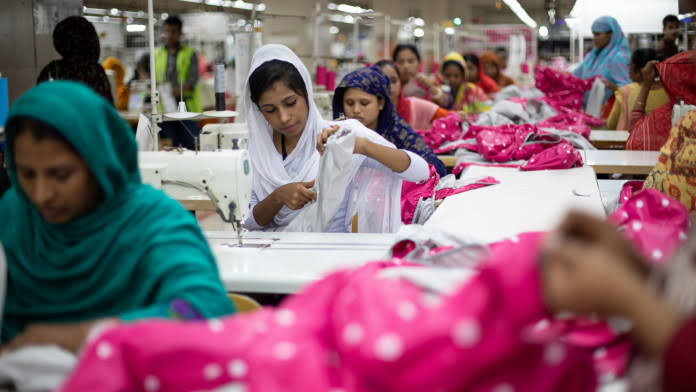
Bangladesh’s apparel exports to the European Union fell sharply in the first half of 2026, declining 16.43 percent year-on-year to €8.64 billion amid a broader contraction in the European apparel market.
The decline was driven by both lower shipment volumes and weaker prices, highlighting growing pressure on Bangladesh’s largest export destination.
Shipment volumes from Bangladesh to the EU fell 8.22 percent during January-June, while the average unit price of exported garments declined 8.94 percent, according to Eurostat data compiled by Bangladesh Apparel Voice (BAV) founder and CEO Mohiuddin Rubel.
The performance reflects a wider slowdown in the European apparel market. Total EU apparel imports from countries around the world fell 9.70 percent in the first six months of the year to €41.10 billion.
EU import volumes declined 6.40 percent, while average import prices dropped 3.53 percent, suggesting that weaker consumer demand and pricing pressure are affecting suppliers across the market.
Despite the steep decline over the first six months, Bangladesh recorded a modest recovery in June.
Apparel exports to the EU increased 0.87 percent year-on-year to €1.37 billion during the month. The improvement was largely volume-driven, with shipment volumes rising 6.53 percent.
However, the increase in volume was partly offset by a 5.31 percent decline in average prices.
The June figures therefore offer some encouragement to Bangladesh’s apparel industry, although they are not yet sufficient to reverse the substantial losses accumulated during the first half of the year.
Bangladesh was not alone in facing a difficult European market.
Most major apparel-exporting countries recorded significant declines in shipments to the EU during H1 2026.
Turkey posted the largest decline among the major suppliers, with exports falling 14.60 percent. India’s exports dropped 12.49 percent, while Pakistan recorded an 12.53 percent decline.
Sri Lanka’s exports fell 11.21 percent, followed by China at 8.88 percent and Cambodia at 8.84 percent.
Vietnam, however, bucked the broader trend, recording a marginal 0.36 percent increase in apparel exports to the EU.
Its performance was largely driven by a sharp improvement in prices. Although Vietnam’s shipment volume fell 11.52 percent, its average unit price increased 13.43 percent, the highest increase among the major suppliers.
The higher prices more than compensated for the decline in volume, allowing Vietnam to achieve overall export growth.
Indonesia and Cambodia also managed to increase their average unit prices, but the gains were insufficient to offset substantial declines in shipment volumes.
The data highlight a particularly important challenge for Bangladesh: the simultaneous decline in export volumes and unit prices.
Bangladesh’s apparel sector has traditionally relied heavily on its competitive pricing advantage in the European market. However, falling unit prices can put additional pressure on manufacturers already facing rising production costs, wage increases, energy expenses and other operational challenges.
The figures also suggest that competing primarily on price may become increasingly difficult as European buyers adjust their sourcing strategies amid weaker demand.
Vietnam’s performance demonstrates how higher-value products and stronger pricing can help offset falling volumes. Its ability to raise average prices significantly while maintaining overall export growth could offer a useful lesson for Bangladesh as the country seeks to diversify its apparel product mix.
The latest export figures come at a challenging time for Bangladesh’s garment industry, which remains heavily dependent on the European Union and other major Western markets.
The sector may therefore need to focus increasingly on product diversification, technological upgrading, productivity improvements, shorter lead times and higher-value apparel to protect its market position.
The sharp fall in EU imports also indicates that the current weakness cannot be attributed solely to Bangladesh’s competitiveness. European demand itself has contracted considerably.
Nevertheless, the larger decline in Bangladesh’s exports compared with the overall EU market suggests that domestic industry-specific challenges also need attention.
The modest recovery in June provides some positive momentum, but sustained growth will depend on whether European demand improves and whether Bangladeshi manufacturers can maintain competitiveness while moving towards higher-value products.